
Choosing and running a scanner
Is an ID scanner worth it for a small bar?
Published November 17, 2026 · 3 sources linked
The short answer
It depends more on the door than the room's size: a scanner may be useful where staff check many IDs, see unfamiliar cards or need scan records and a shared Banned list. A small bar with familiar guests and experienced staff may prefer hand checks where the law does not require a device. Utah, however, requires bars and taverns to verify age electronically before entry unless the ID cannot be verified that way.
What decides it
- What your state asks
- An ID check, and in Utah's bars and taverns an electronic one
- How many IDs the door checks
- Every guest, or only those who look young
- Who works the door
- The same small team, or new staff each season
- What you want on record
- Who checked each guest, when and what they decided
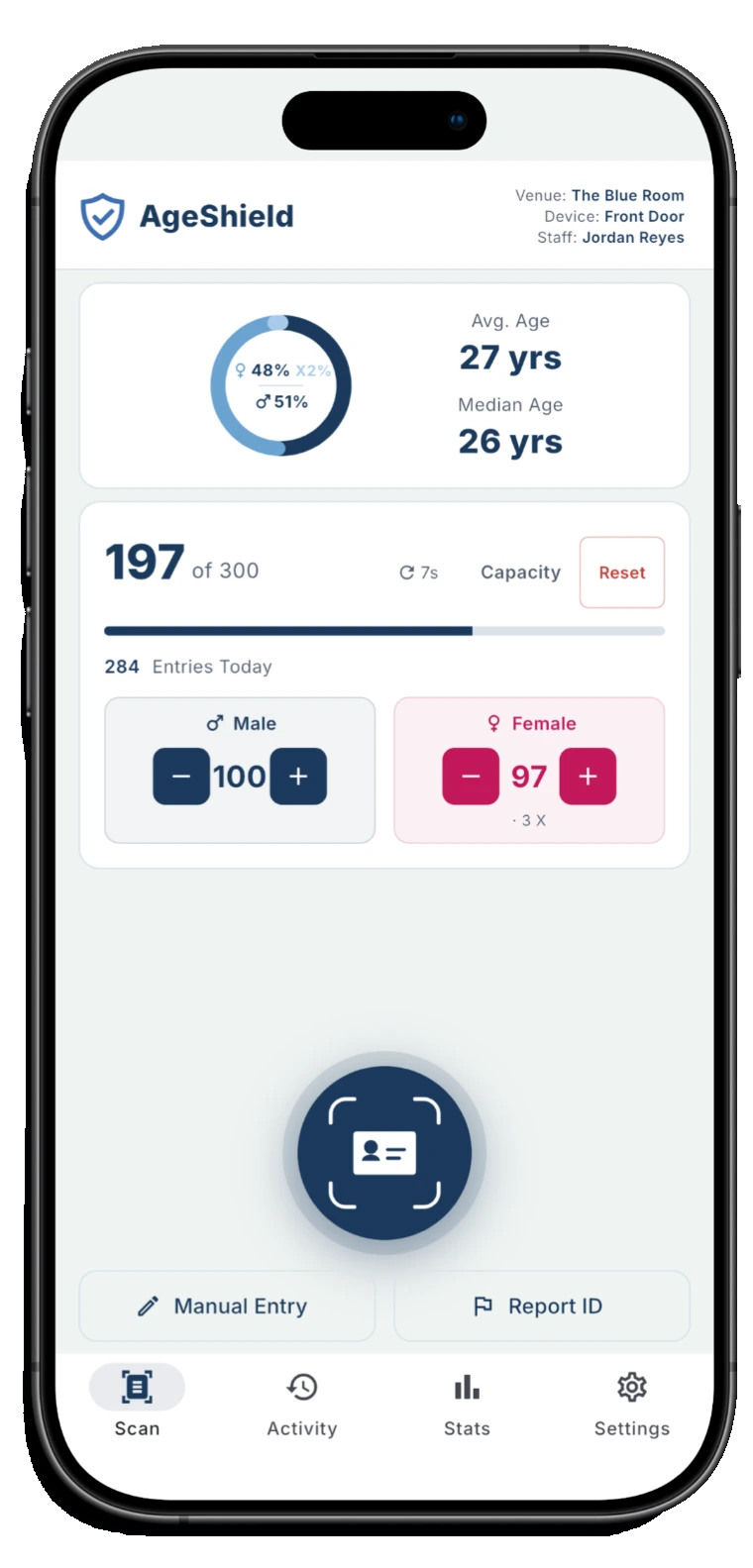
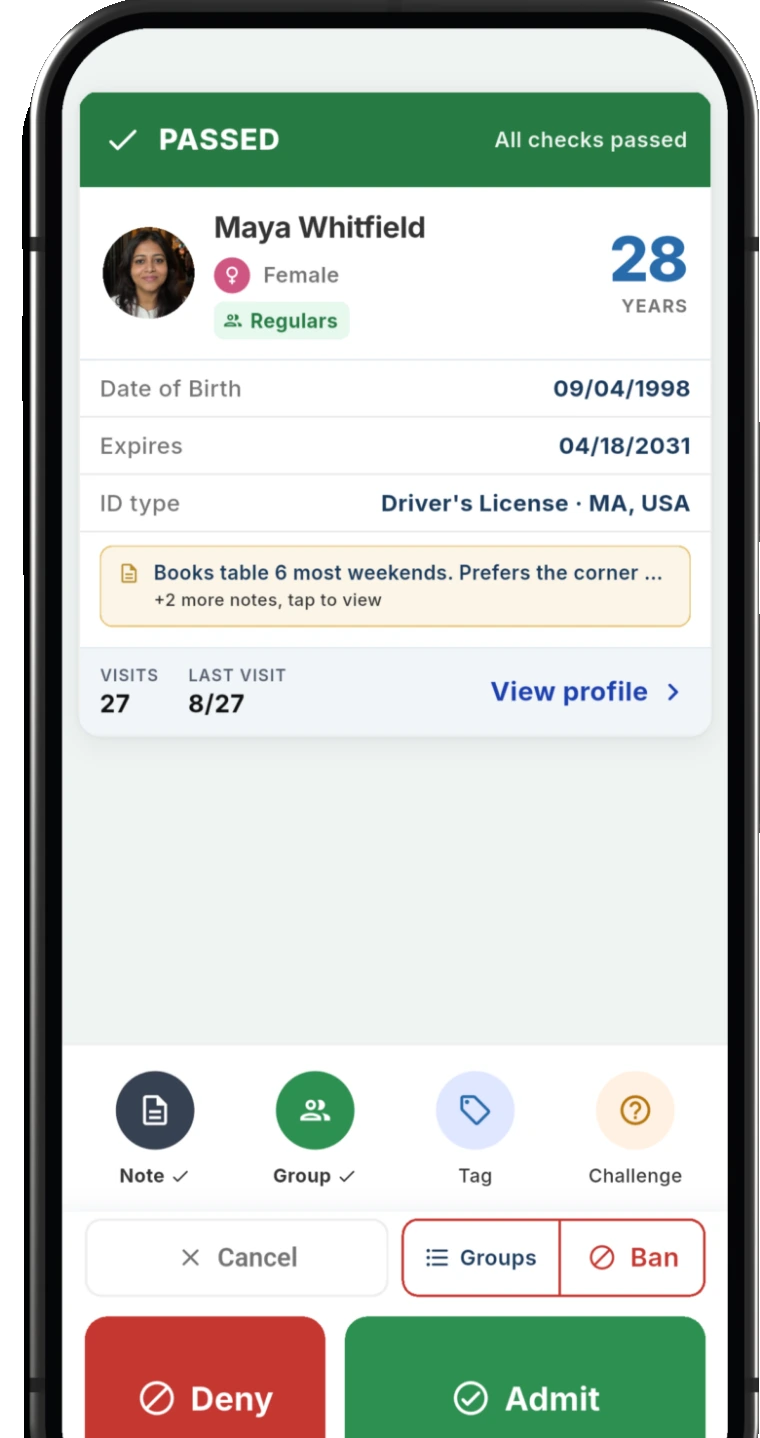
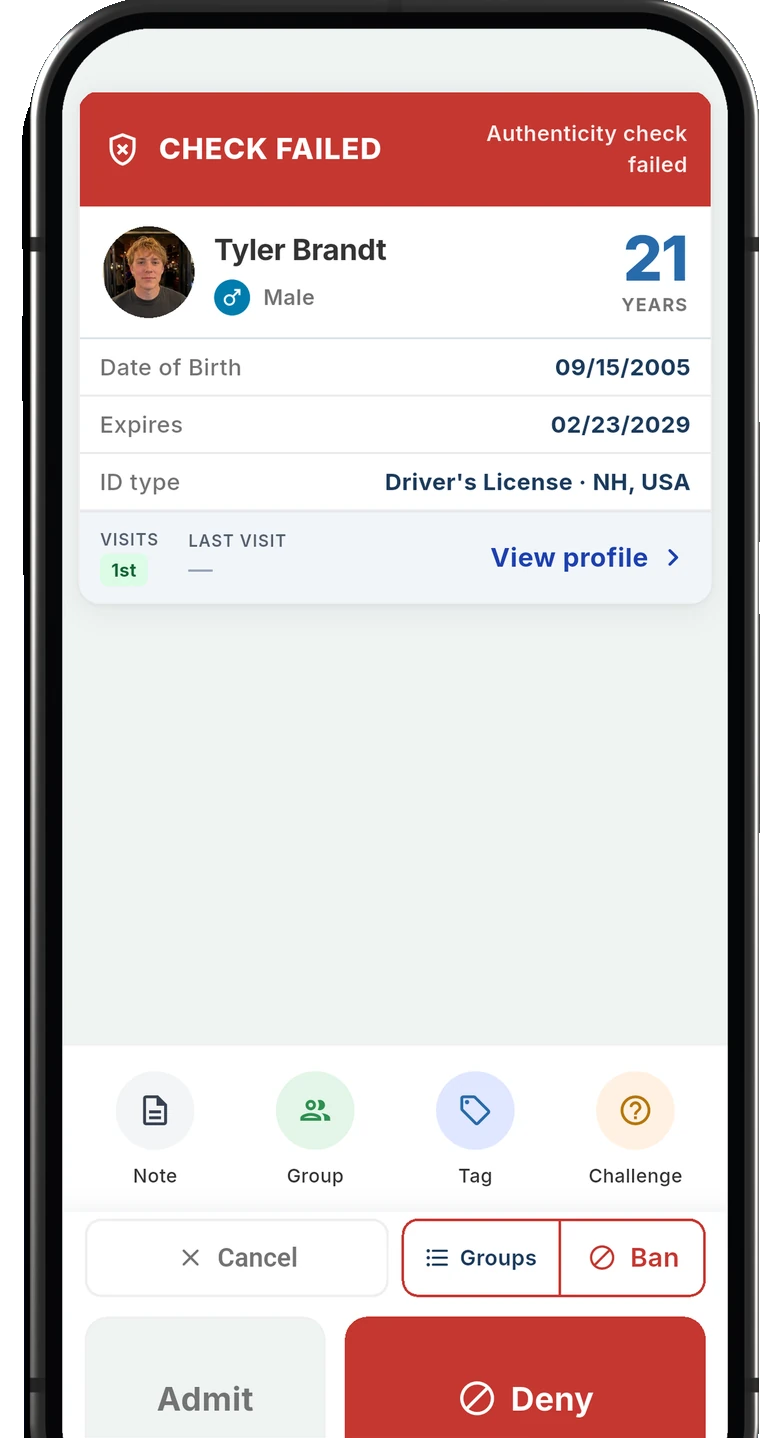
AgeShield ID Scanner
What a scan does at a small bar's door
AgeShield checks the date of birth against your minimum age, flags expired IDs and checks the guest against your Banned list, on the phones your staff already carry. Three devices on every plan.
When the law has already decided
In some places the law settles most of the question before the owner weighs anything. Utah's alcohol law requires bars and taverns to verify proof of age before an individual is admitted, and to verify it electronically. Only where an ID cannot be verified that way does a separate process set by the state's rules apply, so for a typical bar or tavern the electronic check is part of the door process. The Utah guide sets out what the device has to do and how long the record is kept.
Massachusetts sits at the other end. Its law does not require venues to scan an ID, and the Massachusetts guide puts the line plainly: checking an ID and scanning an ID are not the same legal requirement. Where a state asks for a check and not a device, a scanner is the owner's choice, and each state guide says what its state asks.
How many IDs your door checks
A small bar can check a handful of IDs a night or every guest who walks in, depending on its crowd and its house rule. A neighborhood bar whose staff know most guests by name, and card only those who look young, checks few. A small bar near a campus that cards everyone on a Friday checks every guest, often with a line outside.
Each hand check means finding the date of birth and the expiry date, doing the age math and matching the face to the photo, on a card staff may not have seen before. AgeShield checks the date of birth against the venue's minimum age and flags expired IDs, which leaves staff to match the face and make the call. The more checks a night, the more of that work moves from staff to the scan. How to check IDs at the door covers the hand check step by step.
Cards from other states and countries
A bar whose guests carry the home state's license sees the same few designs. A bar near a state line, on a tourist street or near a college sees designs staff cannot know by heart, with the date of birth and expiry in a different place on each. State alcohol laws also differ on which licenses count as proof of age, as out-of-state and foreign licenses at a bar sets out.
A scan reads those details from the card rather than from memory. AgeShield reads driver's licenses from the US and Canada and some from other countries, plus US state IDs, US green cards and passports. A scanned US or Canadian license or state ID barcode is checked for signs of forgery. No scanner catches every fake, so staff still make the call.
What penalties to expect
The penalty for a sale to a minor depends on the state. In Texas, TABC's standard penalty for a first sale to a minor is a suspension of eight to 12 days, and in California, ABC's standard penalty for a first sale is a 15-day suspension.
Selling alcohol to a minor in Texas and in California set out each state's penalties in full, with the defenses each state allows. After a failed alcohol compliance check covers what follows a sale to an underage decoy, and ID scanning laws by state has a guide for every state.
TABC Public Safety Penalty Chart, 16 TAC 34.2 (PDF)California ABC: Disciplinary guidelines (Rule 144 penalty guidelines)
A record of each check
Without a written log, a hand check leaves no record. If a guest later turns out to be under 21, a compliance check goes wrong or something happens inside, the owner has the staff's memory of a busy night. ID check records after an incident covers what a record can show.
With AgeShield every scan creates a visit record: who scanned, when, the document type, the result, the scan mode and what staff decided. The owner chooses which ID details are kept and for how long in the privacy controls. Some states limit what a business may keep from a scan, which what a bar sees when it scans your ID sets out.
Banned guests
In a small bar a ban can live in the heads of the owner and the regular bartender. That breaks down when they are off or leave. How long a bar ban should last covers the policy side.
A Banned list ties the ban to the guest's ID instead of to someone's memory. On AgeShield a guest on the Banned list comes up as BANNED with Do not admit, and every phone at the venue checks the same list.
Staff who come and go
A bar that keeps the same two people on the door for years builds up knowledge no tool replaces: who the regulars are, which cards they carry and which guests caused trouble. A bar that hires for the season, or fills door shifts from the bar staff, starts over with each new person.
Each new hire still needs the house rules, as in a door staff ID training session, and a scan gives them the same age and expiry check on their first night as everyone else. Turn on staff sign-in and each scan records who made it, by personal PIN.
When a hand check may be enough
A scanner adds the least where the state asks for a check and not a device, the crowd is small and familiar, staff card few guests, the same experienced people work every night and nothing calls for a record of each check. A careful hand check, done every time, can serve that door.
It adds the most where staff card everyone, cards come from other states, staff change often and the owner wants a record and a Banned list every staff member sees. A small bar can sit between the two, and a busy night such as New Year's Eve can tip a quiet door the other way.
Working out the cost
The price depends on how a scanner is sold and how many places in the bar check IDs. What an ID scanner costs a bar sets out the four ways ID scanning is priced and has a calculator. Pricing lists AgeShield's plans.
AgeShield runs on the phones and tablets your staff already carry, so there is no hardware to buy, and every plan covers three devices scanning at once. Your first venue gets 14 days free, which lets a small bar try it on its own door before deciding.
AgeShield ID Scanner
Try it on your own door
AgeShield ID Scanner runs on the phones your staff already carry, checks age and expiry on every scan and keeps a record of each check, with one Banned list on every phone. Your first venue gets 14 days free with three devices scanning at once, so you can see what it adds at your door before deciding.
Common questions
Does a small bar need an ID scanner?
It depends on the state. Utah's law requires bars and taverns to verify proof of age electronically before admitting anyone, with a separate process only where an ID cannot be verified that way. Massachusetts law does not require venues to scan an ID, and where a state asks for a check and not a device, a scanner is the owner's choice.
Is a hand check enough for a small bar?
It can be, where the state asks for a check and not a device, the crowd is familiar and the same experienced staff work every night. A hand check leaves no record of who was checked unless staff write one down, and it relies on staff knowing out-of-state cards and banned guests.
Does an ID scanner catch every fake ID?
No. With AgeShield a scanned US or Canadian license or state ID barcode is checked for signs of forgery, but no scanner catches every fake, so staff still match the face to the photo and make the call.
What does an ID scanner cost a small bar?
It depends on how it is priced and how many places check IDs. What an ID scanner costs a bar compares the pricing models with a calculator, and the pricing page lists AgeShield's plans, each with three devices and no hardware to buy.
Sources
- Utah Code 32B-1-407
- TABC Public Safety Penalty Chart, 16 TAC 34.2 (PDF)
- California ABC: Disciplinary guidelines (Rule 144 penalty guidelines)
This page is for informational purposes only and is not a substitute for professional legal advice. We research each rule and link its source, so you can check it against your own venue. Questions are welcome at support@ageshield.bar.
Not sure a scanner fits your bar?
Tell us how many guests you card on a busy night, where they come from and who works your door, and we'll answer by email.