
Running the door
How long should an ID check take on a busy night?
Published November 17, 2026 · 2 sources linked
The short answer
As long as the check needs: the door guidance from California's and Oregon's alcohol regulators asks for a careful check done the same way every time and sets no number of seconds, and California's tells staff to take their time with the card in hand. On a busy night the check stays the same and the wait is cut around it, with IDs ready before the front, doubtful cards moved aside and a second lane opened before the line builds. A count every 15 minutes shows whether the door keeps up.
The busy-night door at a glance
- Time per check
- None set; California and Oregon ask for a careful, consistent check
- What shortens the wait
- IDs out early, a side spot for doubtful cards, a second lane
- How to measure your door
- Guests admitted and guests waiting, every 15 minutes
- When the second lane opens
- At a trigger written down before the night
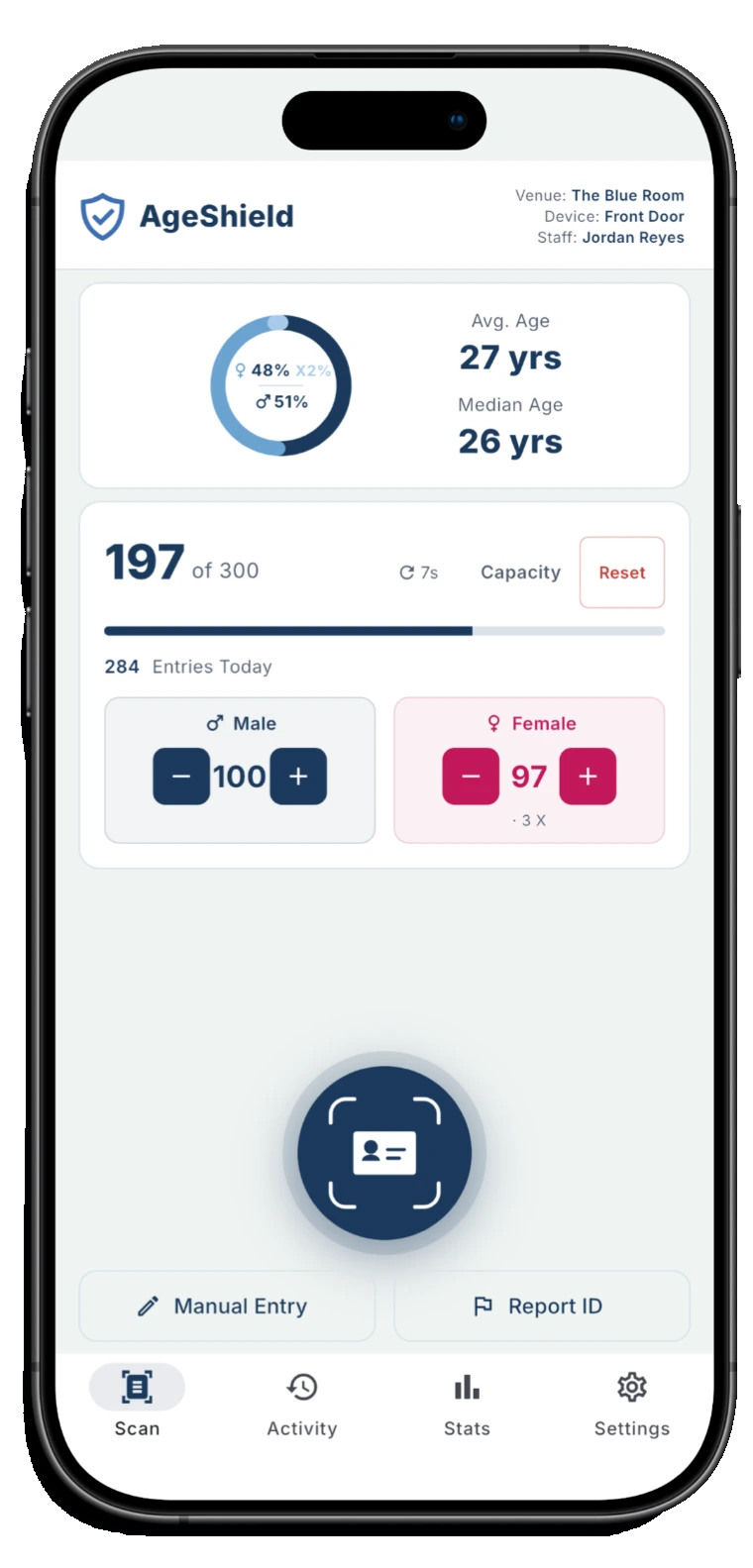
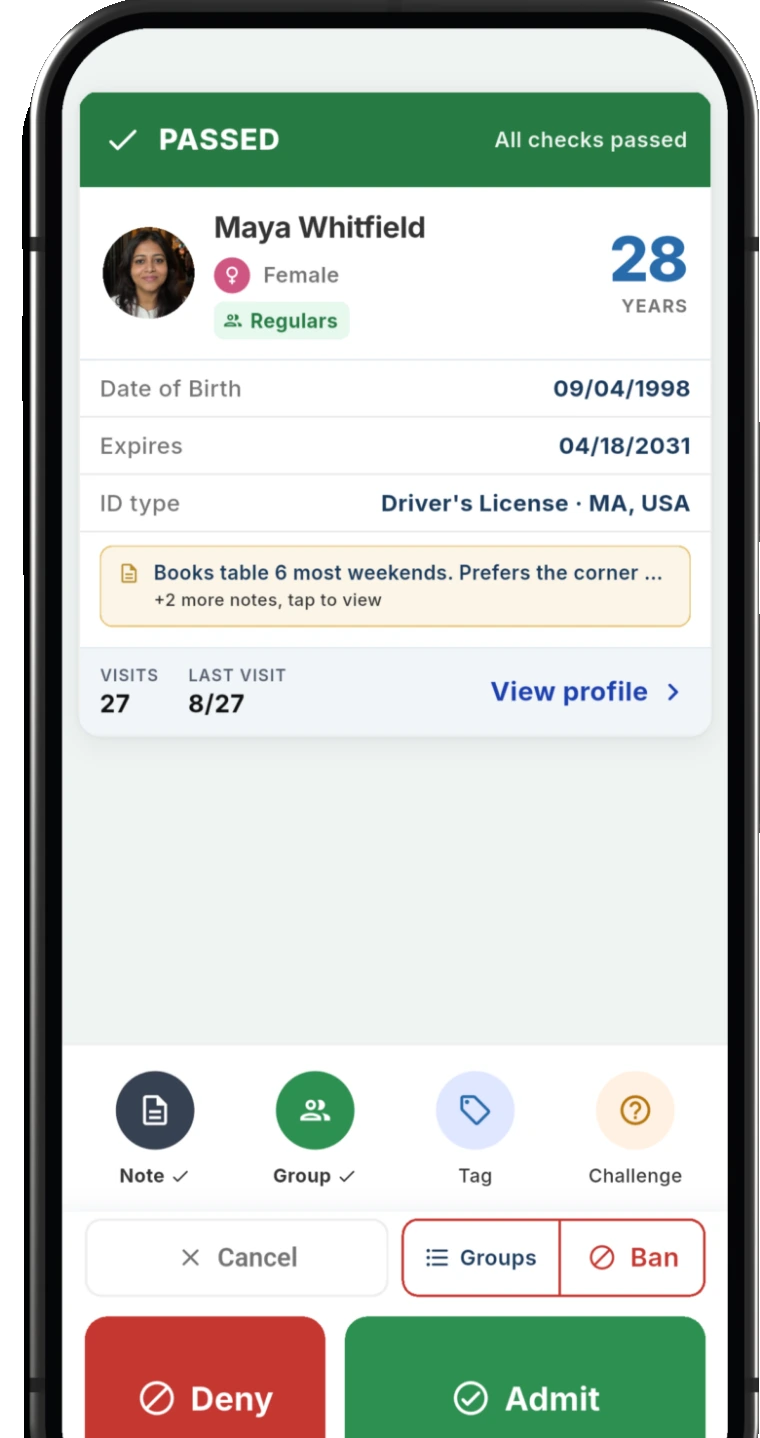
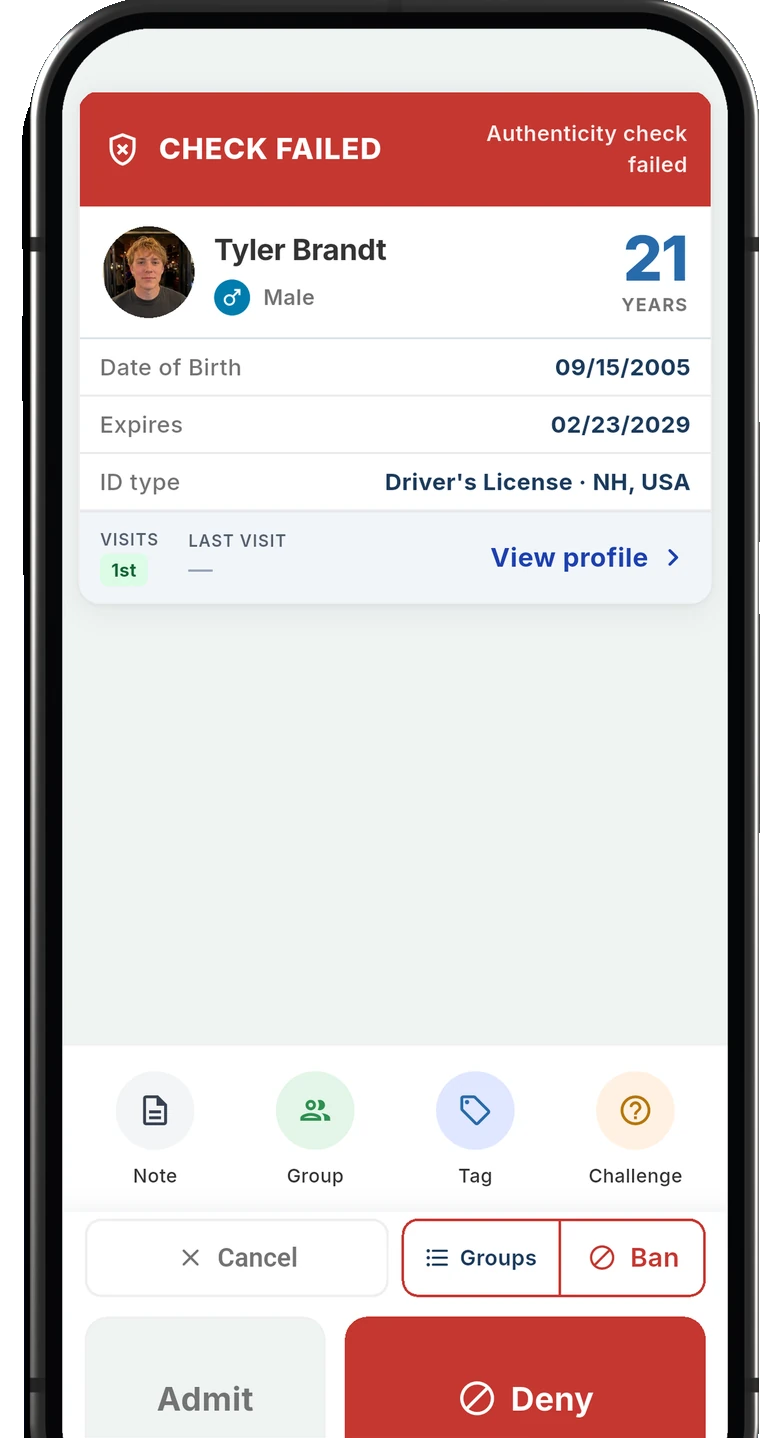
AgeShield ID Scanner
A full line on a busy night
Staff point the camera at the ID, the result shows on screen and one tap admits or denies. Live headcount counts every admit and warns at capacity.
Why there is no target time
The door guidance from California's and Oregon's alcohol regulators is about how to check, and neither sets a time. California's alcohol regulator recommends checking identification in a methodical and systematic manner and tells staff to take their time looking at the ID in their hand. Oregon's says that picking one method and using it consistently makes checking ID easier, faster and more accurate.
Oregon ties the speed to the routine itself, one that staff run without stopping to think. A per-guest target can encourage skipping the photo check or a question. A target for the wait focuses on staffing and the line. The check itself, step by step, is in how to check IDs at the door.
California Department of Alcoholic Beverage Control, Checking IdentificationOregon Liquor and Cannabis Commission, Tips for Checking ID (Responsible Vendor Program)
Where the wait comes from
Watch the front of the line on a busy night and note what stops it. The habits that keep a single check moving, such as IDs out before the front, one guest at a time and a doubtful card taken to the side, are in how to check IDs at the door. The table names three other delays and possible responses.
- What holds up the line
- A refused guest argues in front of everyone
- What the plan can do
- The manager or a second person takes it away from the line
- What holds up the line
- Returning smokers rejoin the same line
- What the plan can do
- A re-entry rule that sends them to a lane or a quick check of their own
- What holds up the line
- The only checker steps away
- What the plan can do
- A named person covers breaks before the peak
Measure your own door
Start with your own door's numbers. On your busiest night, have one person write down two figures every 15 minutes from opening to the peak: how many guests were admitted in those 15 minutes and how many are waiting in line right now. A hand clicker does the first, and so does a scanner's admit count.
Read the sheet afterwards. When the line grows from one quarter hour to the next, guests are arriving faster than the door admits them. If it keeps growing, the plan may need a second lane earlier. Timing one guest from joining the line to reaching the front, once each quarter hour, gives the wait in the terms a guest feels.
A few busy nights of counts show the hour the line builds and how long it lasts. That is the hour the plan staffs for.
When to open a second lane
Opening a second lane after the line grows leaves it playing catch-up. Decide the trigger before the night and write it down, so nobody has to judge it while the line is out the door. Possible triggers:
- A time: the quarter hour before the line usually starts to grow, from your counts.
- A landmark: the line reaching a spot you can see from the door, such as the corner or the next storefront.
- A wait: the guest you timed waiting longer than the house is willing to make guests wait.
The plan names who opens it, where it stands and which phone or scanner it uses. Write down when it closes too, such as the line staying short for two counts in a row, so the second checker goes back to the floor rather than standing at an empty lane. How many devices that takes is covered in how many ID scanners a bar needs.
Who does what at the door
A busy door has several jobs, sometimes shared by one person. What matters is that every job has a name next to it before doors open.
- Checker, one per lane: takes the card, checks it and makes the call.
- Line: asks for IDs out, keeps groups to one guest at a time at the front and keeps the line where it belongs.
- Side check: takes doubtful cards and cards that will not scan, away from the lane.
- Manager on duty: decides what the door cannot and takes over a refusal that turns into an argument.
- The count: writes down the figures every 15 minutes and calls one in, one out at capacity.
Give the plan to the team before the shift, the same way the house rules are covered in a 15-minute door training session.
Line rules
Keep line rules consistent across busy nights. A sign at the start of the line can tell guests to have the card ready.
- Where the line forms, and where it must not reach, such as a neighbor's door.
- Whether a guest list or ticket holders get their own lane. Everyone in it still shows an ID.
- No holding places in line for friends who are not there yet.
- How returning guests come back in, from your re-entry policy.
- Refusals happen out of the line, with the house line from how to refuse entry at a bar.
A card that will not scan follows the same rule as any other doubt: it goes to the side check. When an ID will not scan covers what the door can do with it.
Where a scan fits on a busy night
A scan takes the arithmetic off the checker. An AgeShield scan works out the guest's age against the venue's minimum, flags an expired ID and checks the guest against the Banned list, and one tap admits or denies. Staff still match the face to the photo.
How much the scan reads depends on the scan mode. Standard, which reads the barcode on the back, is usually the quickest, while Secure, which compares the front of a license with its barcode, is the most thorough and the slowest. The owner can set a minimum mode for the venue, and staff can pick a stricter one but not a weaker one, so a long line cannot talk the door down to a lighter check.
Live headcount counts every admit and warns at capacity, which gives the 15-minute count its first figure. See the ID scanner for bars for the setup at the door.
The plan on one page
The busy-night door plan puts all of this on one sheet: the lanes and their phones, who does each job, when the second lane opens and closes, the line rules and who keeps the count. Fill it in with the manager who runs the door, post it where the door team starts the shift and check it against the counts after each busy night.
Big nights of the year get a plan of their own on top of this one, such as Thanksgiving Eve and New Year's Eve.
Download the one-page template
Busy-night door plan
A one-page plan with room to write: the lanes, who does each job, when the second lane opens and closes, the line rules and the 15-minute count.
Common questions
Should door staff have a target time per guest?
A target for the wait in line works better than one per guest. California's alcohol regulator tells staff to take their time with the card in hand, and a per-guest target gives staff a reason to skip the photo or the question when the line is long.
How do I know when to open a second lane?
Count the door every 15 minutes on a busy night: guests admitted and guests waiting. When the line grows from one count to the next, guests are arriving faster than one lane admits them. Write a trigger into the plan, a time, a landmark or a wait, so the lane opens before the line builds.
Does scanning IDs make the line move faster?
A scan does the age math and flags an expired ID, so the checker does not work them out by hand. How quick it is depends on the scan mode: in AgeShield, Standard is usually the quickest and Secure the most thorough and the slowest. Matching the face and the decision stay with staff.
What if an ID will not scan while the line is long?
Send it to the side check so the lane keeps moving. There, staff can try another scan, check the card by hand or ask for a second ID. Where the venue has Manual Entry on, staff can type the details in and the record is marked as typed.
Sources
Planning the door for your busiest night?
Tell us how your door runs when the line is longest and what slows it down, and we'll answer by email.