
Running the door
How to train door staff to check IDs: a 15-minute session
Published November 9, 2026 · 8 sources linked
How do you train door staff to check IDs?
A 15-minute session led by the owner or manager covers the door's house rules, refusal lines, when to call the manager and what the scan checks versus what staff check. It can run before a new hire's first door shift, after a rule change or incident and as a regular refresher. Where a state requires an approved server course, as California and Illinois do for staff who check IDs at the door, the house session comes on top of it.
The session at a glance
- Who runs it
- The owner or the manager on duty, with the written door policy in hand
- What it covers
- House rules, the refusal line, when to call the manager and what the scan leaves to staff
- When to run it
- Before a new hire's first door shift, after a rule change or incident, before busy nights and as a regular refresher
- State courses
- Required in some states, such as California and Illinois; the session adds the house's own rules
AgeShield ID Scanner
Know who scanned and what they decided
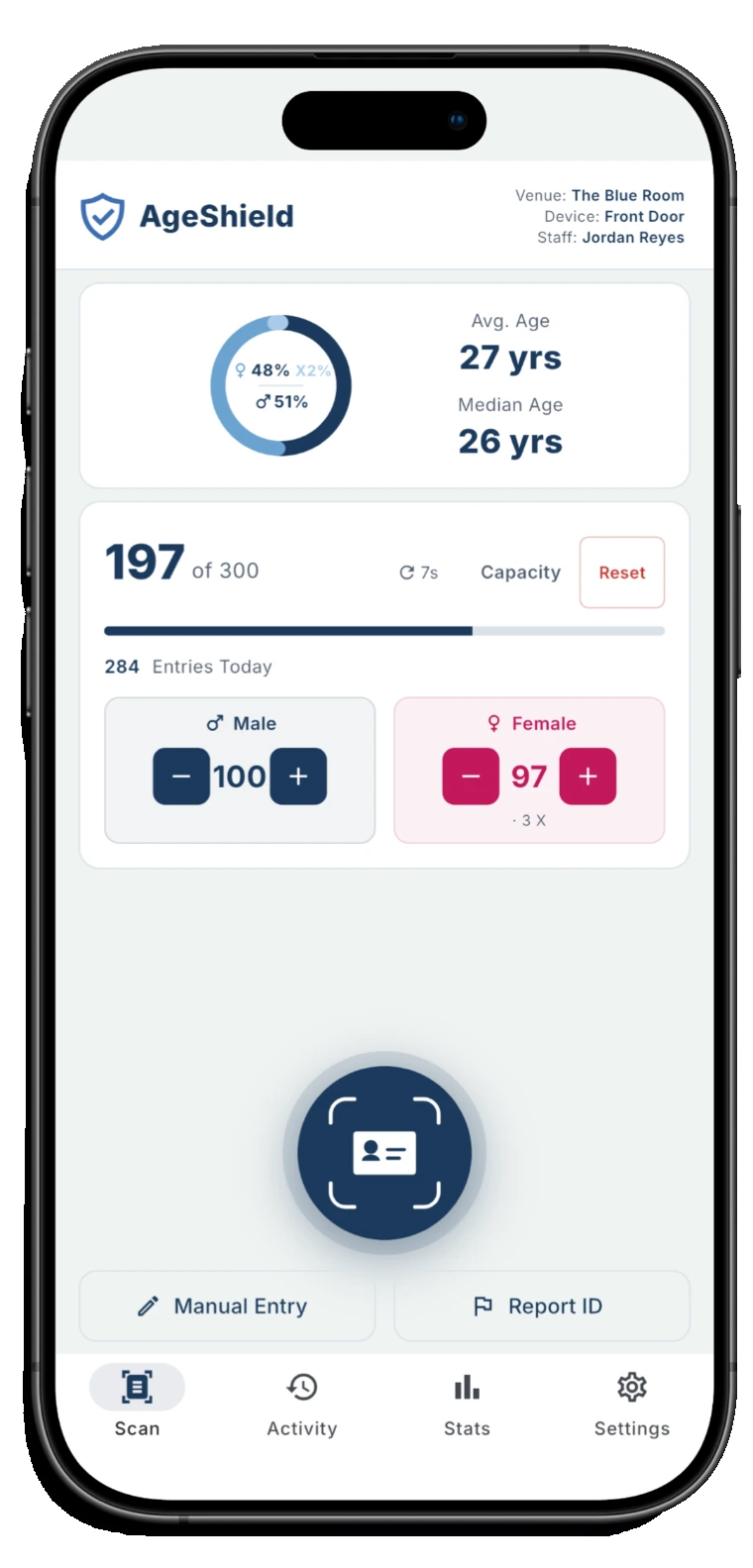
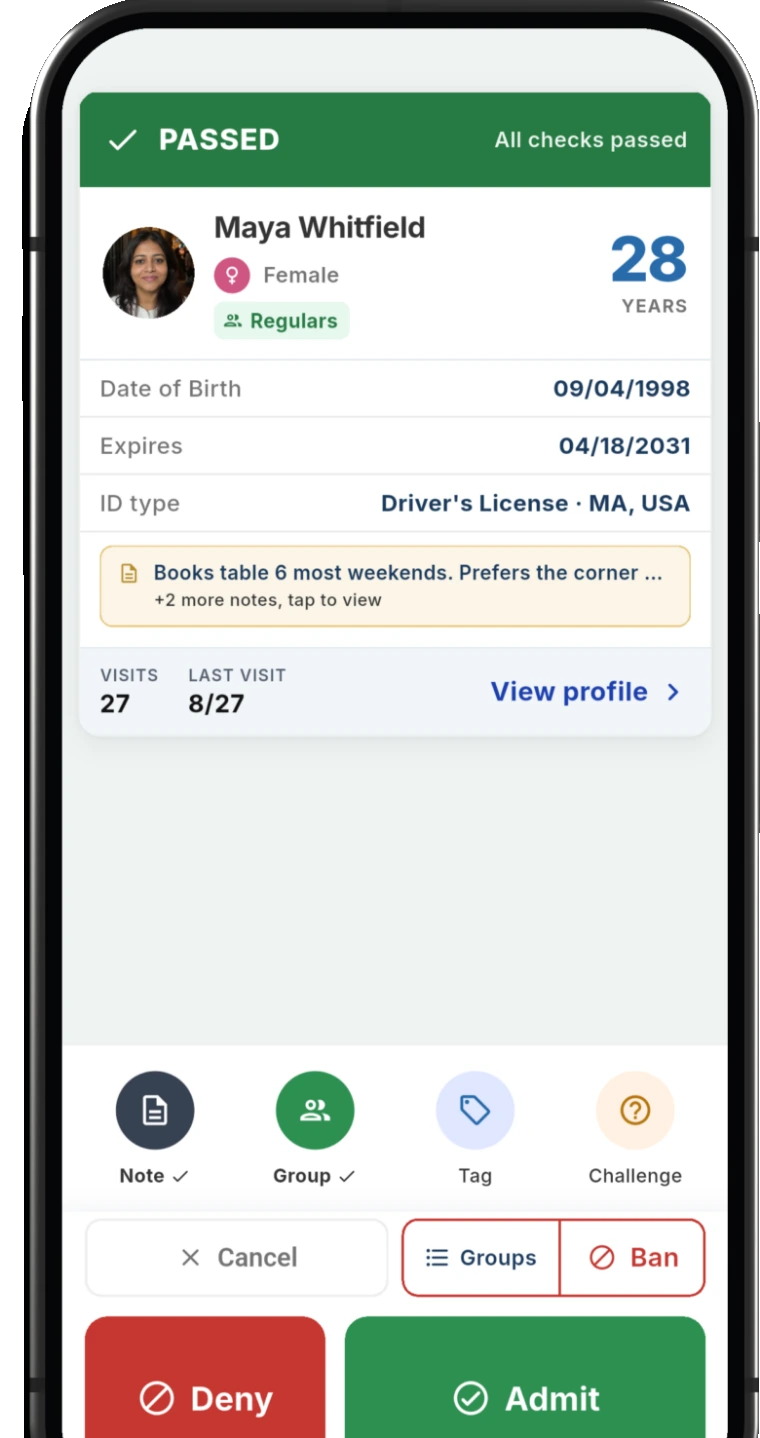
Turn on staff sign-in and each scan records who made it, by personal PIN. Staff tap Admit or Deny, have no override for an underage result and pick a reason for any override you allow.
What a house session covers that a state course does not
A state-approved server course is not about any one venue: in California and Illinois the certificate belongs to the person and goes with them from one employer to the next. What belongs to your door is yours to teach: tonight's minimum age, the IDs your house accepts, the words your staff use to refuse and the manager they call.
The bar door policy is the source text. The session takes the lines that matter at the rope and says them out loud, so whoever works the door on a given night gives the same answers as everyone else.
It fits in 15 minutes because it focuses on what is specific to the venue. The check itself is in how to check IDs at the door, which new staff can read before their first shift.
California Department of Alcoholic Beverage Control, RBS Frequently Asked Questions235 ILCS 5/6-27.1, Responsible alcohol service server training (Illinois General Assembly)
The 15 minutes, part by part
Five parts, with suggested times. Hold it at the door station or wherever the team gathers before doors open, with the door policy and a phone running the scanner to hand.
The house rules (three minutes)
Tonight's minimum age, who gets carded, which IDs the house accepts and the re-entry rule. Read them from the door policy rather than from memory, and say what is different tonight, such as an 18-and-over event or a guest list.
What the scan does and what staff do (three minutes)
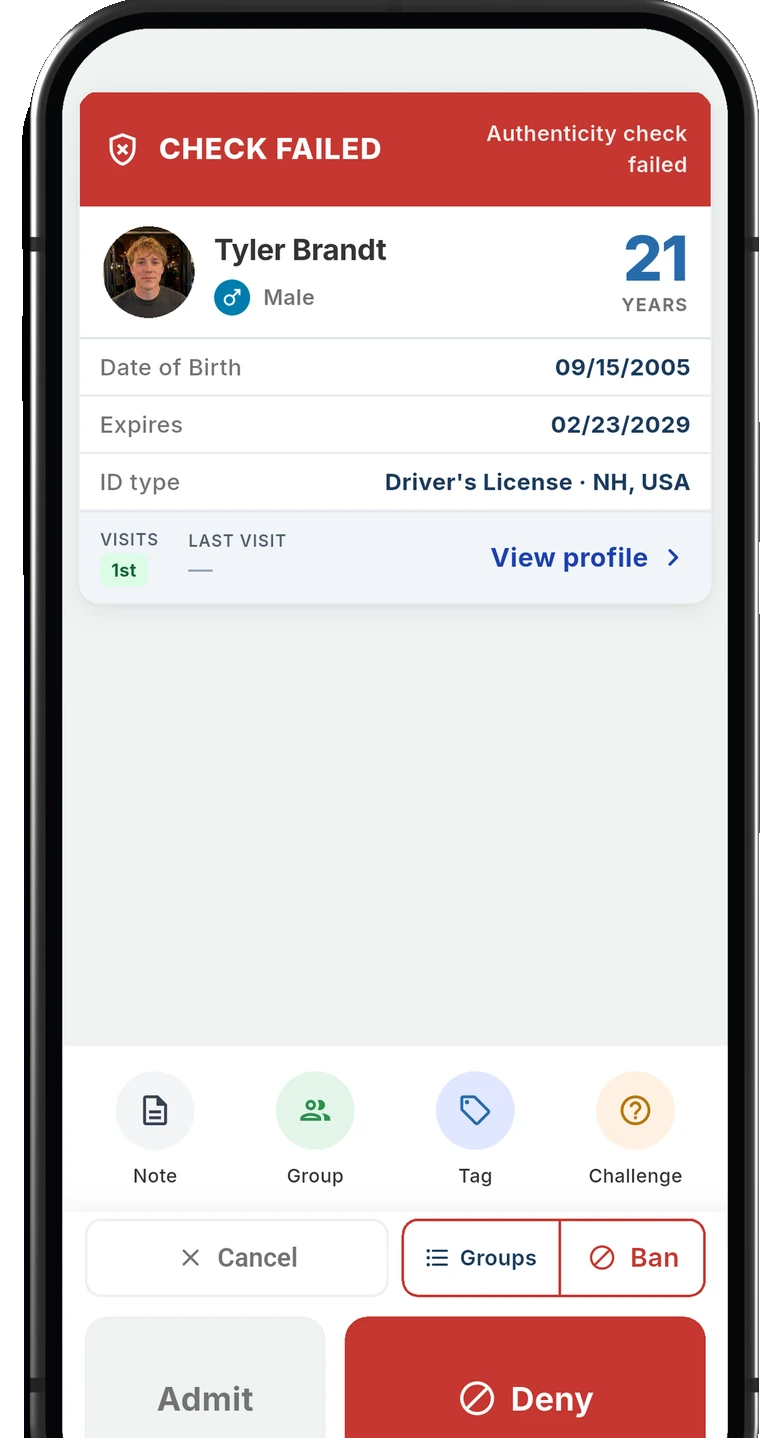
Name the checks the scan makes and the ones it leaves to staff. The scan works out the age against the venue's minimum, flags an expired ID, checks the Banned list and checks the barcode on US and Canadian licenses and state IDs for signs of forgery. Staff match the face, feel the card, ask a question when something is off and make the call.
The refusal line (four minutes)
Each person says the house line once, out loud, to someone playing the guest, then says it again when the guest pushes back. The lines for each reason, and what to do when a guest argues, are in how to refuse entry at a bar.
When to call the manager (three minutes)
Name the manager on duty and how the door reaches them, then the moments that go to them: a card that a question and a second ID did not settle, a guest who keeps arguing after the line, a banned guest, any request to let someone in past a refusal and anything that goes in the incident log.
Questions and tonight's details (two minutes)
Take questions, then the details of the night: the expected crowd, who opens a second lane if the line backs up and whether everyone on the door has signed in with their own PIN.
The manager part is also where staff hear that a refusal will be backed. California's alcohol regulator lists managers supporting their employees' decisions to refuse service among its good ID policies. For a card that may belong to someone else, the steps before the call are in borrowed IDs at the door.
California Department of Alcoholic Beverage Control, Checking Identification
Running it so it sticks
End with three questions answered aloud by different staff members. The answers show who was listening and what needs saying again next time.
- What do you say to a guest whose ID we will not accept?
- What can you do when the scan says UNDERAGE?
- Who do you call when a guest will not take no for an answer, and how?
Use scenarios from the door's own nights. A refusal that went badly last weekend is closer to what staff will meet than an invented one, and the team can agree on what to do differently next time.
Keep a short record of each session: the date, who attended and what it covered. Training records are among the papers an owner pulls together after a failed compliance check.
How often to run it
A new hire gets it before the first shift on the door, together with the written door policy to read and sign. After that, the triggers are the things that change what the door does: a new house rule, an incident or a refusal that went wrong, a change in your state's law and a busy night ahead, such as Halloween or Thanksgiving Eve.
Between triggers, a fixed cadence keeps it from lapsing, for example a session each month before the busiest shift of the week. Washington's liquor penalty rules give an employee training plan with annual training on liquor laws, and a signed acknowledgment of the business's alcohol policy on file for each employee, as examples of mitigating circumstances.
WAC 314-29-015, Penalty guidelines (Washington State Legislature)
State server training programs
Several states run their own server training, and some say plainly whether door staff are part of it. The table shows five of them. Each state's guide covers its ID laws in full.
- State
- California
- Program
- Responsible Beverage Service (RBS) certification, required since July 1, 2022
- Who it covers
- Anyone at an on-premises venue who checks IDs for service or entry, takes drink orders or pours or delivers drinks. Also the managers who hire, train or oversee them
- Deadline and term
- Within 60 days of starting work; valid three years
- State
- Illinois
- Program
- BASSET training, from a program licensed by the Illinois Liquor Control Commission
- Who it covers
- Anyone who sells or serves drinks in open containers, and anyone whose job includes checking ID for those drinks or for entry
- Deadline and term
- Within 120 days of starting work; valid three years
- State
- Washington
- Program
- Alcohol server permit, class 12 or class 13
- Who it covers
- Everyone whose duties include making, selling, serving or handling alcohol at a venue licensed for drinking on site
- Deadline and term
- Within 60 days of starting work; valid five years
- State
- Oregon
- Program
- Alcohol Service Permit, with an approved Alcohol Server Education class
- Who it covers
- Anyone who mixes, serves or sells alcohol at a venue licensed for drinking on site, and the managers who supervise them
- Deadline and term
- Before starting to mix, serve or sell, with the class and test done; valid five years, and reapplying takes the class again
- State
- Texas
- Program
- TABC seller-server certification
- Who it covers
- Not required by state law; certification is among TABC's conditions for not acting against the license over an employee's sale
- Deadline and term
- Valid two years
California Department of Alcoholic Beverage Control, RBS Training ProgramCalifornia Department of Alcoholic Beverage Control, RBS Frequently Asked Questions235 ILCS 5/6-27.1, Responsible alcohol service server training (Illinois General Assembly)RCW 66.20.310, Alcohol server permits (Washington State Legislature)Oregon Liquor and Cannabis Commission, Alcohol Service PermitsTexas Alcoholic Beverage Commission, TABC certification FAQs
The states differ on door staff. California counts anyone who checks IDs for entry as an alcohol server, and Illinois's law names anyone whose job includes checking ID for entry. Oregon's commission says staff who check ID at the door or work as a bouncer or security need no service permit, as long as they do not also mix, serve or sell alcohol or supervise those who do. Washington's permit law speaks of making, selling, serving or handling alcohol and does not mention checking IDs.
In Texas, TABC's FAQ says no state law requires certification. Among its conditions for not taking administrative action against a license over an employee's sale to a minor, three concern certification and written policies:
- The employee who made the sale holds a current certificate from a TABC-approved school
- Staff who sell, serve or deliver alcohol, together with their immediate managers, certified within 30 days of hire
- Written policies for responsible alcohol service that each employee has read and understands
The other three are that the seller is not the owner or an officer of the company, the employer does not encourage breaking the law and there have not been three or more such violations in 12 months.
TABC refers readers to Section 106.14(a) of the Alcoholic Beverage Code and its own rule 34.4. Section 106.14 is covered in after a failed compliance check.
Other state guides cover a training rule of their own, among them South Carolina, Louisiana, Alabama, Iowa, North Dakota and South Dakota.
California Department of Alcoholic Beverage Control, RBS Frequently Asked Questions235 ILCS 5/6-27.1, Responsible alcohol service server training (Illinois General Assembly)RCW 66.20.310, Alcohol server permits (Washington State Legislature)Oregon Liquor and Cannabis Commission, Alcohol Service PermitsTexas Alcoholic Beverage Commission, TABC certification FAQs
Where AgeShield fits in the session
A few of the scanner's settings carry the session's rules to the door. Turn on staff sign-in and each scan records who made it, by personal PIN. Scan-only staff sign in with a PIN on the phone and scan, with no access to the hub, and each phone is signed in by scanning a QR code from the hub.
Two of the session's answers are built in. Staff have no override for an underage result, so the answer to "what can you do when the scan says UNDERAGE?" is the same on every phone. Letting a guest in after a failed ID check and letting in a banned guest are separate settings, both off for a new venue until the owner switches them on. When staff do override, they pick a reason such as Manager Authorised, which is saved with the visit, and the audit log records who did it and when.
For the part of the check that stays with staff, the app's challenge questions give them a question to ask when something feels off, and the app reveals the answer from the ID for the questions it can. An owner can also set a minimum scan mode for the venue, which staff can make stricter on their phone but not weaker.
After a shift, every visit shows in Scan Activity and the audit log in the hub: who scanned, when, the result, the scan mode and what staff decided. The overrides and their reasons are material for the next session.
AgeShield ID Scanner
Where a scanner fits in door training
AgeShield ID Scanner runs on the phones door staff already carry. With staff sign-in on, each scan records who made it. Staff cannot override an underage result, and any permitted override is saved with a reason. After a shift, Scan Activity and the audit log in the hub show what the door did.
Common questions
Do door staff need a state certificate to check IDs?
It depends on the state. California counts anyone who checks IDs for entry to an on-premises venue as an alcohol server who needs RBS certification, and Illinois's BASSET requirement names anyone whose job includes checking ID for entry. Oregon's commission says staff who check ID at the door or work as security do not need a service permit, as long as they do not also mix, serve or sell alcohol or supervise those who do.
Does an in-house session count as state server training?
Not where a state requires an approved course. California's certification takes training from an approved RBS provider and the state's exam, Illinois's comes from a BASSET-licensed program and Washington's permits are issued by approved training entities. A house session teaches the venue's own rules on top of that.
How often should door staff be retrained on IDs?
Before each new hire's first door shift, after a change to the house rules, after an incident and before busy nights, plus a fixed refresher such as monthly. State certificates run on their own clocks: three years in California and Illinois, five in Washington and Oregon and two for Texas's certification.
Who should run ID training for door staff?
The owner or the manager who runs the door, because the session is about the house's own rules and the manager is the person staff call. A head of security can run it too, as long as the rules and the refusal lines come from the written door policy.
What do door staff need to know about the ID scanner?
What the scan checks and what it leaves to them. It works out the age against the venue's minimum, flags an expired ID and checks the Banned list, while staff match the face and decide. They also need to know there is no override for an underage result and who can approve anything past a flag.
Sources
- California Department of Alcoholic Beverage Control, RBS Frequently Asked Questions
- 235 ILCS 5/6-27.1, Responsible alcohol service server training (Illinois General Assembly)
- California Department of Alcoholic Beverage Control, Checking Identification
- WAC 314-29-015, Penalty guidelines (Washington State Legislature)
- RCW 66.20.310, Alcohol server permits (Washington State Legislature)
- Oregon Liquor and Cannabis Commission, Alcohol Service Permits
- Texas Alcoholic Beverage Commission, TABC certification FAQs
- California Department of Alcoholic Beverage Control, RBS Training Program
This page is for informational purposes only and is not a substitute for professional legal advice. We research each rule and link its source, so you can check it against your own venue. Questions are welcome at support@ageshield.bar.
Questions about training your door staff?
Tell us what type of venue you run and we'll point you to the published rules we know of that may apply.