
Running the door
Bar door policy template
Published October 19, 2026 · 1 source linked
What is a bar door policy?
A door policy is the house rules for your door, in writing: who gets carded, which IDs the house accepts, how staff refuse entry, how bans and incidents are recorded and who can overrule a refusal. The two-page template to download leaves room to write each choice. Where a choice touches the law, such as which IDs count, your state's guide shows what the law there says.
The template at a glance
- Format
- Two printed pages, Letter size, with room to write
- What it covers
- IDs, refusals, intoxicated guests, re-entry, bans, incidents and overrides
- Who signs it
- Everyone who works the door, again after each review
- Review cadence
- Every January, after any serious incident and whenever your state's law changes
AgeShield ID Scanner
A record of how the policy ran, night by night
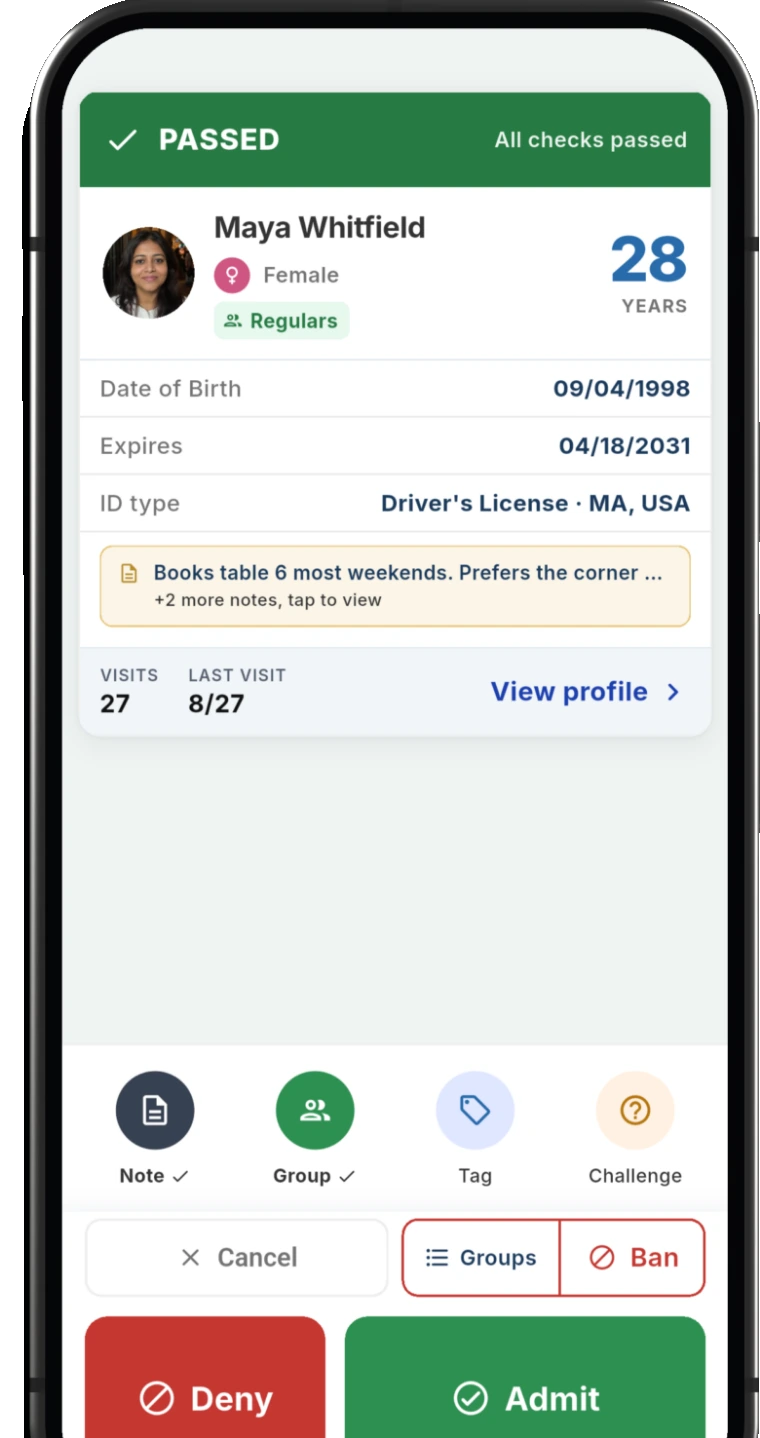
Every scan creates a visit record of who scanned, when, the result and what staff decided. When staff override a check, they pick a reason and the audit log records who and when.
What a written door policy is for
A door runs on decisions made in seconds, often by whoever is working that night. A written policy means the Friday crew and the Tuesday crew card the same guests, accept the same IDs and turn people away with the same words, even when the manager who set the rules is off.
It is also the training material. A new hire can read it before the first shift, and a manager can point to a line instead of explaining a judgment call again at midnight. If an incident is reviewed later, the policy shows what the house rules were and the door's records show whether they were followed.
A licensing office's version looks much the same. The City of Minneapolis publishes a sample alcohol service policy, an outline that covers how and when to check ID, underage guests, intoxicated guests, staff sign-off and what happens when staff break the policy.
Who works the door and who gets carded
Start with the hours the door is staffed, who is assigned on each night and how the door reaches the manager on duty. Written down, they answer who was supposed to be where on any given night.
Then decide who gets carded. The usual choices are every guest, every guest who looks under a set age or every guest after a set time of night. A look-age rule depends on every staff member guessing ages the same way, and carding everyone removes the guess.
Which IDs the house accepts
This line names the documents staff take as proof of age, such as a driver's license, a state ID card, a passport or a military ID. Each state's page in ID scanning laws by state covers which IDs count as proof of age there, so start from yours and write the house list from it.
Decide expired IDs on their own line, so the door has one answer rather than a judgment each time. Can a bar accept an expired ID? covers that question. Then say that anything not on the list is turned away, so nobody has to decide at the door whether a student card or a photocopy counts.
How an ID is checked and what is recorded
Write the check as steps in the order staff do them: take the ID out of the wallet, compare the photo with the face, read the date of birth and the expiration date, then look at the card itself. How to spot a fake ID has the physical checks to train on.
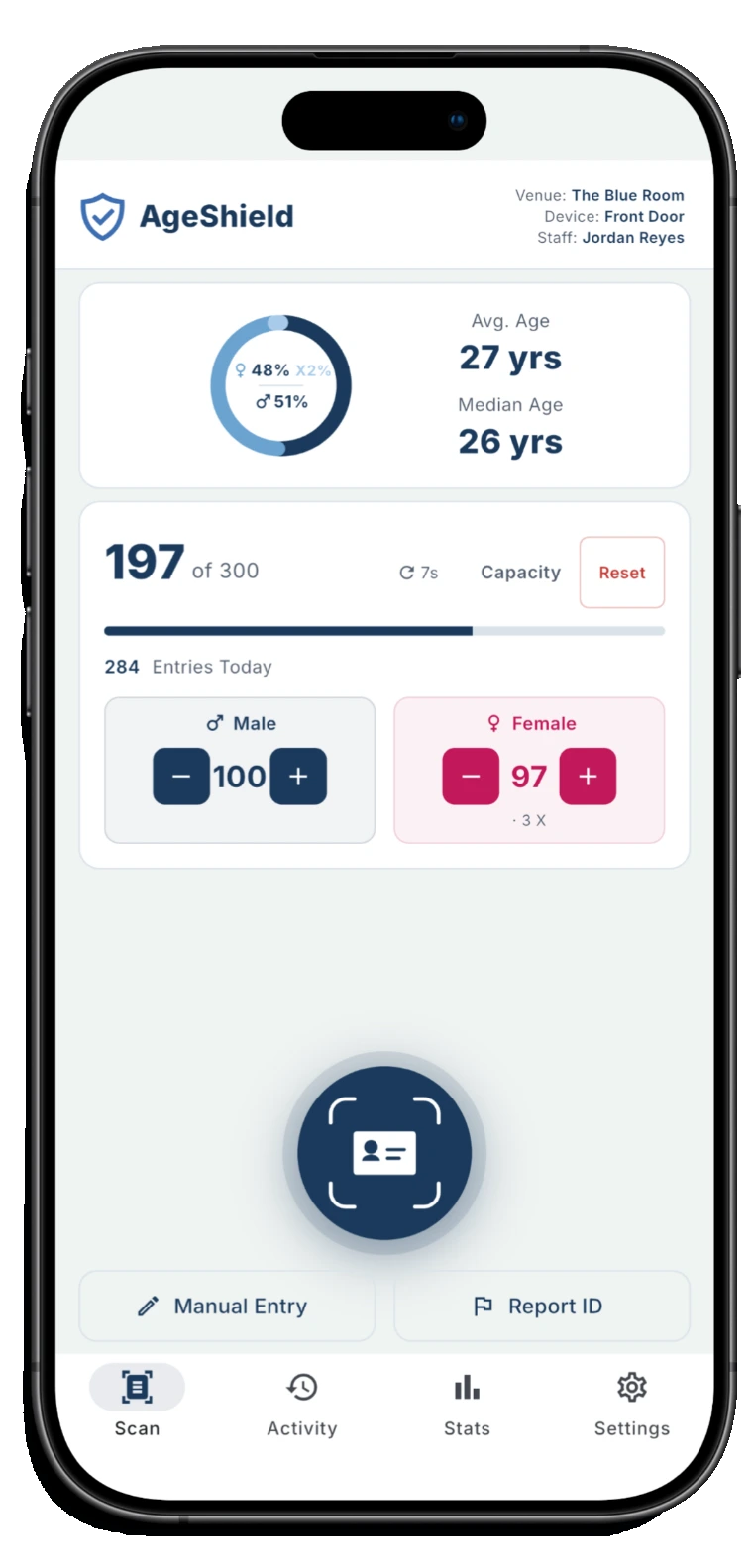
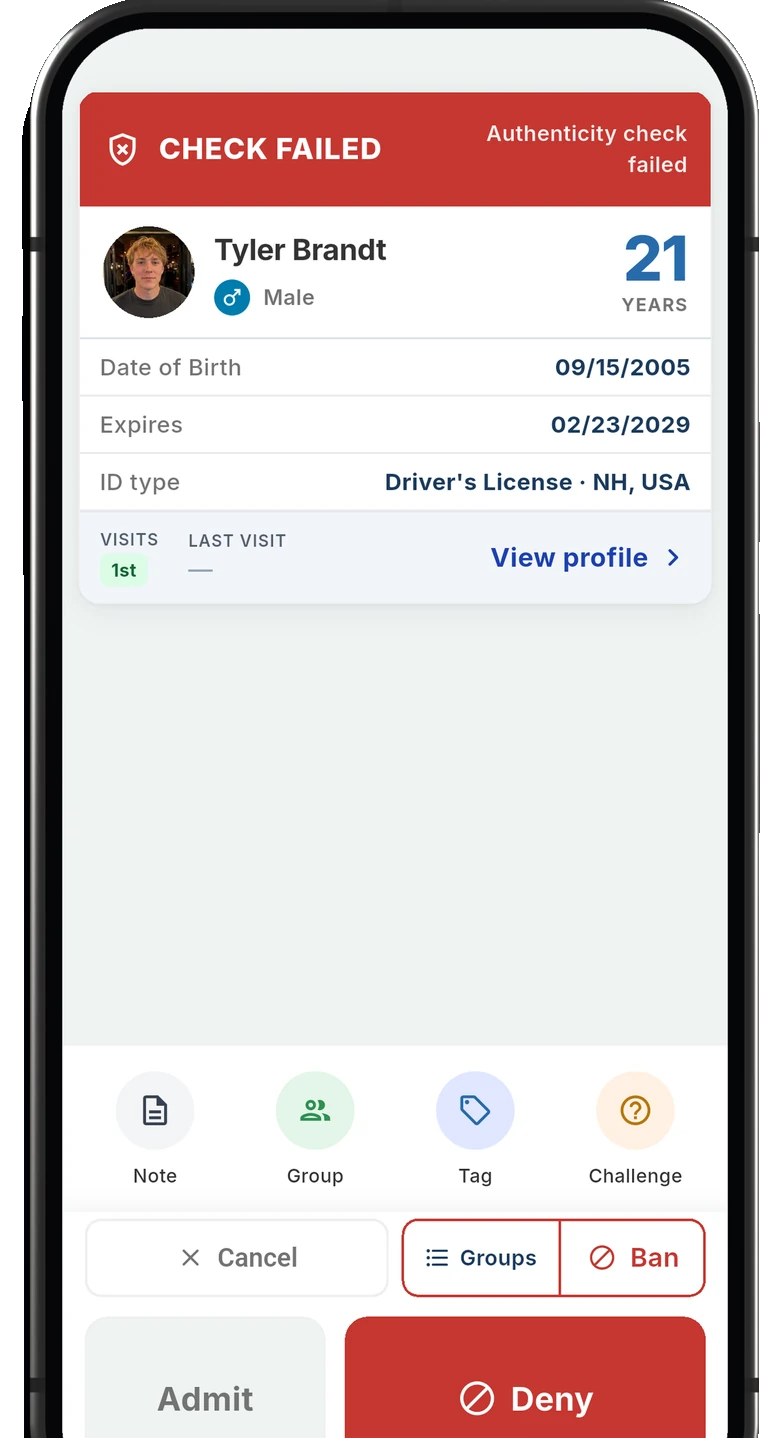
If the door scans IDs, the policy can say what the scan covers and what staff do when it cannot read a card. An AgeShield scan checks the guest's age against your minimum, flags an expired ID and checks your Banned list, and on US and Canadian licenses and state IDs it checks the barcode for signs of forgery. If the camera cannot read a document, staff can tap Manual Entry and type the details, and how a scan works explains each result.
Each scan writes a visit record: when it happened, which device made it, what the check found and whether staff admitted or denied the guest. With staff sign-in on, it also records which staff member scanned. Which ID details are kept and for how long are venue settings, described on privacy controls.
Refusals and suspected fake IDs
A refusal goes better when staff have the words ready. Keep the line about the house rule rather than the guest, say it once and hand the ID back. Writing the exact sentence into the policy means every staff member uses the same one.
For a suspected fake ID, set the steps in order: a question from the ID such as the middle name or date of birth, a second ID or a call to the manager, then admit or refuse. Staff do not need to call a card fake to refuse it. Calling an ID fake is an accusation, often made in front of other people, and a scan can be wrong, so the same refusal line works here.
What staff do with the card itself is a separate line, written down so the door is not deciding it on the spot. Some state guides cover what that state's law says about it, such as Indiana and North Dakota.
Intoxicated guests, re-entry and dress code
Intoxicated guests
Decide what the door does with a guest who arrives visibly intoxicated and who makes that call. Minneapolis's sample policy gives denying an intoxicated guest entry as one way to discourage over-intoxication, and it also asks how the venue discourages an intoxicated guest from driving home.
Re-entry
State whether guests can leave and come back and until what time, then how a returning guest is checked: a stamp, a wristband or a second scan. If returning guests are scanned again, AgeShield can warn when the same ID comes back inside a re-entry window the venue sets, from 1 minute to 24 hours, and shows how long ago it was last scanned. It is a warning rather than a block and staff still decide. It needs guest records on, because it matches the ID that was scanned.
Dress code
If the venue has a dress code, write it as rules staff can see, such as no sports jerseys or no open-toed shoes, and post it where guests read it before they queue. Apply it the same way to every guest on every night.
Banned guests, incidents and overrides
Banned guests
Write who can ban a guest, how long a ban lasts and what is recorded with it: the date, the reason in plain facts and who made the call. Name who can lift a ban, so it does not lapse because someone new on the door does not know the face.
In AgeShield, a ban is an entry on the venue's Banned list, added from a scan or by hand. With guest records on, the banned guest's next scan comes up BANNED with Do not admit, and a ban can cover every venue the owner runs. Up to 10 notes per guest show on the scan result, so the reason for a ban can travel with it.
Incidents
An incident log is where the door writes down anything out of the ordinary: a refusal that turned into an argument, a suspected fake ID, an injury or a call to the police. Each entry records the date and time, who was involved, what happened and what staff did. The policy names where the log lives, who writes each entry before the shift ends and who reads it.
On the Pro plan, AgeShield's visit tags can mark a visit as an incident, so a log entry can be matched to the scan record of the same visit. Staff notes are kept as written, which is one more reason to write them as facts.
Overrides
An override is any time staff admit a guest the policy or the scan says to refuse. Name who can do it, for example the manager on duty only, and how each one is recorded so the decision can be explained later.
In AgeShield, admitting past a failed ID check and admitting past a ban are two separate settings, both off for a new venue until the owner switches them on. Staff then pick a reason from a fixed list, the reason is saved with the visit and the audit log records the staff member and the time. There is no override for an underage result.
How to use the template
Fill it in
Complete every line with the manager who runs the door. Where a line depends on the law, such as accepted IDs, check your state's guide first.
Train on it
Go through it with each new hire before their first shift on the door, then have them read and sign it. The signed copy shows who was trained on which version.
Post the short version
Post the lines guests need at the entrance: who gets carded, which IDs are accepted, the re-entry rule and the dress code. Keep the full policy at the door station or in the office.
Review it each January
Read it again at the start of each year, after any serious incident and whenever your state's law changes. Change the date at the bottom and have the team sign the new version.
Download the two-page template
Door policy
A two-page door policy with room to write each house choice, ready to fill in, sign and keep at the door.
Common questions
What goes in a bar door policy?
Who works the door and when, who gets carded, which IDs the house accepts and how they are checked. Then how staff refuse entry and handle a suspected fake ID, intoxicated guests and re-entry, how bans and incidents are recorded and who can override a refusal.
How do you refuse entry at a bar without an argument?
Give every staff member the same short line, about the house rule rather than the guest, and hand the ID back. Staff do not need to say anything about the card itself. If the guest argues, the policy names who staff call.
Who can override a refusal at the door?
Whoever the policy names. Limiting it to the manager on duty keeps the decision with one person per shift, and recording the reason each time lets the owner review it later. In AgeShield, overrides stay off until the owner switches them on, and each one is saved with a reason, the staff member and the time.
How often is a door policy updated?
The template sets a yearly review at a fixed time, such as each January, plus one after any serious incident and whenever your state's law changes. Each review gets a new date on the policy and a fresh round of staff signatures.
Sources
Writing your door policy?
Tell us how your door runs and which part of the policy you are stuck on, and we'll answer by email.