
Fake IDs
Borrowed IDs: catching a real card in the wrong hands
Published October 27, 2026 · 6 sources linked
How do door staff catch a borrowed ID?
A borrowed ID is a genuine card shown by someone it was not issued to, so checks on the card itself can pass, including a barcode scan. What catches it is the person: the face against the photo, a question the owner would answer without thinking and a second card in the same name. What happens to the card afterwards is set by state law and house policy, and Indiana, for one, lets trained staff keep an ID shown to buy alcohol when they reasonably believe it was not issued to the person who showed it.
Borrowed IDs at a glance
- What a scan sees
- A genuine card: real barcode, real dates, nothing altered
- What catches it
- The face against the photo, a question from the card and a second card in the same name
- Where they come from
- An older relative or friend, or a card passed back out the door
- The card afterwards
- Handed back, or kept where state law allows it and the house policy says so
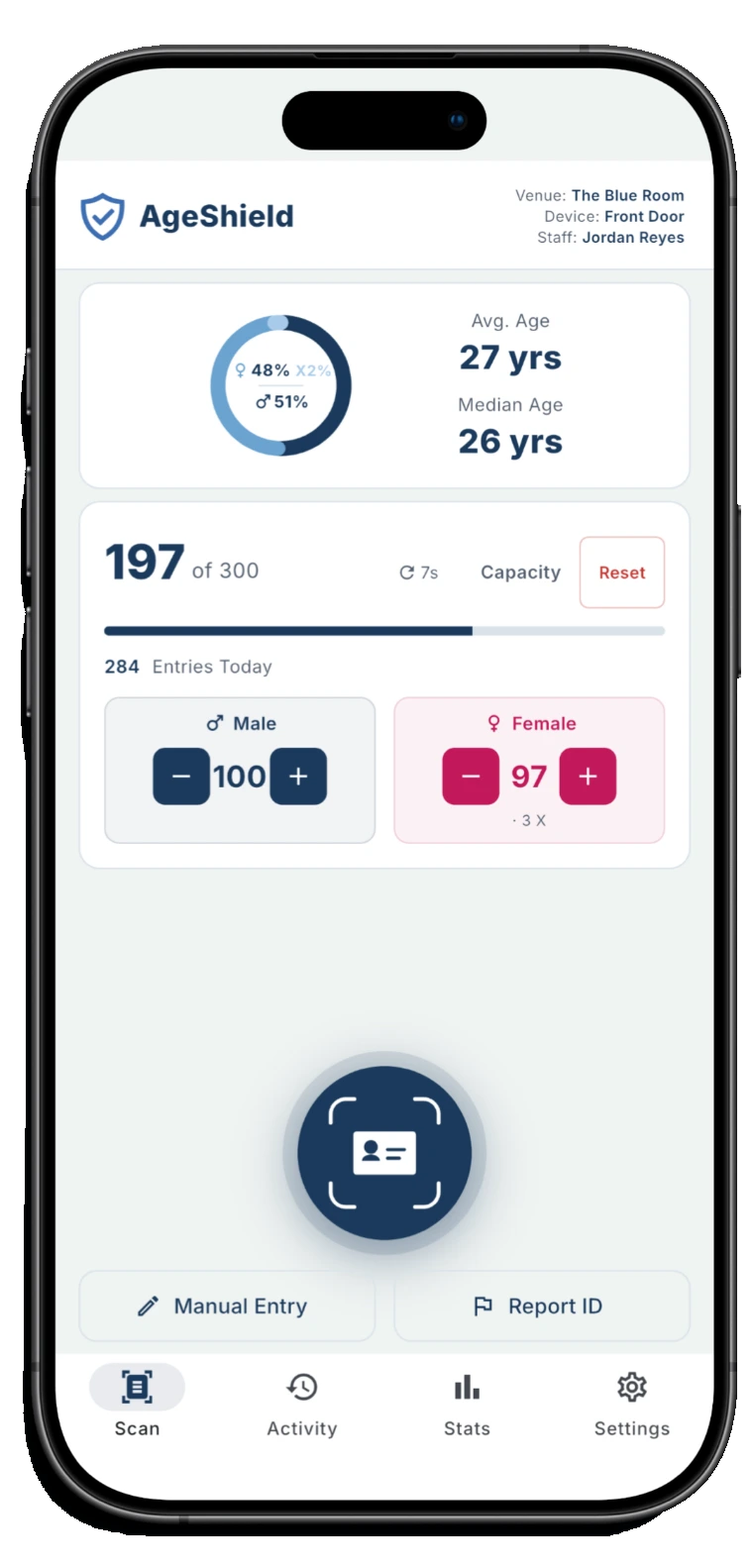
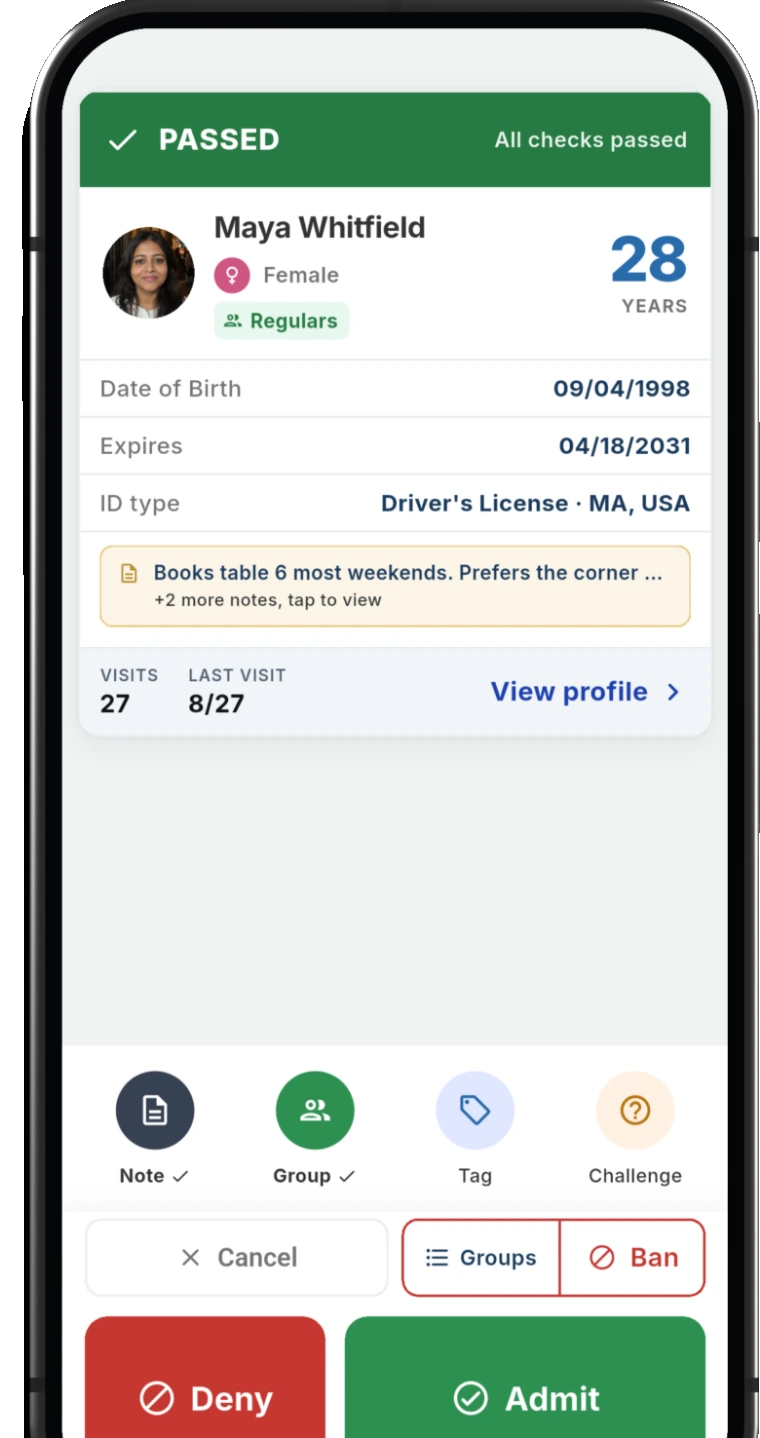
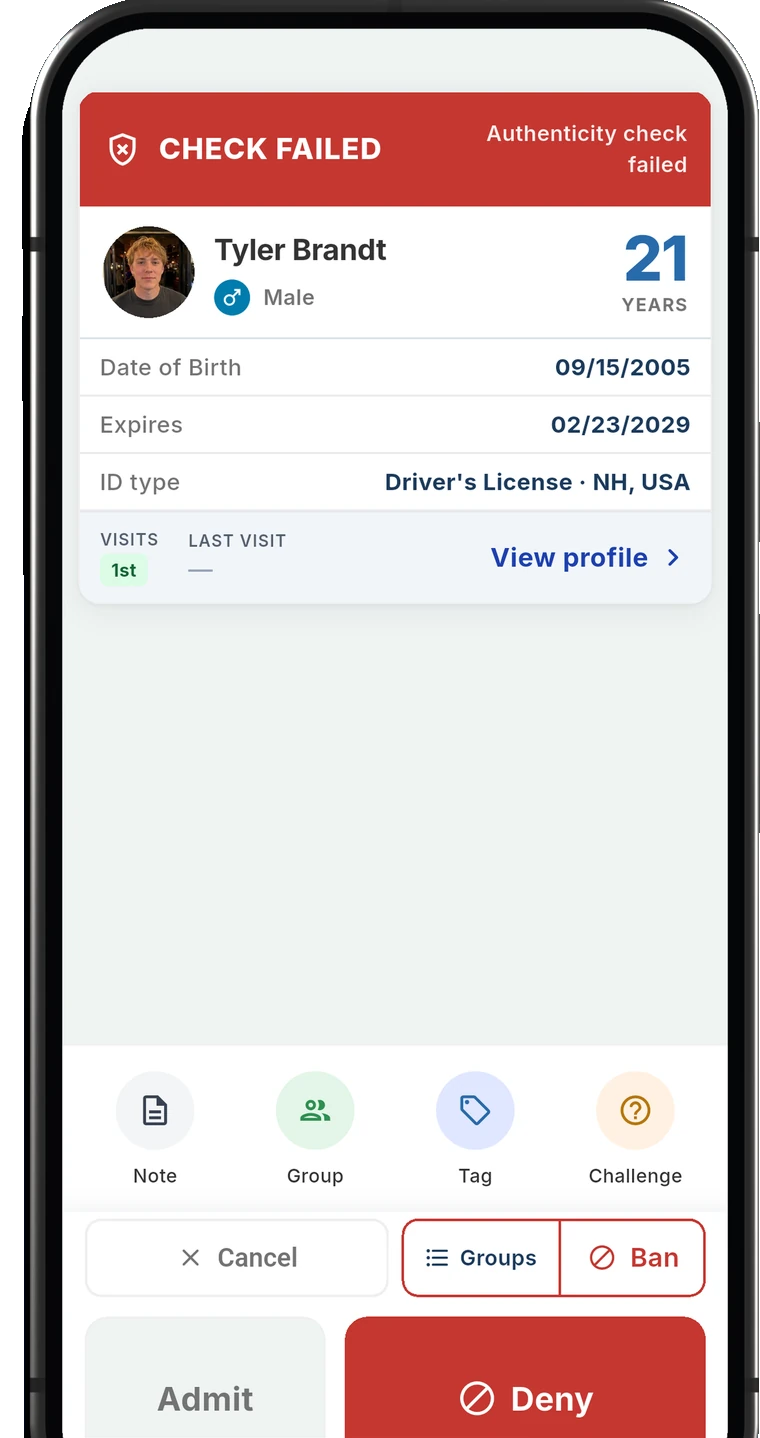
AgeShield ID Scanner
The card checks on every scan, the face left to staff
Each scan works out the age, flags an expired ID and checks your Banned list, so staff can watch the face. When a guest seems off, challenge questions show staff the answer from the ID, and the result is saved with the visit.
Why a borrowed ID passes the scan
A fake ID has something wrong with it: an altered date, forged barcode or card that feels off in the hand. A borrowed ID has nothing wrong with it. A state issued it to a real person who is old enough, and the only problem is that the person holding it at the door is someone else.
Every check a scanner runs is a check on the card. An AgeShield scan works out the age from the date of birth, flags an expired ID, checks the Banned list and runs a forgery check on the barcode of a US or Canadian license or state ID. On a 24-year-old's license held by a 19-year-old, all of that comes back clean, because all of it is true about the 24-year-old. No barcode check catches a real ID that belongs to someone else.
California's alcohol regulator puts a borrowed card on its list of IDs that are not acceptable proof of age, next to stolen and counterfeit ones. It also teaches its F-L-A-G check as a way to spot false or borrowed identification. Montana's regulator says it more bluntly: ID cards are easy to obtain, borrow or buy.
California Department of Alcoholic Beverage Control, Checking IdentificationMontana Department of Revenue, Responsibly Carding: The ABCs of IDs
Where borrowed IDs come from
A borrowed card is chosen for the face on it. The guest looks for someone close enough to pass a glance, which shapes what door staff see.
- An older brother or sister. The resemblance is real, the last name matches everything else in the guest's wallet, and the guest may know the address and the birthday by heart.
- An older friend, sometimes from another state. Kansas's alcohol regulator tells staff to be cautious of out-of-state licenses used by someone youthful in appearance, and California's regulator says that if staff are not familiar with a particular ID, they should not rely on it. Out-of-state and foreign IDs at a bar covers which of those cards count.
- A card passed back out the door. A guest gets in, then hands the ID to a friend still outside, and the same card reaches the front twice in one night.
- A card with an old photo. A license photo can be several years old, which hands the guest a ready excuse when the face does not quite fit.
California's regulator lists a guest's companions and their excuses about the ID among the signs that help staff spot a minor. Around a borrowed card, that can look like a guest who glances at a friend before answering, or explains the photo before anyone asked about it.
Kansas Department of Revenue, Alcoholic Beverage Control, Licensee TrainingCalifornia Department of Alcoholic Beverage Control, Checking Identification
Matching a face that is close
A look-alike card is picked to survive a quick glance, so the face check takes more than one. The photo-to-face step sits in how to check IDs at the door, and which facial features to trust is in how to spot a fake ID. Against a borrowed card, three habits add to it.
- Read the description as well as the photo. Montana's regulator tells staff to check that the eye color and height on the card match the person in front of them. A photo can be close while the printed details are not.
- Hats, hoods and glasses off for the check, so the whole face can be compared and not just the part a cap leaves showing.
- A second look when unsure. Montana's regulator also tells staff to re-card customers at shift change if unsure, and someone who did not wave the guest in sees the face fresh.
Kansas's alcohol regulator lists a picture that does not match the person presenting it among the common mistakes in age checks. Of everything checked on the card itself, it is the one check a borrowed card can fail.
Montana Department of Revenue, Responsibly Carding: The ABCs of IDsKansas Department of Revenue, Alcoholic Beverage Control, Licensee Training
The second-ID ask, aimed at the name
Kansas's alcohol regulator suggests asking for a second or third form of identification, and server guidance from a Nebraska prevention coalition, offered together with local law enforcement, lists asking for other pieces of identification under borrowed IDs specifically. Against a borrowed card the second card has a different job from the first. It does not need to show an age; it needs to show the same name.
A guest using their own license may have a bank card, a student ID or a work badge in the same name. A guest using someone else's license has those cards too, but in their own name. Any card with a printed name will do for this, which makes the ask easy to say yes to: "Have you got a bank card or anything else with your name on it?"
Read the first name as well as the last. A brother's or sister's license shares the last name with everything the guest carries, so a quick glance at a bank card can look like a match when only half of it is. Having only one card is not a refusal on its own; it leaves the decision to the face and the answers.
Kansas Department of Revenue, Alcoholic Beverage Control, Licensee TrainingPanhandle Public Health District (Nebraska), Responsible Beverage Server Training: How to check IDs
Questions that still work on a relative's card
The questions regulators suggest are listed in the questions that catch a borrowed ID. Which of them to lean on depends on whose card it might be.
A friend's card is weakest on the details the friend never shared: the middle name and how it is spelled, the ZIP code, the full date of birth said without a pause. A sibling's card is different. When they grew up in the same home, the ZIP code and the street address on the card are the guest's own, so those two questions catch nothing.
A relative may know the birthday and the middle name too. Against that kind of card the questions do less of the work, and the face, the description and the first name on a second card do more. Ask while still holding the card, so the answer cannot be read off it, and keep the tone of a routine question rather than a test.
What happens to the card
A borrowed card is a genuine government ID belonging to someone who is not at the door. Whether staff may keep it is a question of state law, and states word it differently: some name an ID shown by someone it was not issued to, others speak of altered or false IDs or of an ID used to get alcohol unlawfully.
- State
- Indiana
- What the law says
- Staff who have had alcohol server training may keep an ID shown as proof of age to buy alcohol when they reasonably believe it was altered or falsified, or was not issued to the person who showed it. The person gets a receipt with the date and hour, and within 24 hours the ID goes to the police with a written statement of what happened. If the police do not open an investigation or find probable cause, they release the ID to the person it was issued to. Keeping an ID this way carries no criminal or civil liability, but that does not cover using force to take it.
- Source
- IC 7.1-5-7-4.5
- State
- North Dakota
- What the law says
- A licensed retailer or an employee may seize an ID shown as proof of age when they reasonably believe it has been altered or falsified or is being used to get alcohol unlawfully. They notify a law enforcement agency within 24 hours of the seizure, and the agency takes possession of the ID within 24 hours of the notice.
- Source
- N.D.C.C. 5-01-08.3
Neither law says staff have to keep a card. Each says what staff may do and what follows if they do. Other states set their own rules, and each state's guide covers what its law says about IDs. The bar door policy template has a line for the house's answer.
Whatever the house decides about the card, the refusal itself can name the house rule rather than the guest. Telling someone they are using another person's ID is an accusation, and a real look-alike is exactly the case where it can be wrong. How to refuse entry at a bar has the words for it.
Where AgeShield fits
A scan cannot see a borrowed card, and AgeShield does not claim to. What it does is take the card checks off the door's hands, the age, the expiry, the barcode and the Banned list, so staff attention can go to the step only they can do: the face.
When something feels off, the app's challenge questions give staff a question to ask: date of birth, zodiac sign, middle name, a credit card name match and, on a US license or state ID when the venue collects it, the ZIP code. The app shows the answer from the ID for the questions it can, so staff listen to the guest instead of reading the card. Passed, failed or skipped is saved with the visit.
The credit card name match is the second-ID ask from above, built in: staff ask for a credit card and check the name against the ID. For a card passed back out the door, a venue can set a re-entry window from 1 minute to 24 hours. If the same ID is scanned again inside it, the result shows an amber re-entry warning and how long ago the ID was last scanned.
The re-entry warning does not block anyone. It needs guest records on, because it matches the ID that was scanned. Every scan leaves a visit record of who scanned, when, the result and what staff decided.
Download the one-page template
Borrowed ID door sheet
The signs a card may not be the guest's, your house's rule for a card in doubt and what happens to the card itself, on one page.
Common questions
Does an ID scanner catch a borrowed ID?
No. A borrowed ID is a real card, so its barcode, dates and details are all genuine and a scan reads them as they are. Staff catch a borrowed ID by matching the face and the description to the guest, asking a question from the card and asking for a second card in the same name.
What is a look-alike ID?
A real ID that belongs to someone who looks like the guest, such as an older brother, sister or friend. There is nothing wrong with it as a card, so the check that catches it is the comparison between the person and the photo and description printed on it.
What second ID should door staff ask for with a borrowed card?
Any card with the guest's name on it, such as a bank card, a student ID or a work badge. The point is the name, not the age: a guest using someone else's license carries their own cards in their own name. Read the first name as well as the last, since a sibling's license shares the last name.
Can a bar keep a borrowed ID?
It depends on the state. Indiana lets staff with alcohol server training keep an ID shown to buy alcohol when they reasonably believe it was not issued to the person who showed it, with a receipt and the ID passed to the police within 24 hours. North Dakota lets staff seize an ID shown as proof of age when they reasonably believe it has been altered or falsified or is being used to get alcohol unlawfully, with the police notified within 24 hours. Each state's guide covers what its own law says.
Which questions work when the ID belongs to a sibling?
Fewer than with a friend's card. A sibling who grew up in the same home shares the ZIP code and the address, and may know the birthday and middle name. Against that card the face, the height and eye color on it and the first name on a second card do more of the work.
Sources
- California Department of Alcoholic Beverage Control, Checking Identification
- Montana Department of Revenue, Responsibly Carding: The ABCs of IDs
- Kansas Department of Revenue, Alcoholic Beverage Control, Licensee Training
- Panhandle Public Health District (Nebraska), Responsible Beverage Server Training: How to check IDs
- IC 7.1-5-7-4.5
- N.D.C.C. 5-01-08.3
This page is for informational purposes only and is not a substitute for professional legal advice. We research each rule and link its source, so you can check it against your own venue. Questions are welcome at support@ageshield.bar.
Writing your house rule for borrowed IDs?
Tell us what type of venue you run and we'll point you to the published rules we know of that may apply.