
Running the door
How to check IDs at the door: a routine for door staff
Published October 23, 2026 · 4 sources linked
How do bouncers check IDs at the door?
Door staff run the same short check on every ID, in the same order: the card out of the wallet and in hand, the date of birth against tonight's born-on-or-before date, the photo against the face, the expiry date and one feel of the card. A card that raises a doubt moves to the side for a question, a second ID or the manager, so the line keeps moving. Where the venue scans, the scan does the age math and flags an expired ID, and staff still match the face and make the call.
The routine at a glance
- The order
- Card in hand, date of birth, photo, expiry date, one feel of the card
- Tonight's age line
- At a 21-and-over door, born on or before today's date 21 years back
- When something is off
- Step aside, ask a question, ask for a second ID, then call the manager
- With a scanner
- The scan does the age math and flags an expired ID; staff still match the face
AgeShield ID Scanner
The age math, done on every scan
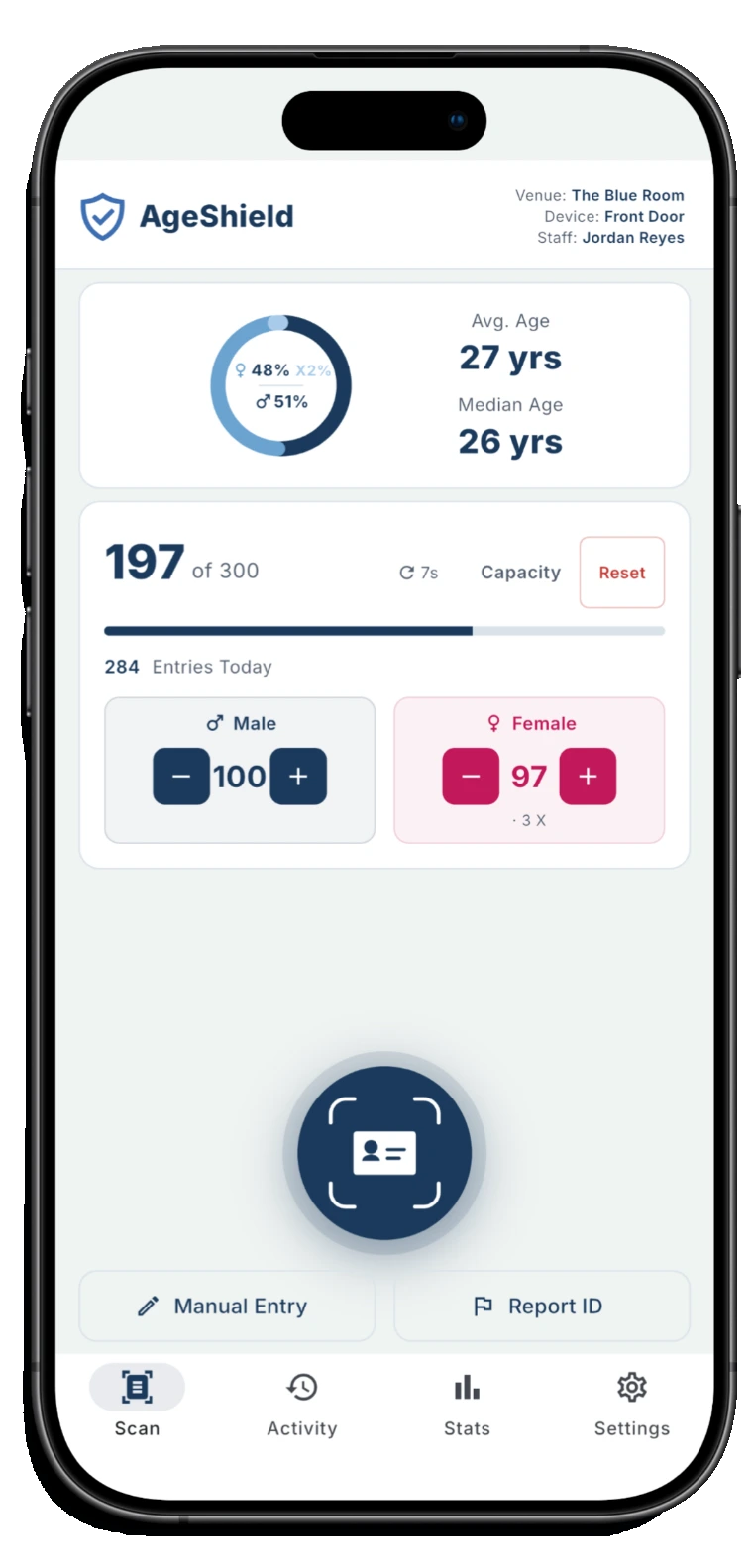
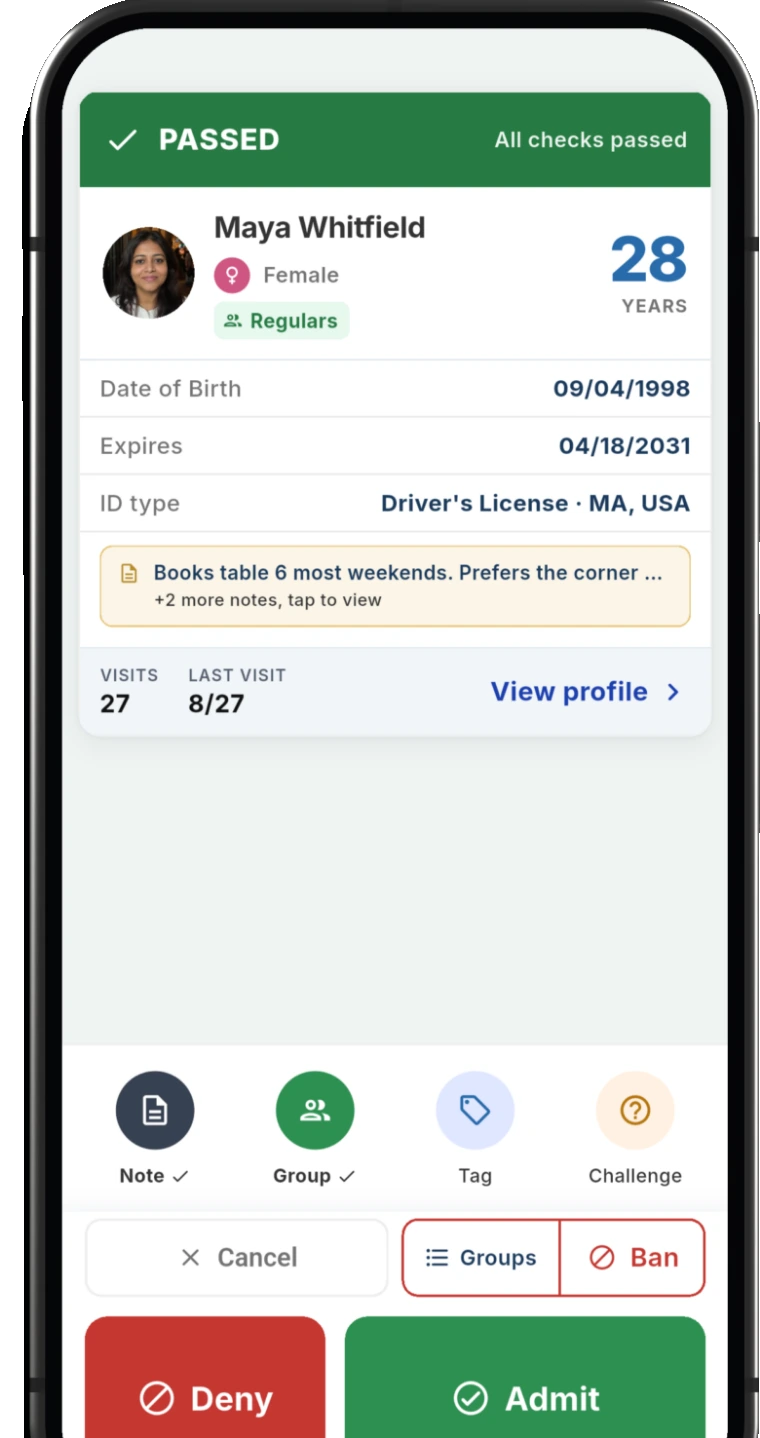
Every scan works out the guest's age against your venue's minimum, flags an expired ID and checks your Banned list. Staff still match the face and tap Admit or Deny, and the decision is saved with the visit.
Why one fixed order is faster
A door check runs fast when nobody has to decide what to look at next. Staff who take every card through the same steps stop thinking about the routine and start noticing what is out of place: a date that does not work, a face that does not fit, an edge that lifts.
Pick a method for checking ID and use it consistently. Having a system will make checking ID easier, faster, and more accurate.
California's alcohol regulator asks for the same thing in its own words: check identification in a methodical and systematic manner. The aim is not a stopwatch time. A clean card goes through quickly because no step needs a decision, and a card that raises a doubt leaves the line and gets the time it needs.
The order below starts with the date of birth, the one comparison that settles an underage guest on its own, while Oregon's server card puts the expiry date first. Either order works as long as the whole team uses the same one.
Oregon Liquor and Cannabis Commission, Tips for Checking ID (Responsible Vendor Program)California Department of Alcoholic Beverage Control, Checking Identification
The routine, step by step
This is the check by hand, in order. None of it needs equipment, and each step is short on a card with nothing wrong.
Card out of the wallet
Ask for the ID out of the wallet, card holder or phone case and take it in your hand. The California and Oregon alcohol regulators both ask for this, so staff can handle the card and examine it properly. A card behind a plastic window cannot be felt or turned over.
Date of birth against tonight's line
Compare the date of birth with tonight's born-on-or-before date, worked out before doors open. It is one comparison: on or before the line, or after it. California's regulator notes that in many decoy operations the server who was cited did ask for ID but did not work out the age.
Photo to face
Look from the photo to the guest and back, on every card, the one in the middle of a group included. What to compare, and why some features count more than others, is in how to spot a fake ID.
Expiry date
Read the expiration date on every card, not only the ones that look old. What state laws say about an expired card is in can a bar accept an expired ID?, and the door policy is where the house's answer is written down.
One feel of the card
Run a thumb over the photo and the date of birth, the two places the California and Pennsylvania regulators name for a cut, a bump or a glue line, then along the edges. Feel the same spots on every card, so the one that feels wrong stands out.
A question when unsure
If a step leaves doubt, ask one thing the real owner answers without thinking, such as the ZIP code, while you still hold the card. Kansas's alcohol regulator suggests asking without letting the guest look at the ID.
Hand it back, or step aside
If everything agrees, hand the card back and wave the guest in. If anything does not, keep the card for now and move the guest out of the line.
California Department of Alcoholic Beverage Control, Checking IdentificationOregon Liquor and Cannabis Commission, Tips for Checking ID (Responsible Vendor Program)Pennsylvania Liquor Control Board, Detecting Fake ID Cards (RAMP)Kansas Department of Revenue, Alcoholic Beverage Control, Licensee Training
Tonight's born-on-or-before date
Working out an age from a date of birth, guest after guest, is slow and easy to get wrong late in a shift. Doing it once, before doors, turns it into a single comparison per card. At a 21-and-over door, take today's date and go back 21 years: on November 7, 2026, a guest born on or before November 7, 2005 is 21 or older. Anyone born later is under 21.
Write the date where every checker can see it. Kansas's alcohol regulator recommends a visible reminder for staff of the date a person must have been born before to be 21, and notes that many businesses use a calendar that changes daily. Where the door scans, the scan makes this comparison on every card.
For a different minimum, such as an 18-and-over night, go back that many years instead. Some licenses issued to guests under 21 print the date the holder turns 21, as Kansas's do, which does the comparison for you. What the alcohol laws say about such a card once that date has passed is in can a bar refuse a vertical ID after the 21st birthday?.
Kansas Department of Revenue, Alcoholic Beverage Control, Licensee Training
Keeping the line moving
Much of a slow line is not the check itself but what comes before it: a guest finding the wallet, prying the card out, asking why. Each of those can happen before the guest reaches the front.
- A sign at the entrance that the door checks IDs. Kansas's alcohol regulator suggests posting one and then actually enforcing the practice.
- Someone working the line on a busy night, asking for IDs out and ready.
- One guest at a time at the front, each card matched to its own face, even when a group arrives together.
- A spot just past the front and out of the line, where a card that needs more than the routine gets it.
- A second checker when the line backs up.
That last point is the one that keeps the check whole. Shortening the routine moves the line by removing the steps that catch problems, while a second checker moves it without removing anything.
Kansas Department of Revenue, Alcoholic Beverage Control, Licensee Training
When something does not add up
Once a card raises a doubt, speed stops mattering for that guest, and it starts mattering for everyone behind them. Taking the doubtful card out of the line serves both.
What staff can do, in order:
- Move the guest a step out of the line and keep the card in hand. If a second checker is free, the next guest comes forward.
- Ask a question from the card, if you have not already. The questions that catch a borrowed ID are in our fake ID guide.
- Ask for a second ID. Kansas's alcohol regulator suggests asking for a second or third form of identification.
- Call the manager if it is still unclear. California's regulator lists managers backing their staff's refusals among its good ID policies.
- Decide: admit, or refuse with the house line.
A refusal that names the house rule rather than the card avoids calling anyone's ID fake, which is an accusation a scan or a hunch can get wrong. The bar door policy template has room for the exact words, and for what happens to a card the door will not accept.
Kansas Department of Revenue, Alcoholic Beverage Control, Licensee TrainingCalifornia Department of Alcoholic Beverage Control, Checking Identification
Where a scan fits in the routine
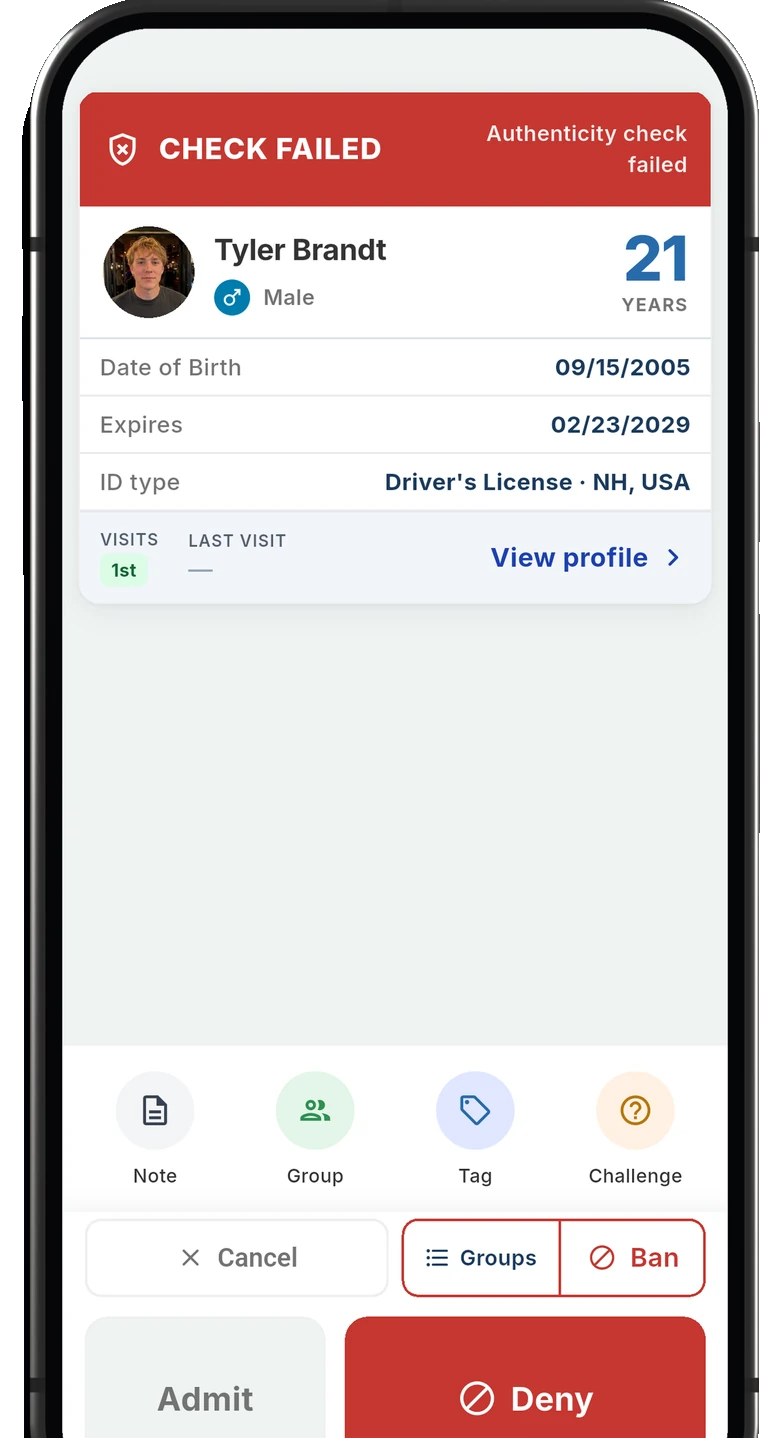
A scanner takes over the steps that are arithmetic and leaves the ones that need eyes. An AgeShield scan works out the guest's age against your venue's minimum, flags an expired ID and checks the guest against your Banned list. When it reads the barcode of a US or Canadian driver's license or state ID, it also runs a forgery check on it.
What it cannot do is match the face. No barcode check catches a real ID that belongs to someone else, so the photo, the feel of the card and the question stay with staff. With a scanner, the routine becomes:
Card in hand
Out of the wallet, as before, so either side can be shown to the camera.
Scan
Which sides the scan needs depends on the scan mode. Fast accepts either side on its own and is the quickest at the door, Standard needs the back barcode and Secure reads the front and the back and compares them. Secure is the most thorough mode and the slowest, and a Fast scan of the front only has no barcode to check.
Read the result
The result shows in capital letters, such as PASSED, UNDERAGE, EXPIRED or BANNED. A flag tells staff to look closer and is not proof on its own that an ID is fake, just as a clean result is not proof that one is real.
Match the face
Look from the photo to the guest, the same as by hand. This is the step the scan cannot do.
Decide
Tap Admit or Deny. When something is off, the app's challenge questions give staff a question to ask, and the app shows the answer from the ID for the questions it can. There is no override for an underage result.
If the camera cannot read a card, staff can tap Manual Entry and type the details, and the record is marked as typed. The result is worked out on the phone, so scanning keeps going when the signal drops. Every scan leaves a visit record of who scanned, when, the result, the scan mode and what staff decided.
An owner can also set a minimum scan mode for the venue. Staff can pick a stricter mode on their phone but not a weaker one, so a long line cannot talk the door down to a lighter check.
AgeShield ID Scanner
Where a scanner fits in the door routine
AgeShield ID Scanner runs on the phones door staff already carry. Each scan works out the guest's age against your venue's minimum, flags an expired ID and checks your Banned list, so the arithmetic steps of the routine are done before staff look up. Staff still match the face and tap Admit or Deny, and every scan leaves a visit record of who scanned, when, the result and what staff decided.
Common questions
How long should an ID check take at the door?
There is no set time. A practiced routine is quick on a card with nothing wrong, because no step needs a decision, and Oregon's alcohol regulator says a consistent method makes checking ID easier, faster and more accurate. A card that raises a doubt moves out of the line and takes as long as it needs.
How do you tell if someone is 21 from their ID?
Work out tonight's line before doors open: today's date, 21 years back. A guest born on or before that date is 21 or older, and anyone born after it is not. Writing the date where staff can see it turns the age math into one comparison per card.
Why do bouncers ask you to take your ID out of your wallet?
So they can hold the card, feel its surface and edges and turn it over. The California and Oregon alcohol regulators both tell staff to ask for the ID out of the wallet so it can be handled and examined properly.
Does an ID scanner replace checking the ID by hand?
No. A scanner can do the age math, flag an expired ID and check the barcode, but it cannot tell whether the card belongs to the person holding it. Staff still compare the photo with the face and decide whether the guest comes in.
What should door staff do when an ID seems off?
Move the guest out of the line, ask a question from the card, ask for a second ID and call the manager if it is still unclear. If staff are not satisfied, they refuse with the house line rather than calling the ID fake.
Sources
- Oregon Liquor and Cannabis Commission, Tips for Checking ID (Responsible Vendor Program)
- California Department of Alcoholic Beverage Control, Checking Identification
- Pennsylvania Liquor Control Board, Detecting Fake ID Cards (RAMP)
- Kansas Department of Revenue, Alcoholic Beverage Control, Licensee Training
Setting up the check at your door?
Tell us how many people work your door and where the line backs up, and we'll answer by email.