
Running the door
How to refuse entry at a bar without a fight
Published October 27, 2026 · 5 sources linked
How do door staff turn a guest away without an argument?
Give the door one short line for each reason a guest is turned away, and have it name the house rule rather than the guest or the card: "We're 21 and over tonight, so I can't let you in." Staff say it once, calmly and quietly, hand the ID back and do not bargain, and a manager takes over if the guest keeps pushing. Afterwards the refusal is written down with its reason, so the owner can see later what the door did and why.
A refusal at a glance
- What the line names
- The house rule, never the guest's age, sobriety or the card
- How it is said
- Once, calmly and quietly, with the ID handed back
- If the guest pushes back
- The same line again, a lower voice, then the manager takes over
- What gets written down
- The time, the reason and who refused, plus an incident log entry for anything more
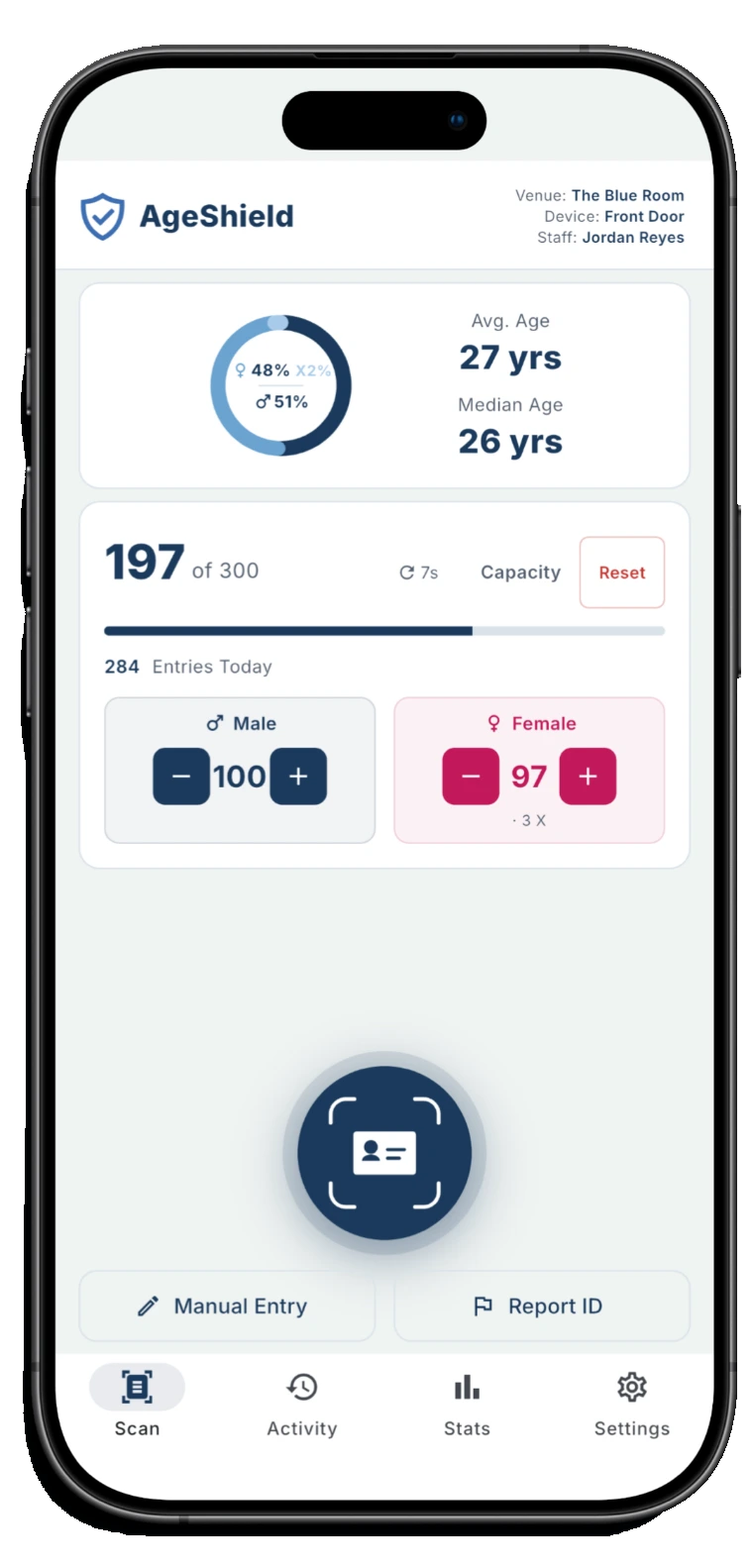
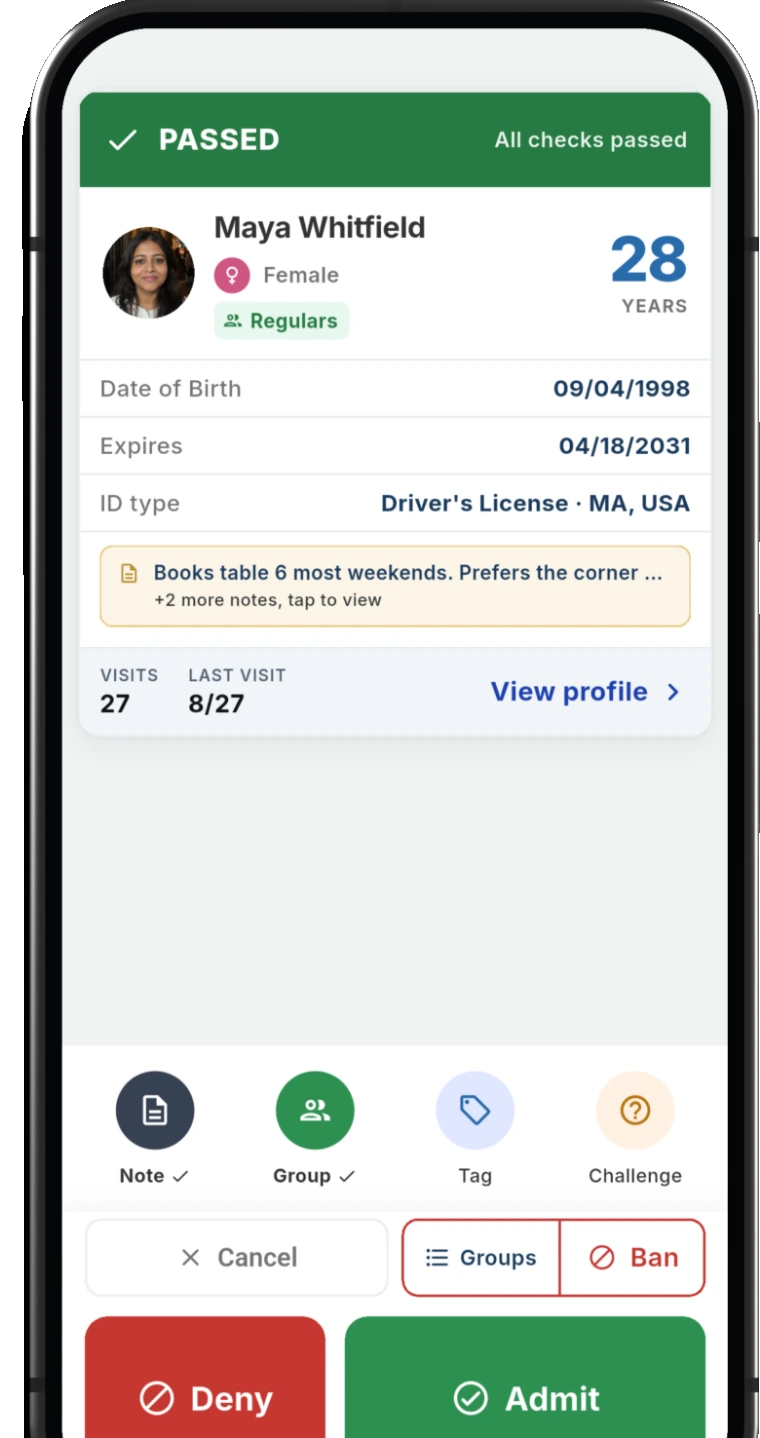
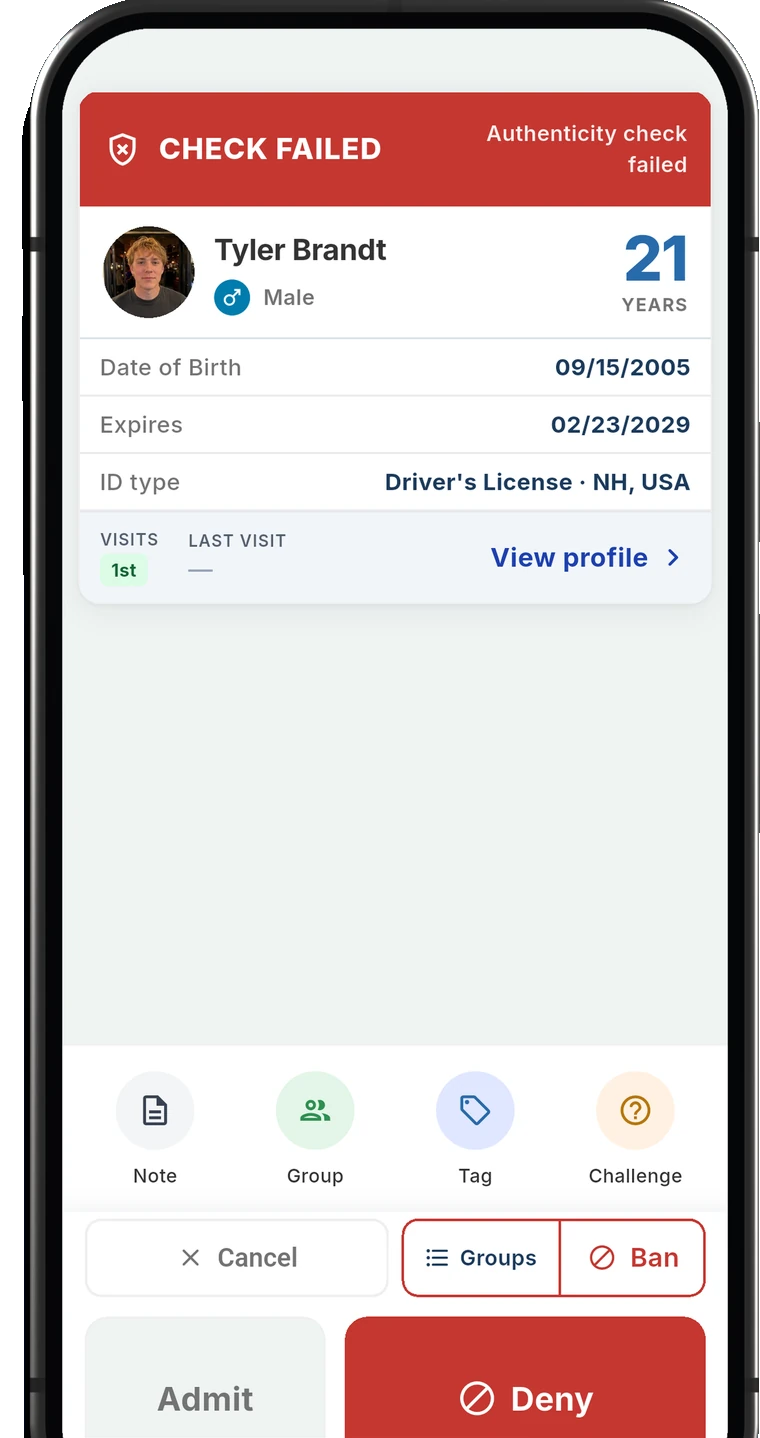
AgeShield ID Scanner
Each Deny saved with its reason
Each scan works out the age against your minimum, flags an expired ID and checks your Banned list. When staff tap Deny, the decision and its reason are saved with the visit. There is no override for an underage result.
Why the house line names the rule, not the card
A refusal can turn into an argument when it becomes about the person: "you're drunk", "this ID is fake", "you look 16". Each one is a judgment the guest can dispute in front of friends, and a claim about a card that staff or a scanner can get wrong. A line about the house rule gives the guest nothing to dispute, because it is the same for everyone in the line.
Regulators' training for servers makes the same point. Texas's alcohol commission tells staff not to make judgmental statements like "You're drunk" and to be courteous but firm. Vermont's server training manual tells staff to avoid putdowns and poor language and not to swear, yell or threaten the customer.
California's server-training curriculum lists the same techniques: be courteous but firm, be quiet and discreet, do not bargain and focus on the server's duty not to serve. At the door, the rule staff can state accurately every time is the house's own: the minimum age for entry tonight, the IDs the house accepts, the dress code, a ban. Nobody has to quote a statute to say it.
Setting the lines is the owner's job, not the doorman's. California's server-training curriculum names stopping service, guests who arrive already intoxicated, potentially violent situations, underage guests and an incident log among the critical elements of a venue's service policies. Write the lines into the refusals section of your bar door policy, so the Friday crew and the Tuesday crew say the same words.
Texas Alcoholic Beverage Commission, Tips for refusing alcohol to intoxicated customersVermont Division of Liquor Control, 1st Class In-House Server Training Manual (July 2026)California ABC, Responsible Beverage Service training regulations (4 CCR 160 to 172)
Lines for each reason a guest is turned away
Use one line per reason, so the guest hears the rule and, where possible, a way back another night. Swap in your own minimum age and dress code.
- Reason
- Under the minimum age
- The line
- "We're 21 and over tonight, so I can't let you in."
- Why it is worded this way
- It states the venue's minimum, not a guess about the guest's age, and says nothing about the ID.
- Reason
- Expired ID
- The line
- "I can't accept an expired ID here, so I can't let you in tonight."
- Why it is worded this way
- The date is on the card for the guest to see, and the fix is a current ID next time.
- Reason
- No ID
- The line
- "We need to see an ID from everyone tonight. You're welcome back with one."
- Why it is worded this way
- The same rule for every guest, so nobody is singled out.
- Reason
- Visibly intoxicated
- The line
- "I can't let you in tonight. Come see us another night. Can I call you a ride?"
- Why it is worded this way
- It never says drunk, and it offers help instead of a verdict.
- Reason
- Banned
- The line
- "I'm not able to let you in. The manager can talk with you about it."
- Why it is worded this way
- The reason stays private and away from the line. One person deals with it.
- Reason
- Dress code
- The line
- "Tonight's dress code is on the sign. You're welcome back in something else."
- Why it is worded this way
- It points to a posted rule that applies to everyone.
Underage, expired and no ID
These three turn on the card or the lack of one. The line only states the rule. What state laws say about an expired ID is in can a bar accept an expired ID?, and the house's answer goes in the door policy. A guest who offers a photo of an ID or a phone wallet instead of a card meets the same rule; see can you show a photo of your ID at a bar?.
If staff doubt the card itself, the refusal line is the same and the steps before it are in when something does not add up. What happens to a card the door suspects is fake is a separate line in the door policy.
A guest who arrives intoxicated
The door is the first chance to turn away a guest who arrives intoxicated. Pennsylvania's liquor board notes that visible intoxication may show in a customer who has just walked in and has not been served. Turning that guest away at the rope is quieter than cutting them off at the bar an hour later.
The line offers help. Texas's alcohol commission suggests offering to call a friend or a cab where the house's policy allows it. It also suggests letting the guest know you would like to see them come back. Pennsylvania's board suggests keeping a refused guest from driving: asking a sober friend to step in, calling a cab or, on occasion, calling the police.
Banned guests and the dress code
A ban is the refusal where the line says least: only that the guest cannot come in. The manager takes the conversation somewhere private, away from the queue. How long a ban lasts and who can lift it belong in the policy; see how long should a bar ban last?.
A dress code line works when the rule is posted where guests read it before they queue. The sign carries the rule, so staff point to it instead of defending it.
Pennsylvania Liquor Control Board, Signs of Intoxication (RAMP)Texas Alcoholic Beverage Commission, Tips for refusing alcohol to intoxicated customers
When the guest pushes back
When a refusal does not end with the line, the order of what staff do next matters more than what they say. It belongs in the policy beside the lines.
Say the same line again
Repeat it rather than explaining it a new way, because each new reason is a new thing to argue with. California's curriculum says not to bargain, and Vermont's manual says to be clear with the refusal and that staff will not change their mind.
Lower your voice
A refusal said quietly draws less of an audience. If the guest gets louder, staff get quieter.
Take it out of the line
Move the conversation a step to the side, away from the queue, as in when something does not add up. With nobody watching, the guest has less reason to keep it going.
Hand over to the manager
California's regulator lists managers supporting their staff's decisions to refuse service among its good ID policies. A new face can repeat the house rule without the history of the first exchange.
Talk to the friends
California's curriculum lists telling the other members of the guest's group. A friend can be the one who gets the guest home.
Do not chase, do not hold
Texas's commission tells staff not to chase a customer or physically hold them, even after calling the police.
Call the police when safety needs it
California's alcohol regulator lists calling the police for help, only if needed, among its good ID policies. Texas's commission names calling law enforcement when staff believe a guest will try to drive and the guest refuses a ride. Vermont's manual says it may be wise to call the police when a guest being refused becomes physical or tries breaking things.
Keep calm. Even if the situation is frustrating, keep your temper under control and show the customer you won't change your mind.
California ABC, Responsible Beverage Service training regulations (4 CCR 160 to 172)Texas Alcoholic Beverage Commission, Tips for refusing alcohol to intoxicated customersVermont Division of Liquor Control, 1st Class In-House Server Training Manual (July 2026)California Department of Alcoholic Beverage Control, Checking Identification
What to write down after a refusal
A refusal that ends at the rope can still raise a question weeks later: who was turned away, when and why. A plain record answers it in one line, and anything beyond a plain refusal goes in the incident log. Texas's commission tells staff to record what happened in an incident log, and Vermont's manual tells them to record and report any incidents to their employer.
A refusal record holds:
- The date and time and who made the call.
- The reason, as the rule the guest did not meet: "no ID", "expired ID", "dress code", not "fake" or "drunk".
- Whether the manager was called and what happened next.
- For the incident log, a name or a description of the guest and a short account, as Vermont's server manual suggests.
California's training lists the incidents a log is for, among them when service was stopped, when other transport was arranged for a guest, any seizure of an ID, any violent incident and any call to the police. Where the log lives and who reads it are lines in the door policy's incidents section.
Texas Alcoholic Beverage Commission, Tips for refusing alcohol to intoxicated customersVermont Division of Liquor Control, 1st Class In-House Server Training Manual (July 2026)California ABC, Responsible Beverage Service training regulations (4 CCR 160 to 172)
Where a scan helps with a refusal
A scan settles the reasons that are facts on the card before staff say a word. An AgeShield scan works out the guest's age against your venue's minimum, flags an expired ID and checks your Banned list, where a banned guest comes up BANNED with Do not admit. Staff still choose the words; the result tells them which rule to name.
Staff have no override for an underage result, so an argument at the rope cannot talk a guest past it. Letting someone in after a failed ID check or past a ban are separate settings, both off for a new venue until the owner switches them on.
When staff tap Deny, the decision and its reason are saved with the visit. One reason staff can pick is Re-entry Too Soon, for an ID scanned again inside the venue's re-entry window. Even at the strictest privacy settings the record keeps admit or deny with the reason, and which staff member scanned when staff sign-in is on.
The house line also matches what AgeShield asks of venues: never tell a guest their ID is fake because of a scan result. As what a flag means explains, calling an ID fake is an accusation, and a scan can be wrong.
Download the one-page door card
Refusal lines
The house line for each reason a guest is turned away, what to do when they push back and what to write down, on one page for the door.
Common questions
What do you say when refusing entry at a bar?
A short line that names the house rule and the outcome, such as "We're 21 and over tonight, so I can't let you in." It says nothing about the guest or the card. Staff say it once and calmly and hand the ID back.
Should door staff explain why they are refusing someone?
Only by naming the rule. A longer explanation gives the guest something new to argue with, and California's server-training curriculum says not to bargain. If the guest wants more, the manager can talk it through away from the line.
How do you refuse entry to someone who is drunk?
Without the word drunk. Texas's alcohol commission tells staff not to make judgmental statements like "You're drunk". A line such as "I can't let you in tonight. Can I call you a ride?" refuses entry and offers help in the same breath.
What should staff write down after refusing entry?
The date and time, who refused, the reason as the rule the guest did not meet and whether the manager was called. Anything more, such as an argument, a ride arranged or a call to the police, goes in the incident log.
Can door staff let in a guest the scanner shows as underage?
Not in AgeShield. Staff have no override for an underage result. Overrides for a failed ID check or a ban exist only if the owner switches them on, and each one is saved with a reason.
Sources
- Texas Alcoholic Beverage Commission, Tips for refusing alcohol to intoxicated customers
- Vermont Division of Liquor Control, 1st Class In-House Server Training Manual (July 2026)
- California ABC, Responsible Beverage Service training regulations (4 CCR 160 to 172)
- Pennsylvania Liquor Control Board, Signs of Intoxication (RAMP)
- California Department of Alcoholic Beverage Control, Checking Identification
Writing the refusal lines for your door?
Tell us what kind of venue you run and which refusals cause trouble at your door, and we'll answer by email.