
Running the door
Bar re-entry policy: hand stamps, wristbands and rescans
Published November 9, 2026 · 2 sources linked
What goes in a bar re-entry policy?
A re-entry policy sets whether guests can return, the cutoff time, how stamps or wristbands work and whether returning guests show ID again. It also addresses capacity counting and the smoking area. The one-page template to download has a blank for each of those choices.
The re-entry policy at a glance
- What it covers
- Whether guests can come back and until when, stamps and wristbands, ID checks on return, the count and the smoking area
- Who signs it
- The manager who owns the policy and everyone who works the door
- Review cadence
- Once a year with the door policy, after any incident at re-entry and whenever your state's law changes
AgeShield ID Scanner
Know when the same ID comes back
Set a re-entry window from 1 minute to 24 hours, and a second scan of the same ID inside it shows an amber warning with how long ago it was last scanned. The window covers every connected phone at the venue.
Why re-entry needs its own rules
The ID check at the door happens once, when a guest first comes in. Re-entry is everything after that: a guest goes out for a cigarette or to meet a friend and comes back to a door that has to decide again whether they belong inside.
Without a written rule, a stamp may get a different answer at 10 pm than at 1 am, depending on who works the door. The bar door policy template gives re-entry one line on its sheet. A re-entry policy spells out those choices for every shift.
Whether guests can come back, and until when
The first choice is whether a guest who leaves can come back in at all. A venue can allow it all night, allow it until a set time or not allow it at all. With no re-entry, a guest who leaves is a new guest who joins the line, pays any cover and goes through the full check again.
With a cutoff, write the time down, such as no re-entry after midnight or none once the door closes to new guests. Staff then have one answer to give instead of a judgment call at the rope.
Two smaller lines belong here too: whether a returning guest pays the cover again and whether there is a limit on how many times a guest can come back. Post the rule where guests read it before they step out, so they know the answer before anyone is outside asking.
Hand stamps and wristbands
Whichever the house picks, the mark says one thing: this guest went through the door check tonight. Staff put it on after the ID check rather than handing it over.
What each one gives the door:
- A hand stamp is quick to apply and costs little. A design that changes each night keeps last week's stamp from working tonight, and an ink that shows only under a black light is harder to copy with a pen.
- A wristband is easy to see from across the room. A color that changes each night and a single-use band that tears when it comes off make it harder to hand over.
A venue that lets in guests under 21 can give the mark a second job: a band or stamp only for guests 21 and older, so bar staff can see who was checked as old enough. North Carolina's rules speak to that use.
What North Carolina says about wristbands and stamps
North Carolina's alcohol law gives a seller a defense to a charge of selling to someone under 21. One route to it is evidence of other facts that reasonably indicated at the time of sale that the buyer was 21 or older, and the state ABC Commission's rules name wristbands and stamps on that point:
Wrist bands, ink stamps or other similar devices are not reasonable indications of age of a purchaser at the time of sale as referenced by G.S. 18B-302(d)(2).
The North Carolina guide covers which IDs that defense rests on. For other states, each state guide covers what that state's law says about IDs.
N.C. Gen. Stat. 18B-302, Sale to or purchase by underage persons (PDF)14B NCAC 15B .0201, General guidelines (North Carolina ABC Commission rules, Cornell LII copy)
When a stamp or band gets passed on
A mark only works while it stays with the guest who earned it. A band can be slipped off and handed through a fence, and a fresh stamp can be pressed onto another hand, so the people coming in on a passed mark are the ones who never went through the check.
What staff look at on the way back in:
- A stamp that is smudged, faint or reversed
- A stamp or band from an earlier night
- A band loose enough to slide over the hand, or with a closure that is torn, cut or taped
- A marked guest who walks up from the street or the line rather than from the smoking area
The policy decides what a doubtful mark means. One approach treats a missing or doubtful mark as a new arrival, with the full ID check, cover and line. Turning away a guest who cannot pass that check works like any other refusal, covered in how to refuse entry at a bar.
An ID can go back out the door as well as a band, which is a different problem: a genuine ID shown by someone it does not belong to. Borrowed IDs at the door covers how staff check for it.
Checking IDs again on the way back in
A mark says a guest was checked. It does not show that the person in front of staff is the one who was checked, which is why a policy can ask for the ID again on the way back in.
The choices, from lightest to strictest:
- The mark alone, with a full check only when the mark is missing or doubtful
- The mark and the ID for every returning guest, with the photo compared to the face again
- The mark and a scan for every returning guest
Rechecking every guest slows the door when the smoking area empties at once, so a house that rechecks everyone may give returning guests their own lane. How many ID scanners a bar needs covers that count.
Where a rescan helps
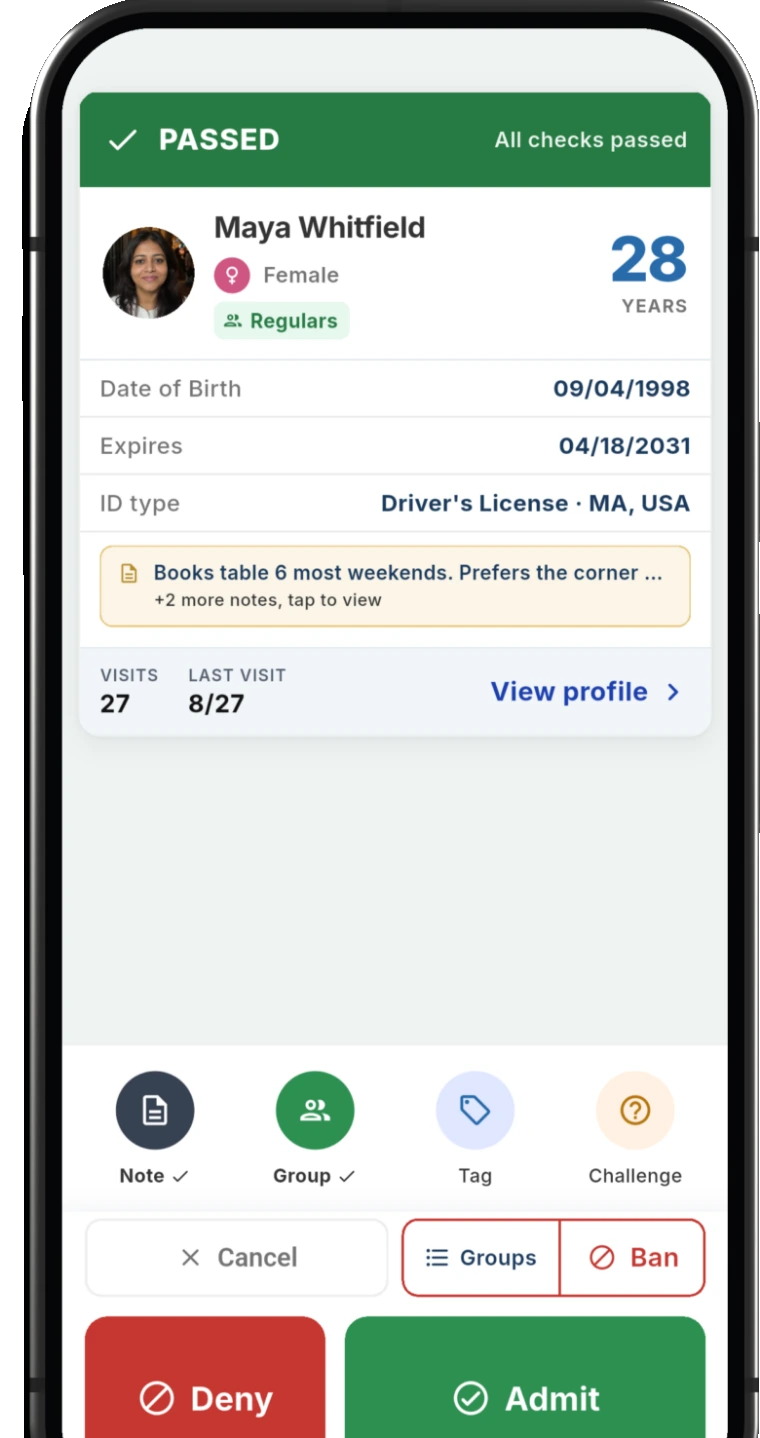
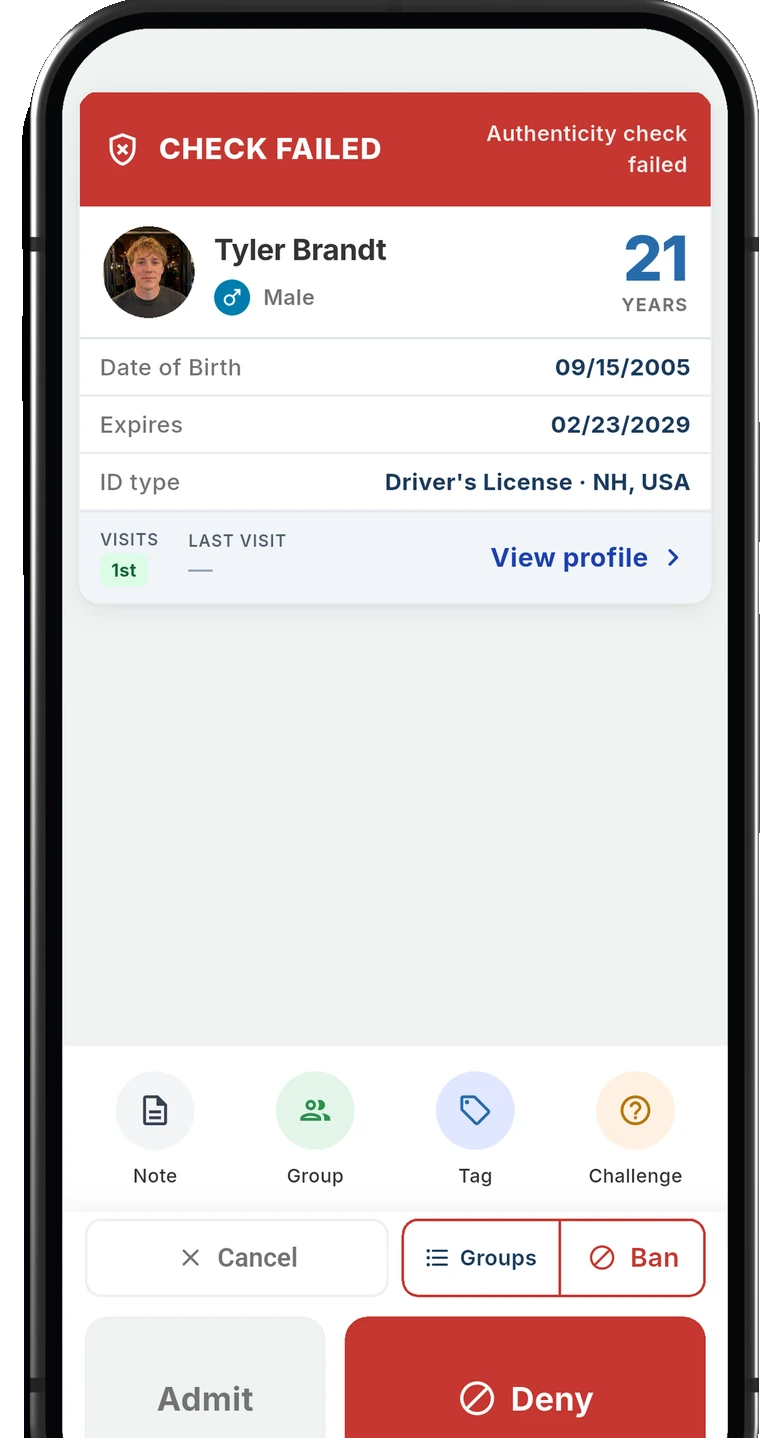
When returning guests are scanned again, AgeShield's re-entry warning looks for what a stamp cannot show: an ID passed back out the door. Set a re-entry window for the venue, from 1 minute up to 24 hours. If the same ID is scanned again inside that window, the result shows an amber re-entry warning and how long ago the ID was last scanned.
It is a warning, not a block. Staff still make the call, and Re-entry Too Soon is one of the reasons they can pick when they deny. Each warning is saved with the scan, and the policy says what staff do when one shows.
The window covers every connected phone at the venue. Without a signal, a phone checks against the scans it already has. It stays off until a window is set in the hub, and it needs guest records on, because it matches the ID that was scanned.
The count and the smoking area
Capacity
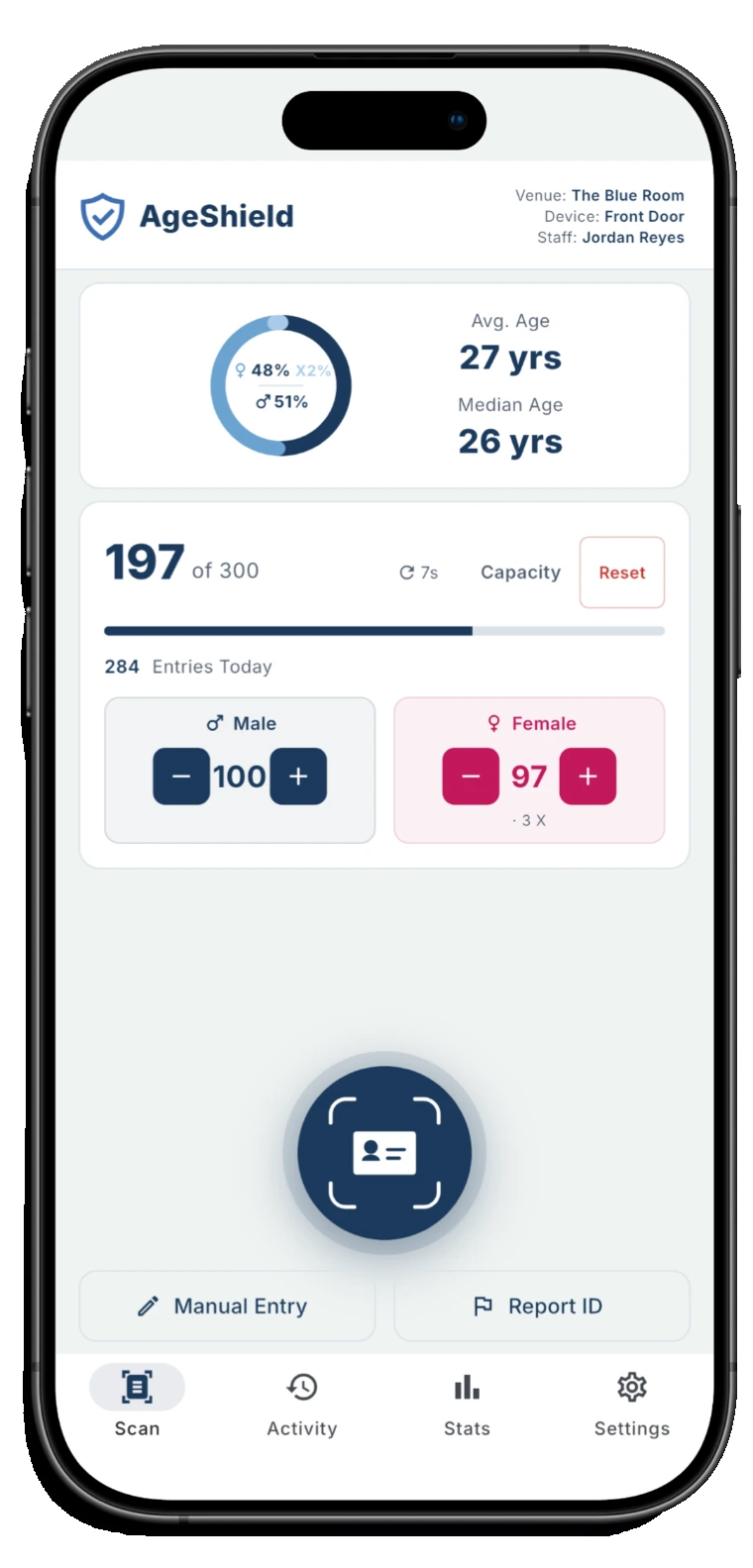
If the house counts heads against its capacity, re-entry changes the count. The policy says whether a guest who steps out comes off the count and goes back on when they return, and who keeps the count at each door, so the number late in the night matches the people inside. AgeShield's live headcount counts every admit, with an at-capacity warning, on all plans.
Smoking area
Where guests smoke decides whether they have left at all. A fenced patio past the door check keeps smokers inside the count and out of the re-entry question, while a spot on the sidewalk makes every smoker a returning guest.
Name the spot, who watches it on a busy night and whether drinks stay inside. A fence or rail that people on the street can reach across can also be where bands and IDs get handed over, so it is worth a staff member's eye.
Putting the policy on paper
Fill it in with the manager who runs the door
Write each choice on the template: whether guests can come back and until when, the mark, when IDs are checked again, the count and the smoking area.
Choose each night's mark ahead of time
Keep the stamps or bands out of reach until doors open, and change the design or color from night to night so an old mark does not work.
Post the short version
A sign at the door with the re-entry rule and the cutoff time tells guests before they step out. The signed copy stays at the door station.
Review it with the door policy
Read it again once a year with the door policy, after any incident at re-entry and whenever your state's law changes, then have the door team sign the new version.
Download the one-page template
Re-entry policy
A one-page re-entry policy with a blank for each house choice, to fill in with the door team and sign.
Common questions
What are the options for a bar re-entry rule?
Re-entry all night, re-entry until a set time or no re-entry, where a guest who leaves comes back as a new guest through the line and the full check. Whichever the house picks, a sign at the door tells guests before they step out.
Is a hand stamp or a wristband better for re-entry?
Both tell staff the guest went through the door check tonight. A stamp is quicker and cheaper, a wristband is easier to see and a single-use band is harder to hand over. Changing the design or color each night keeps an old mark from working.
Does a wristband count as an age check at the bar in North Carolina?
Not for the seller's defense. The state ABC Commission's rules say wristbands, ink stamps and similar devices are not reasonable indications of age at the time of sale. The North Carolina guide covers which IDs the defense rests on.
Does AgeShield stop a guest coming back in on a passed ID?
No. The re-entry warning shows that the same ID was scanned again inside the window the venue set and how long ago it was last scanned, and staff decide what happens next. It stays off until a window is set in the hub and needs guest records on.
Sources
- N.C. Gen. Stat. 18B-302, Sale to or purchase by underage persons (PDF)
- 14B NCAC 15B .0201, General guidelines (North Carolina ABC Commission rules, Cornell LII copy)
This page is for informational purposes only and is not a substitute for professional legal advice. We research each rule and link its source, so you can check it against your own venue. Questions are welcome at support@ageshield.bar.
Writing your re-entry rules?
Tell us what type of venue you run and we'll point you to the published rules we know of that may apply.