
Compliance checks and penalties
Selling alcohol to a minor in California: what the license holder faces
Published November 9, 2026 · 21 sources linked
What happens to a California license after a sale to someone under 21?
One sale can bring a misdemeanor charge against the seller and a separate accusation by the Department of Alcoholic Beverage Control (ABC) against the license. ABC's standard penalties are 15 days' suspension for a first sale, 25 days for a second within 36 months and revocation for a third, and a licensee may petition to pay instead of serving a suspension of 15 days or less or any suspension for a second sale within 36 months. Staff who asked for, were shown and relied on a qualifying ID give the licensee a defense, and since 2026 a scan that fails to catch a fake ID is considered evidence where the card was also physically inspected, seemed genuine and matched the customer.
California's penalties at a glance
- First sale to a minor
- A 15-day suspension, ABC's standard penalty
- Second within 36 months
- A 25-day suspension, with an offer in compromise of $2,500 to $40,000 possible
- Third within 36 months
- Revocation, with no offer in compromise allowed
- The person who sold
- A misdemeanor, punished by a fine, community service or both
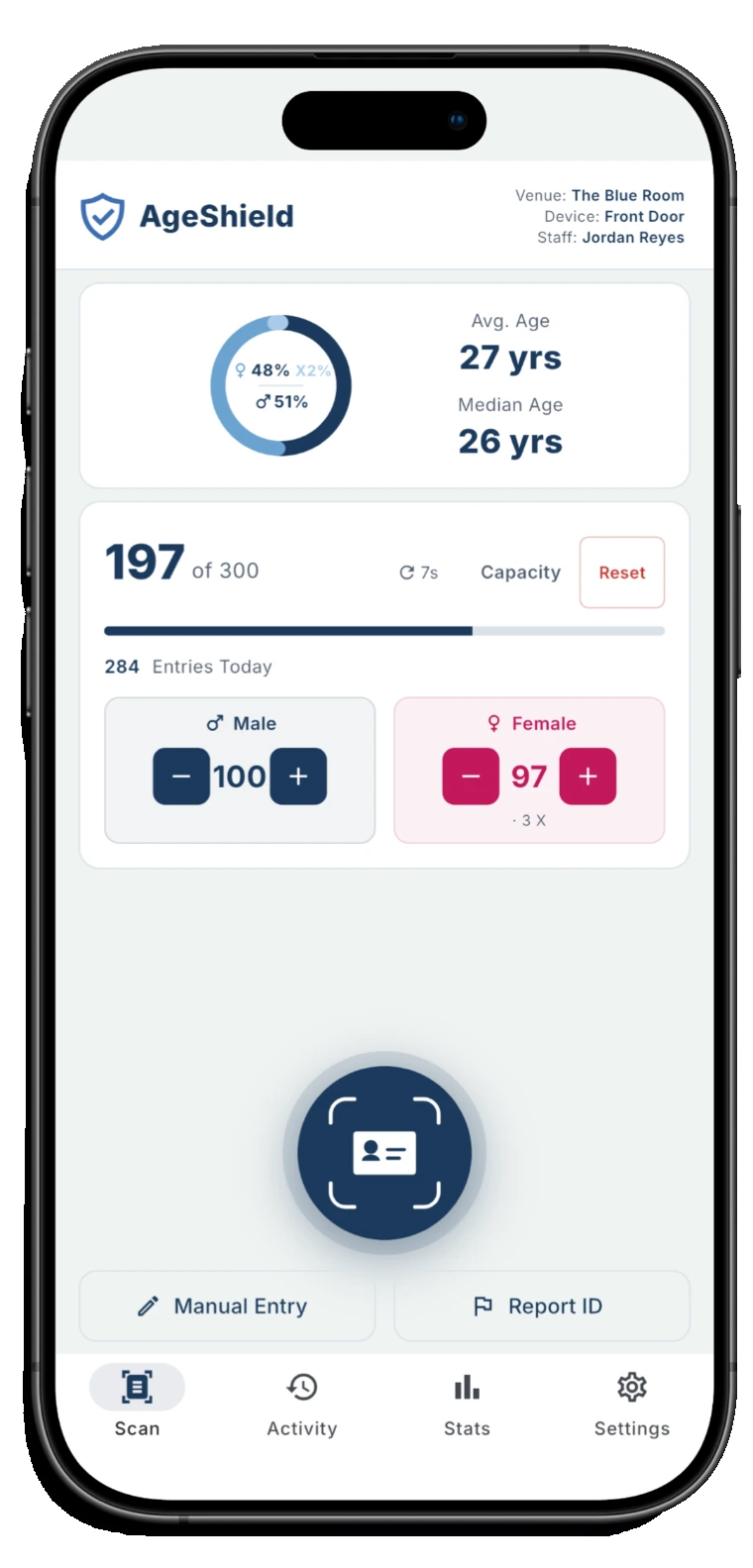
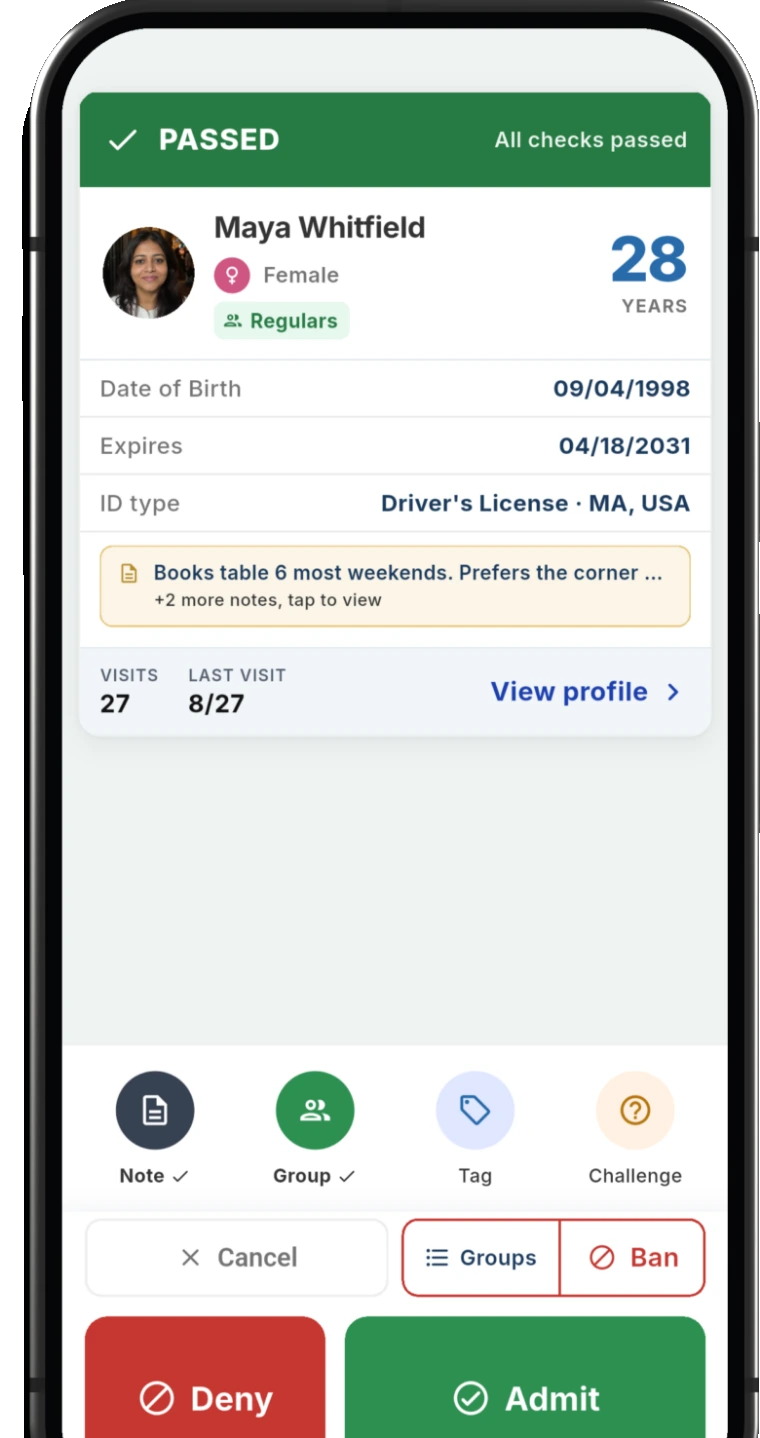
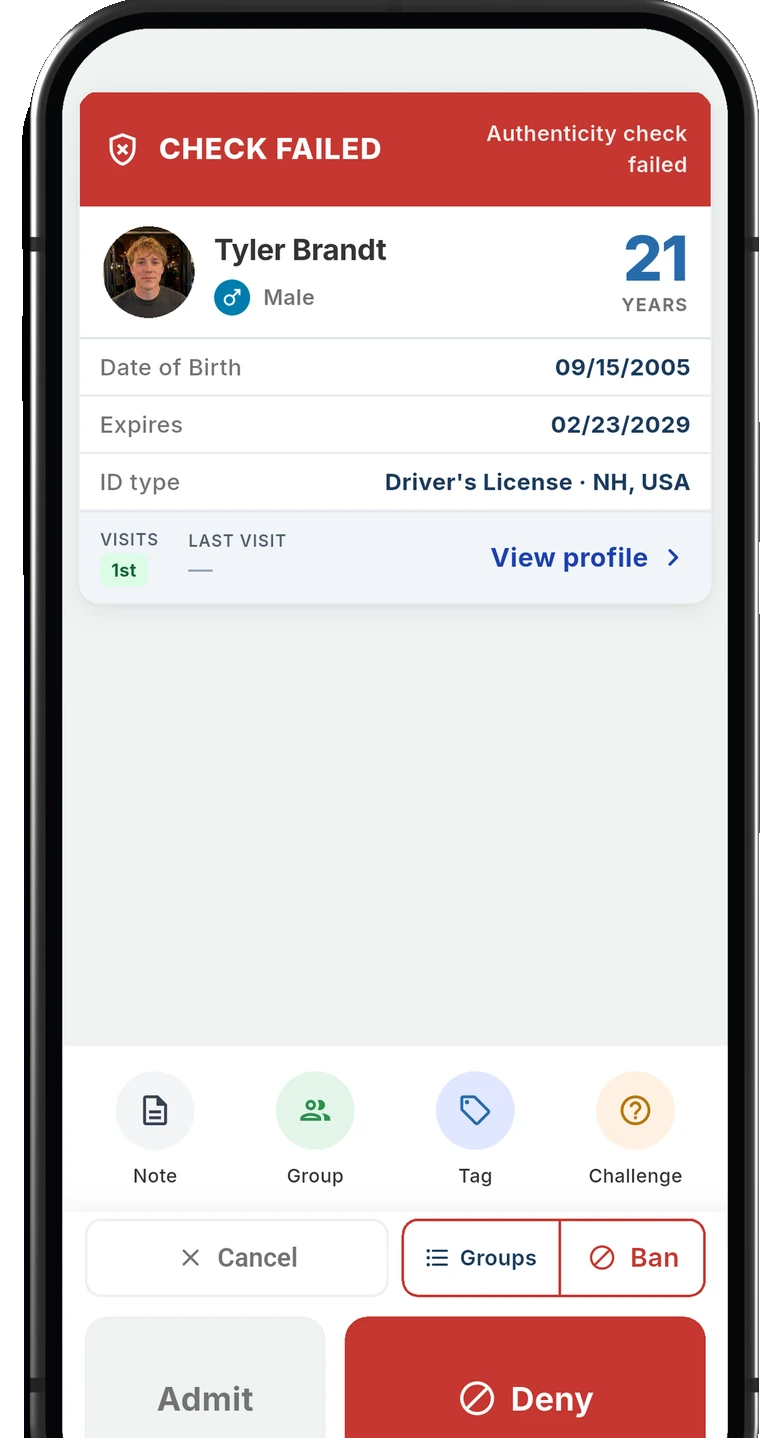
AgeShield ID Scanner
An age check and a record for every scan
The app works out the age from the date of birth and checks it against your venue's minimum, which starts at 21. Staff cannot override an underage result, and each scan creates a visit record.
Two cases from one sale
Selling or serving alcohol to anyone under 21 is a misdemeanor under Business and Professions Code section 25658(a), and the seller can be arrested and charged. ABC says its own case against the license, an accusation, comes in addition to any criminal or civil case that local city and district attorneys bring, not in place of one.
For the seller, section 25658(e) sets a $250 fine the court may not suspend, 24 to 32 hours of community service or a mix of the two. A separate paragraph sets a higher penalty:
(2) Except as provided in paragraph (3), any person who violates subdivision (a) by furnishing an alcoholic beverage, or causing an alcoholic beverage to be furnished, to a minor shall be punished by a fine of one thousand dollars ($1,000), no part of which shall be suspended, and the person shall be required to perform not less than 24 hours of community service during hours when the person is not employed and is not attending school.
An accusation for a sale to a minor has a one-year filing deadline. When the buyer was a minor decoy, the decoy's rules are in California minor decoy operations and Rule 141, and the first month after the notice is in after a failed alcohol compliance check.
Cal. Bus. & Prof. Code s. 25658California ABC: Frequently asked questions on the disciplinary processCal. Bus. & Prof. Code s. 24206
The penalty schedule ABC starts from
Rule 144 (California Code of Regulations, title 4, section 144) has ABC consider its published penalty guidelines when it decides on discipline, and lets it depart from them where facts in aggravation or mitigation warrant it. For sales to minors, the schedule counts violations within 36 months.
- Violation
- First
- Standard penalty
- 15-day suspension
- Paying instead of the suspension
- Possible: half the estimated gross alcohol sales for each day, at least $750 and at most $6,000, or $1,500 to $12,000 after a final suspension or revocation in the previous three years
- Violation
- Second within 36 months
- Standard penalty
- 25-day suspension
- Paying instead of the suspension
- Possible whatever the length: half the estimated gross alcohol sales for each day, $2,500 to $40,000
- Violation
- Third within 36 months
- Standard penalty
- Revocation
- Paying instead of the suspension
- Not allowed
Letting someone under 21 drink on the premises carries the same 15-day standard penalty as a sale. In the schedule, revocation includes a stayed revocation. An earlier violation counts toward the second or third only once its decision is final.
California ABC: Disciplinary guidelines (Rule 144 penalty guidelines)Cal. Bus. & Prof. Code s. 23095Cal. Bus. & Prof. Code s. 25658.1
Section 25658.1 lets ABC revoke a license for a third violation within any 36-month period without limiting its power to revoke sooner when the circumstances warrant it. ABC's guidelines add:
Higher or lower penalties from this schedule may be recommended based on the facts of individual cases where generally supported by aggravating or mitigating circumstances.
Cal. Code Regs. tit. 4, § 144, Penalty guidelines (LII)California ABC: Disciplinary guidelines (Rule 144 penalty guidelines)Cal. Bus. & Prof. Code s. 25658.1
What moves a penalty up or down
ABC's guidelines include these aggravating factors:
- Prior disciplinary history
- Prior warning letters
- Licensee involvement
- Premises in a high crime area
- A licensee not cooperating in the investigation
- The appearance and actual age of the minor
- A continuing course or pattern of conduct
Mitigating factors include:
- Years licensed at the premises without prior discipline or problems
- Positive action by the licensee to correct a problem
- Documented training of the licensee and employees
- A licensee cooperating in the investigation
How ABC has weighed them
Three of ABC's precedential decisions show how the factors play out. In 19-03-E, a store sold to a minor while an earlier accusation of the same kind was still pending. That case could not count as a prior violation before it was final, but ABC treated it as notice of a problem, and the store's failure to take any steps afterwards offset more than 28 years without discipline. ABC's lawyer had asked for 25 days, and the decision set 15.
In 24-01-E, a clerk sold wine to a 20-year-old without asking for ID, saying he had seen her ID on earlier visits. The ID defense failed, and the license was suspended for 10 days with all 10 stayed for 12 months, ABC giving weight to more than eight years without discipline. Under the order, the stayed days can be imposed only if a later final determination finds cause for discipline during those 12 months.
In 25-02-E, a clerk asked for and scanned the ID of a 22-year-old buyer but not that of the 19-year-old whose debit card paid for the case of malt beverages, and the accusation was sustained. The decision counted as mitigation that the store used a scanner without an opt-out for age-restricted sales, that the clerk had checked the buyer's ID and that the sale did not appear intentional. It also found the store needed better training for purchases involving more than one person, and set 10 days against the 15-day standard.
California ABC: Disciplinary guidelines (Rule 144 penalty guidelines)California ABC, Precedential Decision 19-03-E (PDF)California ABC, Precedential Decision 24-01-ECalifornia ABC, Precedential Decision 25-02-E (PDF)
Paying instead of serving a suspension
Section 23095 calls the payment an offer in compromise. The licensee petitions once the decision suspending the license is final and before the suspension starts. ABC can grant it if letting the business stay open would not impair public welfare and morals and if the licensee's books show, with reasonable accuracy, the alcohol sales the suspension would have cost.
Except for a second sale-to-minor violation, the suspension has to be 15 days or less. Under ABC's guidelines, any stayed revocation rules the payment out, as does a stayed part that would take the total past 15 days. Where part of a suspension is stayed, the payment is worked out on the days actually to be served.
Once the money is paid, ABC orders the suspension permanently stayed. If ABC does not grant the petition, the suspension takes effect on the date it sets, and for a third violation within 36 months of the first, no petition is allowed at all.
Cal. Bus. & Prof. Code s. 23095California ABC: Disciplinary guidelines (Rule 144 penalty guidelines)Cal. Bus. & Prof. Code s. 23096Cal. Bus. & Prof. Code s. 23098Cal. Bus. & Prof. Code s. 25658.1
The ID defense, and what changed in 2026
Section 25660 gives a defense, in a criminal case and in a license case, when the licensee or an employee or agent asked for, was shown and acted in reliance on a qualifying ID, or used a biometric system that reviews a qualifying ID and verifies that it is valid. The California ID scanning guide lists the IDs that qualify.
In 24-01-E, ABC held that the licensee has to establish every part of the defense. It can cover a fake ID that appears to be government-issued, but not one that does not look genuine, not when the holder's appearance gives more than a mere suspicion that the card is someone else's and not when the minor does not match the description on it. The earlier-visit claim failed because the store could not show which ID the clerk had seen or when, or that he had inspected it with care.
Since January 1, 2026, section 25660(b)(3), added by AB 509, covers age verification software or a device that scans the barcode or magnetic stripe and fails to catch a fake ID. Its use is considered evidence in a prosecution or a license case, provided the ID was one of the qualifying IDs, was physically inspected, seemed genuine and matched the customer's appearance. Under Rule 141, a minor decoy carries their own ID showing their true date of birth, or none.
Cal. Bus. & Prof. Code s. 25660California ABC, Precedential Decision 24-01-ECal. Code Regs. tit. 4, § 141, Minor decoy requirements (LII)
Hearing, decision and appeal
A licensee can contest the accusation at a public hearing before an administrative law judge, with a lawyer at its own expense, and the judge's proposed decision goes to ABC's director. ABC's power to reconsider a decision ends 30 days after it is delivered or mailed, or on its effective date if that comes first.
An appeal to the ABC Appeals Board is due within 10 days after the last day on which ABC could order reconsideration. The Board takes no new evidence: it reviews ABC's record on questions such as whether ABC acted within its powers and whether substantial evidence supports the findings. Within 30 days of the Board's final order, a party can ask the Court of Appeal or the California Supreme Court to review it.
California ABC: Frequently asked questions on the disciplinary processCalifornia ABC, Precedential Decision 19-03-E (PDF)Cal. Bus. & Prof. Code s. 23081Cal. Bus. & Prof. Code s. 23083Cal. Bus. & Prof. Code s. 23084Cal. Bus. & Prof. Code s. 23090
Where a scan fits
Neither section 25658 nor ABC's penalty schedule makes scanning alone a defense. A scan that misses a fake ID counts as evidence only with a physical inspection and the other statutory conditions. When staff scan an ID with AgeShield, the app works out the age from the date of birth and checks it against the venue's minimum age, which is 21 unless the owner changes it, and staff have no override for an underage result.
Each scan is saved as a visit record of who scanned, when, the document type, the result and what staff decided. How a scan works shows every result, and the door routine covers the checks around it.
Four emails a year
What changed in ID law, before it takes effect
Many state rules on IDs and age checks take effect on January 1 or July 1. Each quarter we send one short summary of the changes we found, with the source for every line, starting with the states you pick.
Common questions
What is the fine for selling alcohol to a minor in California?
For the person who sold, section 25658(e) sets a $250 fine, 24 to 32 hours of community service or a mix of the two, and a $1,000 fine plus at least 24 hours of community service where the violation is supplying alcohol to a minor. The license faces a suspension rather than a fine, but a licensee can petition to pay an offer in compromise instead: $750 to $6,000 for a retailer's first violation with no recent prior, or $2,500 to $40,000 for a second within 36 months.
Can ABC revoke a license after one sale to a minor?
The standard penalty for a first sale is a 15-day suspension, and revocation is the standard for a third within 36 months. Section 25658.1 says it does not limit ABC's power to revoke before a third violation when the circumstances warrant it, and ABC's guidelines allow a heavier penalty where aggravating factors support one.
When does an earlier sale count against a California license?
It counts as a prior violation only once its decision is final. A pending accusation can still raise the penalty: in precedential decision 19-03-E, ABC treated one as notice of a problem and weighed the store's failure to take any steps afterwards as an aggravating factor.
Does RBS or LEAD training lower the penalty?
Neither is named in ABC's penalty guidelines, which list documented training of the licensee and employees among the mitigating factors. Responsible Beverage Service certification is required by law for anyone who sells or serves alcohol for drinking on licensed premises and for their managers, and a licensee's failure to comply is itself grounds for discipline. LEAD is ABC's free, voluntary course for retail licensees and their staff.
Is scanning an ID a defense to a sale to a minor in California?
The defense in section 25660 rests on asking for, being shown and relying on a qualifying ID, or on a biometric system. Since January 1, 2026, a barcode or magnetic stripe scan that fails to catch a fake ID is considered evidence in a criminal or license case, where the ID was a qualifying one that was physically inspected, seemed genuine and matched the customer.
Sources
- Cal. Bus. & Prof. Code s. 25658
- California ABC: Frequently asked questions on the disciplinary process
- Cal. Bus. & Prof. Code s. 24206
- Cal. Code Regs. tit. 4, § 144, Penalty guidelines (LII)
- California ABC: Disciplinary guidelines (Rule 144 penalty guidelines)
- Cal. Bus. & Prof. Code s. 25658.1
- Cal. Bus. & Prof. Code s. 23095
- California ABC, Precedential Decision 19-03-E (PDF)
- California ABC, Precedential Decision 24-01-E
- California ABC, Precedential Decision 25-02-E (PDF)
- Cal. Bus. & Prof. Code s. 23096
- Cal. Bus. & Prof. Code s. 23098
- Cal. Bus. & Prof. Code s. 25660
- Cal. Code Regs. tit. 4, § 141, Minor decoy requirements (LII)
- Cal. Bus. & Prof. Code s. 23081
- Cal. Bus. & Prof. Code s. 23083
- Cal. Bus. & Prof. Code s. 23084
- Cal. Bus. & Prof. Code s. 23090
- California ABC: LEAD training
- Cal. Bus. & Prof. Code s. 25683
- Cal. Bus. & Prof. Code s. 25684
This page is for informational purposes only and is not a substitute for professional legal advice. We research each rule and link its source, so you can check it against your own venue. Questions are welcome at support@ageshield.bar.
Questions about California penalties?
Tell us what type of venue you run and we'll point you to the published rules we know of that may apply.