
Compliance checks and penalties
California minor decoy operations and Rule 141
Published November 3, 2026 · 18 sources linked
What does Rule 141 require of a California minor decoy operation?
California ABC's Rule 141 sets five minimum standards for in-person minor decoy operations: the decoy is under 20, has the appearance generally expected of someone under 21 in the circumstances the seller faced, carries their own ID or none, answers any question about their age truthfully and, after a sale, the officer makes a reasonable attempt to have the decoy identify the seller face to face. If an operation fails one, the licensee has a defense to the sale-to-minor case, but bears the burden of establishing it. Courts have declined to add conditions beyond the rule.
The five standards at a glance
- Age
- Under 20
- Appearance
- What is generally expected of someone under 21, in the circumstances the seller faced
- ID
- Their own, or none
- Questions about age
- Answered truthfully
- After a sale
- A reasonable attempt at a face-to-face identification of the seller
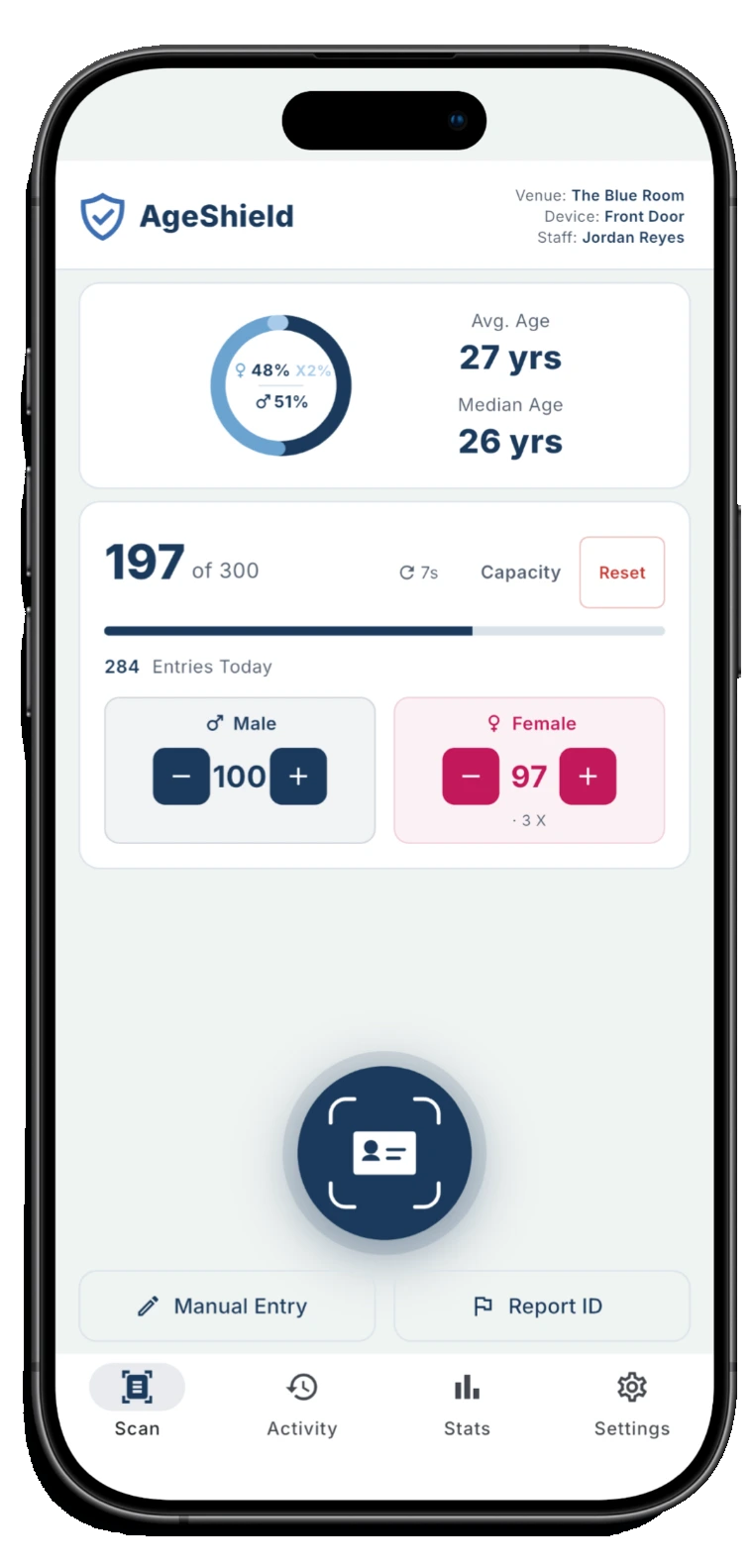
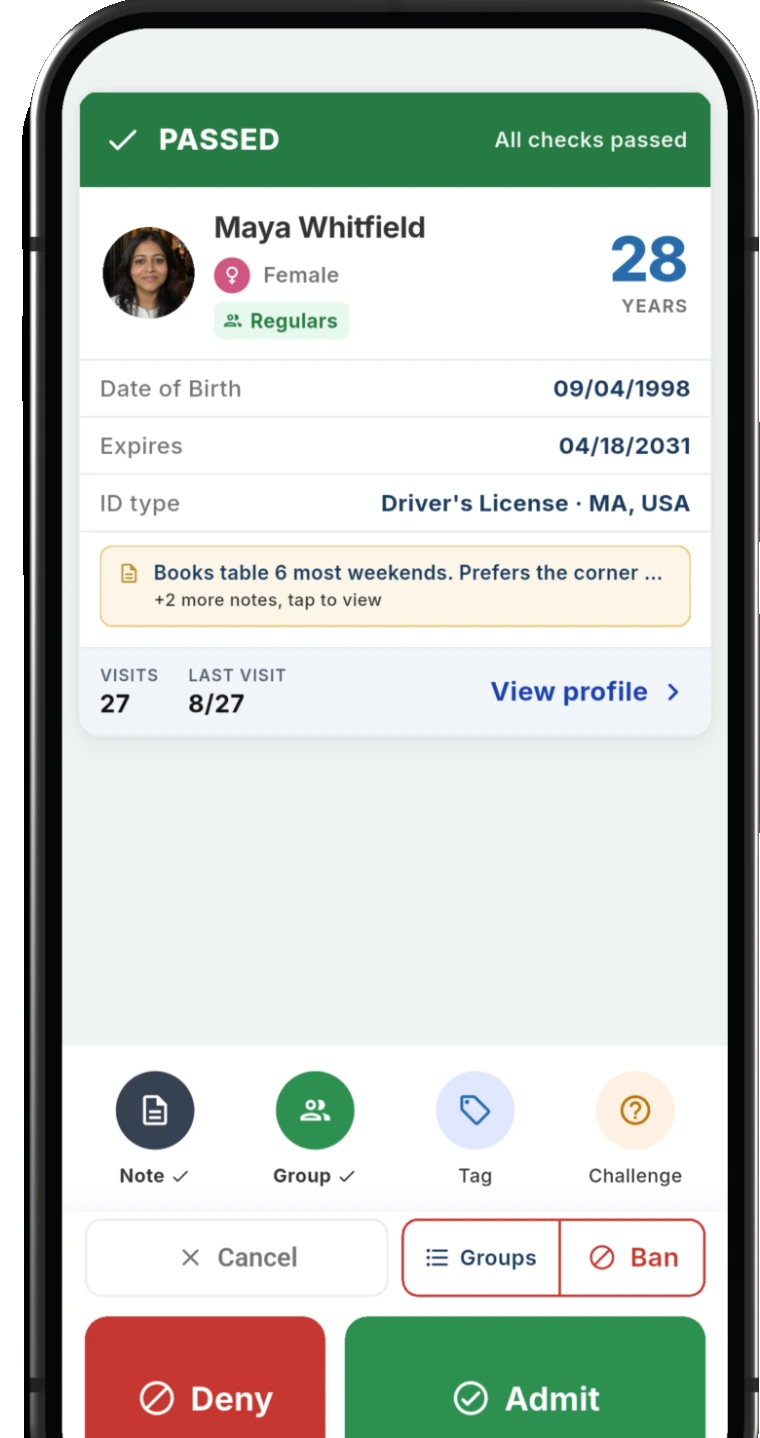
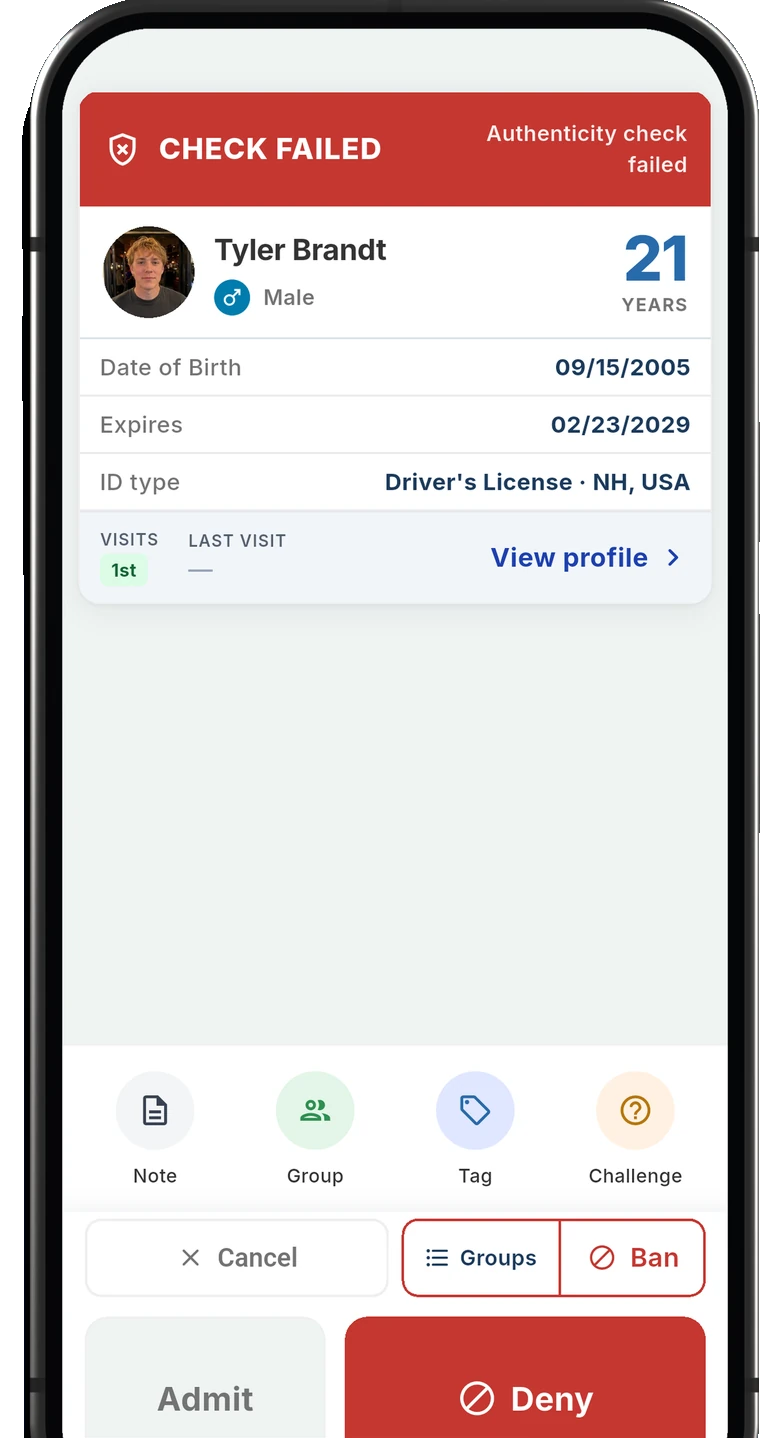
AgeShield ID Scanner
The age check, on every scanned ID
The app works out the guest's age from the date of birth and checks it against your venue's minimum, which starts at 21. Staff have no override for an underage result, and each scan is saved as a visit record.
Where Rule 141 comes from
Business and Professions Code section 25658 makes selling or serving alcohol to anyone under 21 a misdemeanor in California. Its subdivision (f) lets peace officers use people under 21 to catch licensees, their employees or agents and anyone else who sells to minors. The decoy is immune from prosecution for the purchase, and ABC has to adopt its decoy guidelines as regulations.
Rule 141 (California Code of Regulations, title 4, section 141) governs in-person sales. Alcohol delivery has its own rule, 141.1. How a decoy visit runs, and how California's rules compare with other states', is in how alcohol compliance checks and minor decoy stings work, and Texas is in how TABC stings work.
Cal. Bus. & Prof. Code s. 25658California ABC: Minor Decoy ProgramABC Appeals Board, California minor decoy law, Part 1: written law (training packet, July 10, 2026, PDF)
The five standards and what decisions have said about them
The rule opens with its purpose:
(a) A law enforcement agency may only use a person under the age of 21 years to attempt to purchase alcoholic beverages to apprehend licensees, or employees or agents of licensees who sell alcoholic beverages to minors (persons under the age of 21) and to reduce sales of alcoholic beverages to minors in a fashion that promotes fairness.
Subdivision (b) then sets five minimum standards for any case under section 25658 in which a minor decoy bought alcohol.
- Standard
- Age
- What Rule 141 says
- The decoy is under 20 at the time of the operation.
- What decisions have held
- The rule sets no lower age. ABC's penalty guidelines list the appearance and actual age of a minor as an aggravating factor, and in a 2025 delivery case under Rule 141.1 ABC added five days to the 25-day guideline, citing a recent prior violation and a 17-year-old decoy.
- Standard
- Appearance
- What Rule 141 says
- The decoy displays the appearance generally expected of someone under 21, under the actual circumstances the seller faced.
- What decisions have held
- Under ABC's precedential decision 19-02-E, a decoy who is under 20 is presumed to have that appearance, and the licensee has to bring actual evidence that they looked over 21 in the circumstances the seller faced. In January 2026 the Appeals Board held that the rule does not dictate how appearance is proved and does not require photos showing everything the decoy wore.
- Standard
- ID
- What Rule 141 says
- The decoy carries their own ID showing their correct date of birth, or none. A decoy with an ID shows it to any seller who asks.
- What decisions have held
- In two 2025 appeals the clerk asked for the decoy's California license, looked at it and completed the sale although it showed the decoy was 18 or 19. In one, the card was in the vertical format issued to people under 21.
- Standard
- Questions about age
- What Rule 141 says
- The decoy answers any question about their age truthfully.
- What decisions have held
- The Court of Appeal held in 2017 that this covers questions, not statements. A decoy who stayed silent after a clerk looked at his license and remarked that she would not have guessed it had not broken the rule.
- Standard
- Face-to-face identification
- What Rule 141 says
- After a sale, and no later than any citation, the officer makes a reasonable attempt to enter the premises and have the decoy identify the seller face to face.
- What decisions have held
- Where no attempt was made, the Court of Appeal reversed the discipline (1998). Later decisions held that the identification need not happen inside (2003) and has no set distance (2017). A citation is issued when the officer hands it over, not when it is filled in (ABC's reading, upheld by the Appeals Board in 2024).
The vertical format is covered in vertical IDs after 21.
ABC Appeals Board, California minor decoy law, Part 2: case law (training packet, August 14, 2026, PDF)Cal. Code Regs. tit. 4, § 141, Minor decoy requirements (LII)California ABC: Disciplinary guidelines (Rule 144 penalty guidelines)ABC Appeals Board, AB-10021, issued August 13, 2025 (PDF)California ABC, Precedential Decision 19-02-EABC Appeals Board, AB-10026, issued January 21, 2026 (PDF)ABC Appeals Board, AB-10015, issued May 15, 2025 (PDF)ABC Appeals Board, AB-10016, issued May 15, 2025 (PDF)California Court of Appeal, Dept. of ABC v. ABC Appeals Bd. (Garfield Beach CVS) (2017) 7 Cal.App.5th 628 (PDF)California Court of Appeal, Dept. of ABC v. ABC Appeals Bd. (CVS Tahoe) (2017) 18 Cal.App.5th 541 (PDF)ABC Appeals Board, AB-10004, issued November 14, 2024 (PDF)
The Rule 141(c) defense and who has to show it
(c) Failure to comply with this rule shall be a defense to any action brought pursuant to Business and Professions Code Section 25658.
The Appeals Board treats this as an affirmative defense, so the licensee carries the burden of showing that a standard was missed. In a 2024 appeal, a photo of the decoy and the clerk together showed the clerk holding a citation book with the top page filled in. The Board held that the photo alone did not show the citation had been issued before the identification and upheld a 25-day suspension.
Courts apply the rule strictly both ways. In 2017 the Court of Appeal held that the fairness named in subdivision (a) is secured by the five standards and that the Appeals Board has no power to add a defense the rule does not state. In January 2026 the Board put it this way:
Rule 141 must be strictly followed, and failure to comply with one of its express requirements is fatal to discipline. Conversely, when the regulation’s enumerated requirements are satisfied, the Board may not invalidate a minor decoy operation by imposing additional conditions not found in the rule.
ABC Appeals Board, AB-10004, issued November 14, 2024 (PDF)California Court of Appeal, Dept. of ABC v. ABC Appeals Bd. (Garfield Beach CVS) (2017) 7 Cal.App.5th 628 (PDF)ABC Appeals Board, AB-10026, issued January 21, 2026 (PDF)California ABC, Precedential Decision 19-02-E
What follows a sale to a decoy in California
In the cases below, officers cited the clerk who made the sale. Section 25658(f) gives the agency that ran the operation a notice duty: when a decoy sale leads to a citation, it tells the licensee and ABC within 72 hours, which it can do by leaving a written notice at the premises or mailing one. The duty is not limited to sales:
After the completion of every minor decoy program performed under this subdivision, the law enforcement agency using the decoy shall notify licensees within 72 hours of the results of the program.
An accusation for a sale to a minor has to be filed within one year. Rule 144 has ABC consider its published penalty guidelines in deciding the discipline, and the standard penalties, the hearing and the usual offer in compromise are in after a failed alcohol compliance check.
Two statutes shape repeat cases. For a second violation within 36 months, a licensee may petition for an offer in compromise however long the suspension, at half the estimated gross alcohol sales for each day, between $2,500 and $40,000. For a third within 36 months, no offer in compromise is allowed and ABC may revoke the license, counting only violations that have become final.
What recent appeals show
In May 2025 the Board upheld a 25-day suspension of a pharmacy's license for a second sale within 36 months and held that ABC did not have to find an ongoing risk at the store first. In January 2026 it upheld revoking a liquor store's license for a third sale within 36 months, with multiple earlier sales to minors on its record.
In another May 2025 appeal, a second pharmacy argued that one employee's mistake should not cost it a suspension. The Board answered with earlier court decisions:
[A] licensee can draw no protection from his lack of knowledge of violations committed by his employees or from the fact that he has taken reasonable precautions to prevent such violations.
Precautions can still affect the penalty: ABC's guidelines list documented training and positive action to correct a problem among mitigating factors. In that case ABC asked for 30 days instead of the standard 25, citing a second sale in 15 months, a register prompt reminding the clerk to check ID that she cleared (she had asked for the decoy's license and looked at it) and no evidence of steps taken after the earlier violation. The administrative law judge noted there was no evidence of the store's policies either way and proposed 25 days, and ABC adopted it.
Cal. Bus. & Prof. Code s. 25658Cal. Bus. & Prof. Code s. 24206California ABC: Disciplinary guidelines (Rule 144 penalty guidelines)Cal. Bus. & Prof. Code s. 23095Cal. Bus. & Prof. Code s. 25658.1ABC Appeals Board, AB-10016, issued May 15, 2025 (PDF)ABC Appeals Board, AB-10026, issued January 21, 2026 (PDF)ABC Appeals Board, AB-10015, issued May 15, 2025 (PDF)
How California's ID defense sits next to a decoy
California's ID defense in section 25660 applies when the licensee or an employee or agent asked for, was shown and acted in reliance on a qualifying ID, or used a qualifying biometric system, as the California ID scanning guide sets out. Under Rule 141, a decoy who carries an ID carries their own, showing their correct date of birth, and a decoy asked their age answers truthfully.
Cal. Bus. & Prof. Code s. 25660Cal. Code Regs. tit. 4, § 141, Minor decoy requirements (LII)
Where a scan fits
Neither Rule 141 nor section 25658 depends on a scanner, and under the May 2025 decision quoted above a licensee can be held responsible for an employee's sale whatever precautions it took. What a scan can do is catch the age. A decoy's own ID shows their real date of birth, AgeShield checks the age against the venue's minimum age (21 unless the owner changes it) and staff cannot override an underage result.
When a decoy carries no ID, the app has nothing to read. Asking every guest for ID remains the first step of the door routine. Each scan is saved as a visit record of who scanned, when, the document type, the result and what staff decided; how a scan works shows every result the phone can give.
Four emails a year
What changed in ID law, before it takes effect
Many state rules on IDs and age checks take effect on January 1 or July 1. Each quarter we send one short summary of the changes we found, with the source for every line, starting with the states you pick.
Common questions
Can a 20-year-old be a minor decoy in California?
Section 25658(f) lets peace officers use people under 21, but Rule 141 sets under 20 at the time of the operation as a minimum standard for an in-person case under section 25658. An operation that misses it gives the licensee a defense.
Does a decoy have to correct a clerk who gets their age wrong?
No. In 2017 the Court of Appeal held that Rule 141 requires truthful answers to questions about age, not a reply to a clerk's statement. In that case the clerk looked at the decoy's license, remarked that she would not have guessed it and sold the beer while the decoy said nothing.
How soon is a California licensee told about a decoy operation?
Within 72 hours after a decoy program is completed, the law enforcement agency that ran it tells licensees the results. When a decoy sale leads to a citation, it tells the licensee and ABC within 72 hours of the citation, and it can do so by leaving a written notice at the premises or mailing one.
Does Rule 141 apply to alcohol delivery?
Delivery decoys have their own rule, 141.1, which sets four standards: the decoy is under 20, has the appearance generally expected of someone under 21 in the circumstances the person delivering faced, carries their own ID or none and shows it on request and truthfully answers that person's questions about age at delivery. It has no face-to-face identification standard.
Is staff training a defense to a sale to a decoy?
Not to the violation itself. The Appeals Board has held, citing earlier court decisions, that a licensee can be held responsible for an employee's sale even after taking reasonable precautions. ABC's penalty guidelines list documented training of the licensee and employees among mitigating factors, which can bear on the penalty.
Sources
- Cal. Bus. & Prof. Code s. 25658
- California ABC: Minor Decoy Program
- ABC Appeals Board, California minor decoy law, Part 1: written law (training packet, July 10, 2026, PDF)
- ABC Appeals Board, California minor decoy law, Part 2: case law (training packet, August 14, 2026, PDF)
- Cal. Code Regs. tit. 4, § 141, Minor decoy requirements (LII)
- California ABC: Disciplinary guidelines (Rule 144 penalty guidelines)
- ABC Appeals Board, AB-10021, issued August 13, 2025 (PDF)
- California ABC, Precedential Decision 19-02-E
- ABC Appeals Board, AB-10026, issued January 21, 2026 (PDF)
- ABC Appeals Board, AB-10015, issued May 15, 2025 (PDF)
- ABC Appeals Board, AB-10016, issued May 15, 2025 (PDF)
- California Court of Appeal, Dept. of ABC v. ABC Appeals Bd. (Garfield Beach CVS) (2017) 7 Cal.App.5th 628 (PDF)
- California Court of Appeal, Dept. of ABC v. ABC Appeals Bd. (CVS Tahoe) (2017) 18 Cal.App.5th 541 (PDF)
- ABC Appeals Board, AB-10004, issued November 14, 2024 (PDF)
- Cal. Bus. & Prof. Code s. 24206
- Cal. Bus. & Prof. Code s. 23095
- Cal. Bus. & Prof. Code s. 25658.1
- Cal. Bus. & Prof. Code s. 25660
This page is for informational purposes only and is not a substitute for professional legal advice. We research each rule and link its source, so you can check it against your own venue. Questions are welcome at support@ageshield.bar.
Questions about decoy operations in California?
Tell us what type of venue you run and we'll point you to the published rules we know of that may apply.