Compliance checks and penalties
How alcohol compliance checks and minor decoy stings work
Published October 27, 2026 · 15 sources linked
How does an alcohol sting work?
A person under 21, working with the state alcohol agency or the police, tries to buy alcohol while officers supervise. Each state sets its own decoy rules: California's regulation requires a decoy under 20 who looks under 21, carries their own ID or none and answers truthfully about their age, while Colorado's model guidelines let a decoy who shows a valid ID lie about their age. What follows the attempt varies too, from a face-to-face identification of the seller in California to an officer telling the cashier and the owner or manager in Utah.
Decoy rules at a glance
- How old the decoy is
- Under 20 in California; 18 to 20 in Oregon's and Washington's programs
- What ID the decoy carries
- Their own ID or none in California and Colorado; a state-supplied ID showing their true age in Utah
- If staff ask their age
- A truthful answer in California; Colorado's model guidelines allow a lie
- Who gets told afterwards
- In Utah, the cashier and the owner or manager, after any attempt; in Illinois, a venue that passed, within 30 days
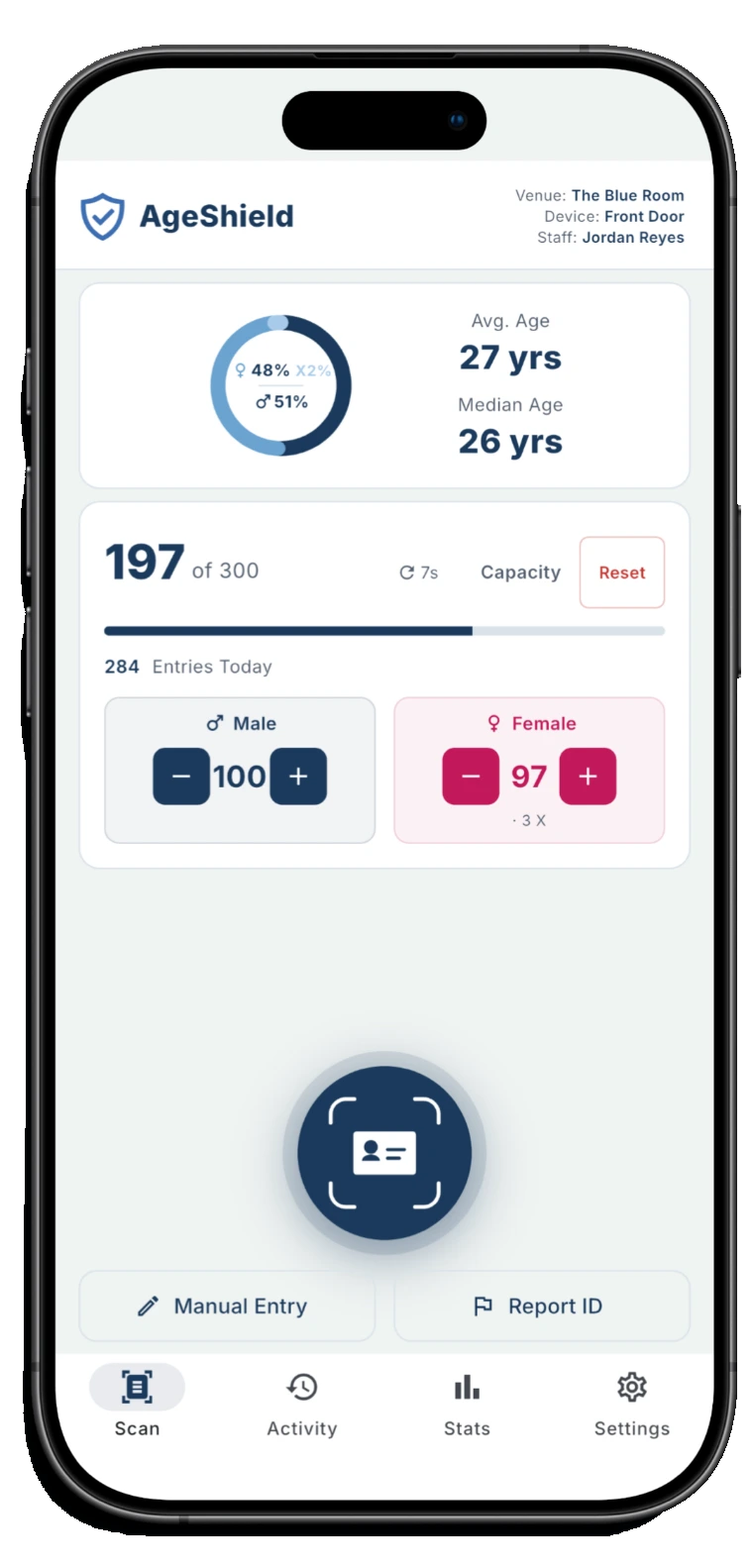
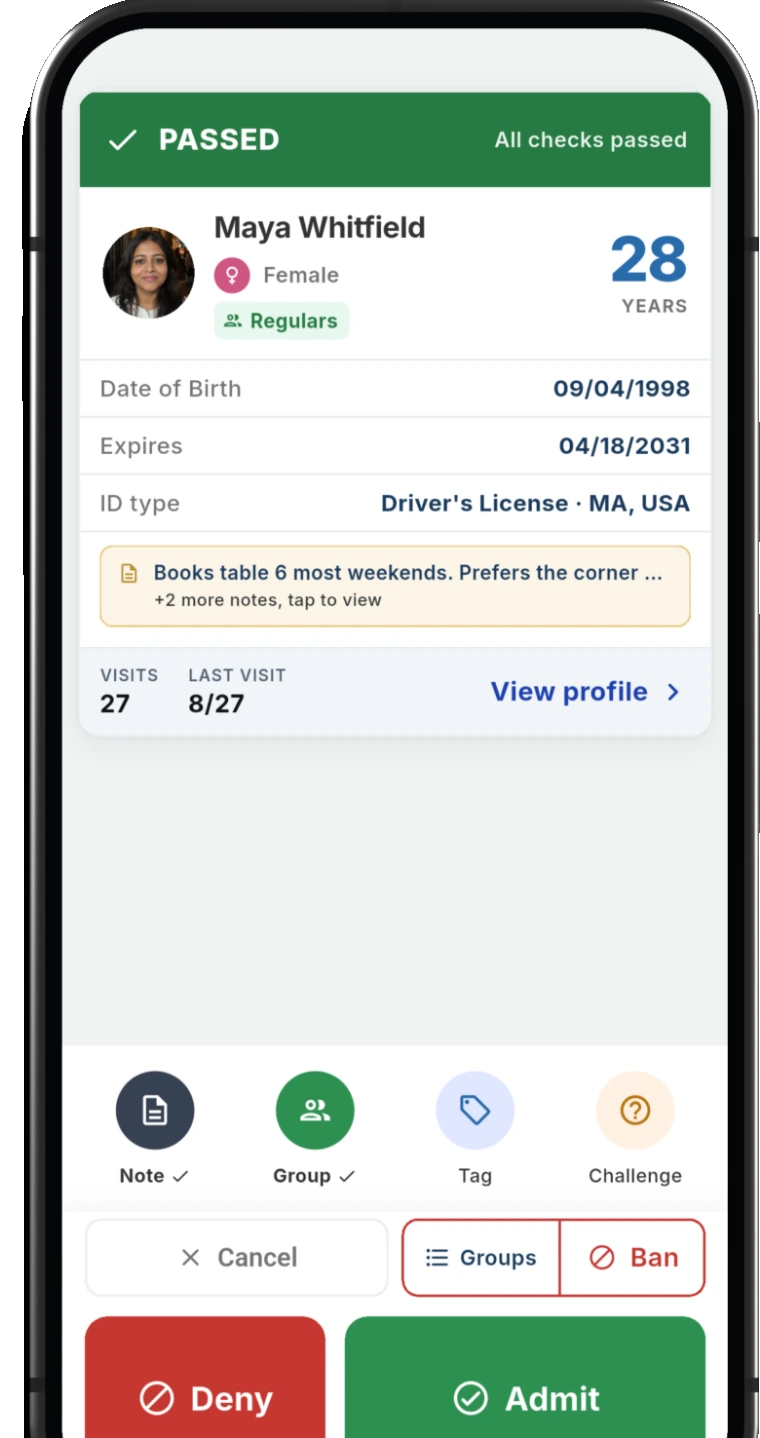
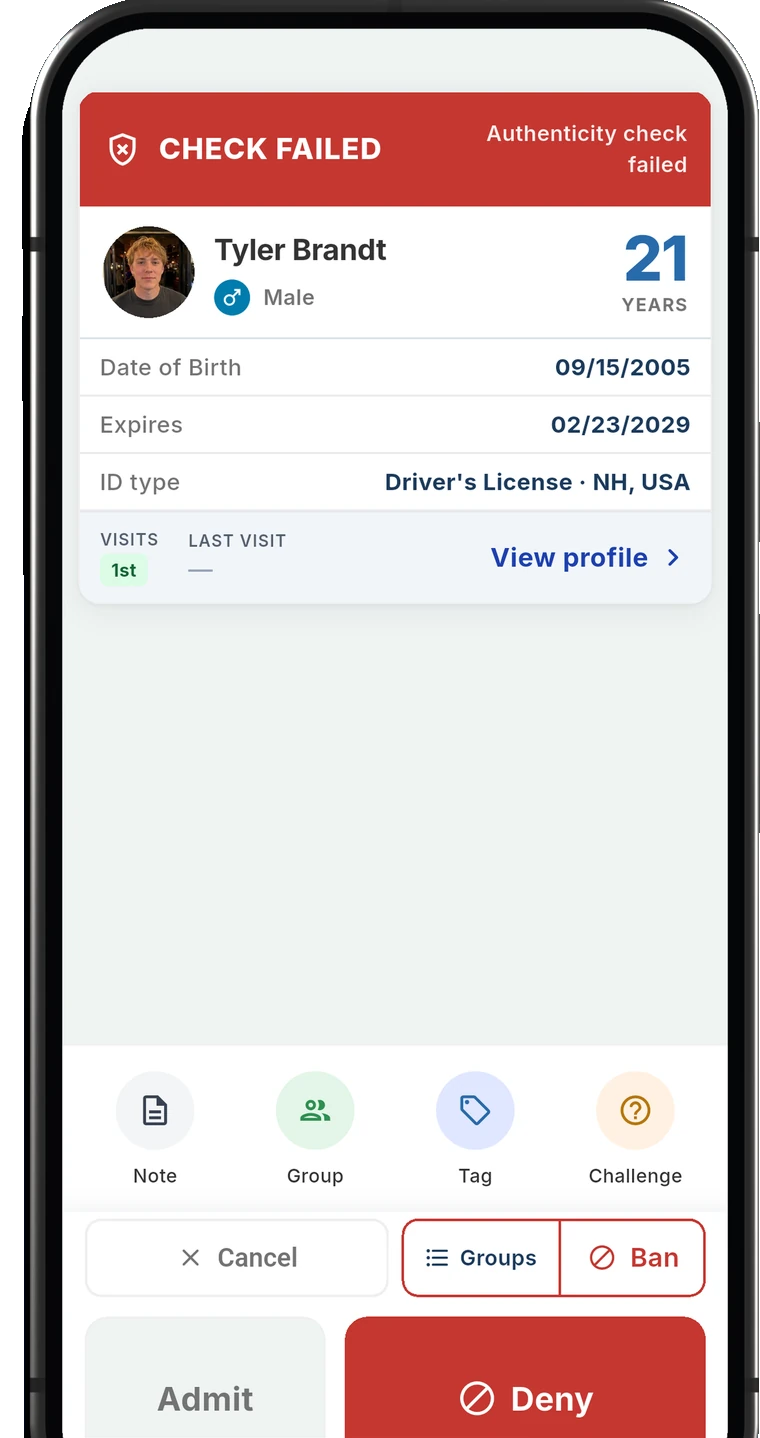
AgeShield ID Scanner
The age math, done on every scan
The app works out the guest's age from the date of birth and checks it against your venue's minimum, which starts at 21. Each scan is saved as a visit record of who scanned, when, the result and what staff decided.
How a compliance check runs
A compliance check, also called a minor decoy operation or sting, tests whether staff sell or serve alcohol to someone under 21. In California, local police and the state's Department of Alcoholic Beverage Control (ABC) both use decoys, and in Oregon and Washington the state agency uses its own.
Illinois's model policy for police describes the visit. The decoy enters alone and should not look as if they are with adults or officers, while an officer watches from inside or from where the sale can be seen. In a bar, the observing officer smells the drink served to confirm it is alcohol, and the decoy does not drink it.
What follows a sale is covered in after a failed alcohol compliance check, and federal tobacco checks in what happens in an FDA tobacco compliance check.
California ABC: Minor Decoy ProgramOregon Liquor and Cannabis Commission: Minor Decoy OperationsWashington State Liquor and Cannabis Board: Retail enforcementIllinois Law Enforcement Training and Standards Board, Model policy and guidelines for alcohol and tobacco compliance checks, revised 2006 (PDF)
Who the decoy is and what ID they carry
- State
- California
- Age and appearance
- Under 20; the appearance generally expected of someone under 21
- ID carried
- Their own ID showing their correct date of birth, or none; shown on request
- If asked their age
- Answers truthfully
- State
- Oregon
- Age and appearance
- Under 21 and looks under 26; OLCC's own decoys are 18 to 20
- ID carried
- No false ID
- If asked their age
- May not lie about their age
- State
- Washington
- Age and appearance
- 18 to 20
- ID carried
- Their real ID
- If asked their age
- Not stated on the board's page
- State
- Utah
- Age and appearance
- Under 21; a parent's written consent if under 18
- ID carried
- May use an ID provided by the Department of Public Safety that shows their true age and a current photo, which the statute calls false identification
- If asked their age
- Not addressed in the statute
- State
- Colorado
- Age and appearance
- 18 to 20 and six months, with no age enhancements
- ID carried
- Their own valid ID or none
- If asked their age
- May lie; without an ID, gives an excuse such as having lost it
- State
- Illinois
- Age and appearance
- 18 to 20, dressed for their age, appearance not altered
- ID carried
- A valid state-issued ID or none, never a fake
- If asked their age
- Answers truthfully
California's, Oregon's and Utah's rows are binding rules. Washington's describes the board's own program. Colorado's and Illinois's are model guidelines the state published for local police, which local agencies can adapt.
Cal. Code Regs. tit. 4, § 141, Minor decoy requirements (LII)California ABC: Minor Decoy ProgramOAR 845-009-0200, Uniform standards for minor decoy operations (Oregon Secretary of State)Oregon Liquor and Cannabis Commission: Minor Decoy OperationsWashington State Liquor and Cannabis Board: Retail enforcementUtah Code 77-39-101, Investigation of sales to underage individualsColorado Liquor & Tobacco Enforcement Division, Model guidelines concerning compliance checks for underage alcohol sales, 2013 (PDF)Illinois Law Enforcement Training and Standards Board, Model policy and guidelines for alcohol and tobacco compliance checks, revised 2006 (PDF)
Oregon's rule also has licensees and their staff return an ID the decoy presented immediately when police or an OLCC representative ask for it.
California's regulation sets the appearance test this way:
The decoy shall display the appearance which could generally be expected of a person under 21 years of age, under the actual circumstances presented to the seller of alcoholic beverages at the time of the alleged offense.
In a January 2026 appeal, a liquor store argued that the decoy wore a baseball cap the photos in evidence did not show. The Appeals Board upheld the decision against it.
Colorado's guidelines differ: a decoy who shows a valid ID may still claim to be older, for this reason:
This demonstrates whether the seller is relying upon the valid ID presented or a verbal representation of age.
California ABC Appeals Board, AB-10026, issued January 21, 2026 (PDF)
Which venues get checked
Some states limit how venues are selected. Oregon's statute and OLCC's rule require decoy operations in cities of 20,000 or more to be random or targeted. Random checks give every licensee as equal a chance as possible, and a targeted check needs a documented compliance problem at that venue. Utah's law allows random attempts to buy alcohol at one location no more than four times in 12 months, unless the supervising officer writes down a reasonable suspicion that the venue sold to someone under 21.
Colorado's guidelines describe checks after a complaint or at random, and recommend not rechecking a venue that passed at unreasonably short intervals.
ORS 471.346, Uniform standards for minor decoy operationsOAR 845-009-0200, Uniform standards for minor decoy operations (Oregon Secretary of State)Utah Code 77-39-101, Investigation of sales to underage individualsColorado Liquor & Tobacco Enforcement Division, Model guidelines concerning compliance checks for underage alcohol sales, 2013 (PDF)
What the venue is told, before and after
Some programs announce themselves in general terms. California's ABC strongly encourages police to notify all licensees by letter "of the results of a pending Decoy Program" and to consider telling the local media. Illinois's model policy suggests news releases and letters to merchants, including congratulatory ones after a refused sale.
California
After a sale, and no later than any citation, the officer directing the decoy makes a reasonable attempt to bring the decoy back in to identify the seller face to face. ABC says the decoy and the seller should then be photographed together.
Utah
Right after any attempt (sale or not) or as soon as practical, the officer tells the cashier and the owner or manager that the buyer was under age. Any citation has to be issued within seven days, and the officer writes a report with a photo of how the decoy looked.
Colorado
The guidelines have the seller told the same day, a criminal summons served within three days and the licensee told within 14 days if administrative action will follow.
Illinois
State law requires that a venue found to have complied be told within 30 days that no violation was found. The model policy has the officer explain any violation to the manager on site.
California ABC: Minor Decoy ProgramCal. Code Regs. tit. 4, § 141, Minor decoy requirements (LII)Utah Code 77-39-101, Investigation of sales to underage individualsColorado Liquor & Tobacco Enforcement Division, Model guidelines concerning compliance checks for underage alcohol sales, 2013 (PDF)235 ILCS 5/6-16.1, Enforcement actionsIllinois Law Enforcement Training and Standards Board, Model policy and guidelines for alcohol and tobacco compliance checks, revised 2006 (PDF)
When a check does not follow the rules
California's regulation says that failure to comply with it is a defense to any action brought under the state's law on sales to minors. Oregon's law takes a different line: a departure from the state's standards is not grounds to challenge a complaint, citation or conviction, but the commission may not consider a sale from such an operation when imposing a civil penalty, deciding on the renewal, suspension or cancellation of the license or otherwise sanctioning the licensee.
Cal. Code Regs. tit. 4, § 141, Minor decoy requirements (LII)California ABC Appeals Board, AB-10026, issued January 21, 2026 (PDF)ORS 471.346, Uniform standards for minor decoy operations
Can a venue run its own decoy checks?
In some states, yes, with conditions. Washington allows in-house programs with the board's prior written approval of a written plan. The buyers are at least 18, use no fraudulent ID and should not look deceptively mature, and the venue takes two photos of each on the day. A first failure cannot be the only reason an employee is fired, and results cannot be used for criminal or administrative prosecution.
Oregon's rule has a licensee testing its own staff use a decoy who meets the state's standards and give OLCC and the local police at least 24 hours' notice, with the decoy's name, date of birth and a current photo. Illinois lets a licensee run a sting on its own staff after giving written notice at least 14 days ahead to the police, the local liquor control commissioner or both. Michigan exempts the underage buyer in an employer-sponsored check that the local prosecutor's office approved in advance.
RCW 66.44.290WAC 314-21-015WAC 314-21-025OAR 845-009-0200, Uniform standards for minor decoy operations (Oregon Secretary of State)235 ILCS 5/6-16.1, Enforcement actionsMCL 436.1703
Where a scan fits
Where the rules above address the decoy's ID, it shows their true age. If staff ask for the ID and scan it, the app works out the age from the date of birth and checks it against the venue's minimum age, which is 21 unless the owner changes it. Staff have no override for an underage result. The underage flag only goes away if the owner switches on Allow Underage Entry for that venue, which is off by default.
A decoy who carries no ID never reaches the scanner, so the check still depends on staff asking every time, as in how to check IDs at the door. Every scan creates a visit record of who scanned, when, the document type, the result and what staff decided, as how a scan works shows.
AgeShield ID Scanner
An age check on every scanned ID
AgeShield ID Scanner runs on the iPhones and Android phones staff already carry, with three devices on all plans. A scan checks the date of birth against the venue's minimum age, which starts at 21. Every scan creates a visit record of who scanned, when, the result and what staff decided.
Common questions
Do bars get warned before a sting?
None of the rules above gives a venue notice of a particular visit. Some programs are announced in general terms: California's ABC encourages police to write to licensees and tell the local media about a decoy program, and Illinois's model policy suggests news releases.
Can an underage decoy lie about their age?
It depends on the state. California's regulation and Illinois's model policy have the decoy answer truthfully, and Oregon's rule says the decoy may not lie about their age. Colorado's model guidelines let a decoy who has shown a valid ID claim to be older.
Is a minor decoy sting entrapment?
Not in California. ABC says the California Supreme Court ruled in 1994 that using minor decoys was not entrapment and did not violate due process.
Does the decoy drink what they are served?
No. Colorado's guidelines say the decoy may not drink alcohol under any circumstances, and Illinois's model policy says the decoy must not drink it and has the observing officer smell it to confirm it is alcohol.
Can a bar use its own underage testers?
In Washington, with the board's prior written approval; in Oregon, after 24 hours' notice to OLCC and the local police; in Illinois, after 14 days' written notice to the police or the local liquor control commissioner. Michigan exempts the young buyer from its minor-purchase offense when the local prosecutor's office approved the employer's operation in advance. Washington's results cannot be used to prosecute the venue.
Sources
- California ABC: Minor Decoy Program
- Oregon Liquor and Cannabis Commission: Minor Decoy Operations
- Washington State Liquor and Cannabis Board: Retail enforcement
- Illinois Law Enforcement Training and Standards Board, Model policy and guidelines for alcohol and tobacco compliance checks, revised 2006 (PDF)
- California ABC Appeals Board, AB-10026, issued January 21, 2026 (PDF)
- Cal. Code Regs. tit. 4, § 141, Minor decoy requirements (LII)
- OAR 845-009-0200, Uniform standards for minor decoy operations (Oregon Secretary of State)
- Utah Code 77-39-101, Investigation of sales to underage individuals
- Colorado Liquor & Tobacco Enforcement Division, Model guidelines concerning compliance checks for underage alcohol sales, 2013 (PDF)
- ORS 471.346, Uniform standards for minor decoy operations
- 235 ILCS 5/6-16.1, Enforcement actions
- RCW 66.44.290
- WAC 314-21-015
- WAC 314-21-025
- MCL 436.1703
This page is for informational purposes only and is not a substitute for professional legal advice. We research each rule and link its source, so you can check it against your own venue. Questions are welcome at support@ageshield.bar.
Questions about compliance checks in your state?
Tell us what type of venue you run and we'll point you to the published rules we know of that may apply.