Compliance checks and penalties
Selling alcohol to a minor in Texas: what the license holder faces
Published November 9, 2026 · 13 sources linked
What happens to a Texas license or permit after a sale to a minor?
A sale to a minor can bring two cases: TABC may pursue the license or permit, while the seller may face a Class A misdemeanor charge. For a first violation, the statute allows cancellation or a suspension of up to 90 days and TABC's standard penalty is eight to 12 days, with a civil penalty in its place only if TABC offers one. Under section 106.14, a staff member's sale is not held against a business that requires TABC-approved seller training, if the employee attended it and the business did not encourage the violation.
What a first sale to a minor can cost in Texas
- The business, under TABC's standard chart
- An eight- to 12-day suspension
- The business, at most
- A suspension of up to 90 days, or cancellation of the license or permit
- Paying instead of a suspension
- Only if TABC offers it, at $150 to $25,000 a day
- The employee who sold
- A Class A misdemeanor charge, and 30 days to recertify if they hold a TABC certificate
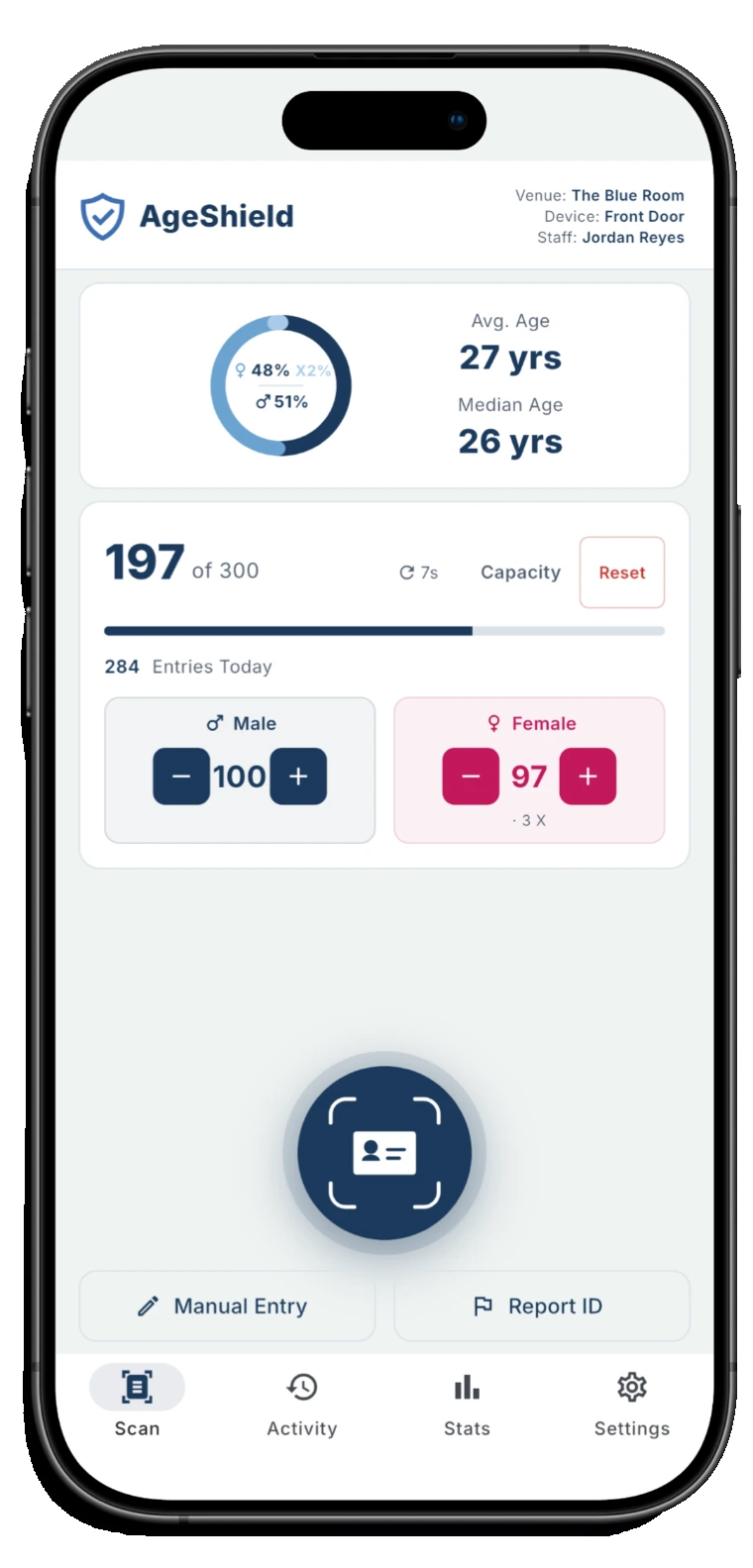
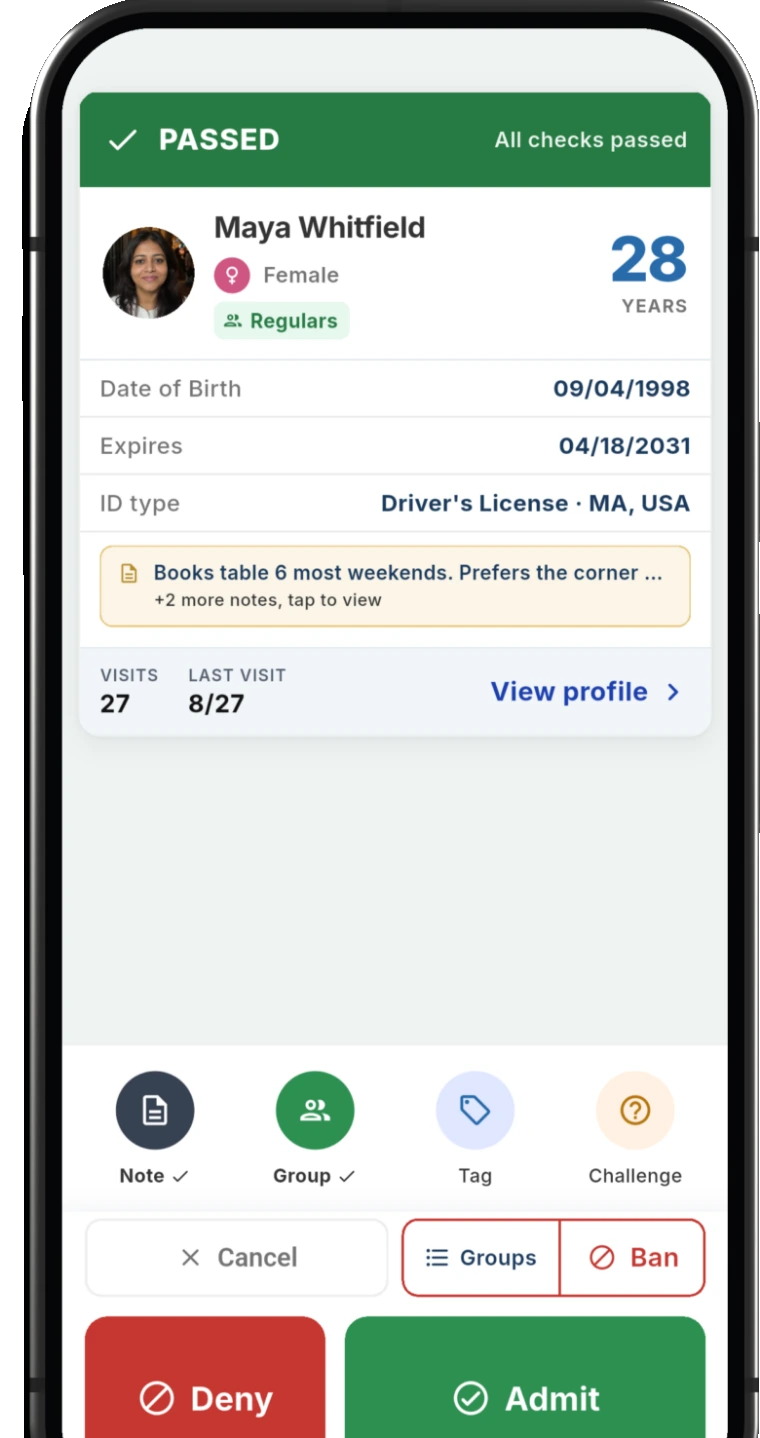
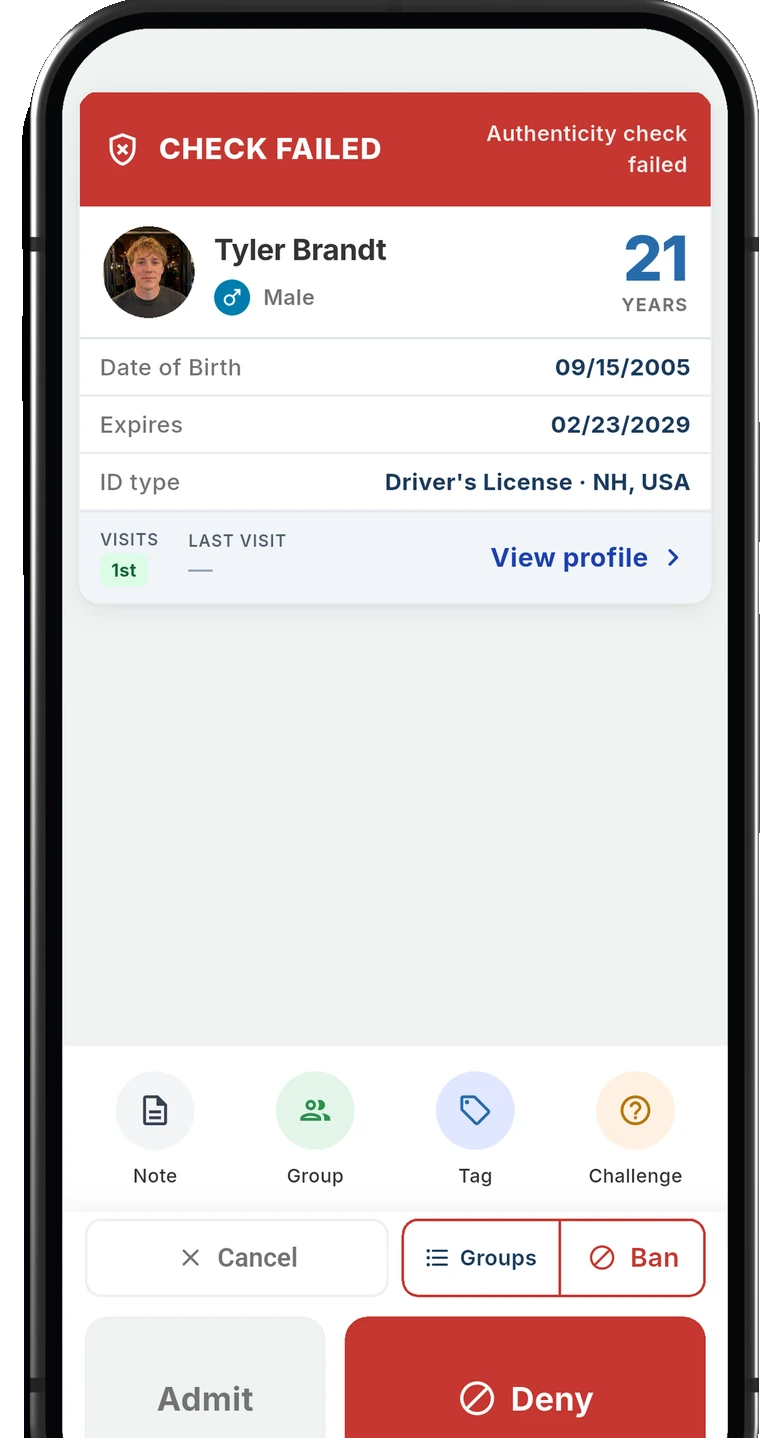
AgeShield ID Scanner
Every scan checked against your minimum age
The app flags expired IDs and checks the date of birth against your venue's minimum age, which starts at 21. No scanner catches every fake, so your staff still make the call.
Two cases from one sale
One sale can produce two cases: TABC's administrative action against the license or permit and criminal charges against the seller, often prosecuted by a county attorney, according to TABC.
TABC sting procedures are covered in TABC stings: how they work, and the notice and the first month in after a failed alcohol compliance check. A sale to a minor is also a public safety violation, which puts the business on TABC's priority list for additional inspections over the next six months.
TABC: ViolationsTABC Administrative Rules, 16 TAC 34.1, 34.2, 34.4, 34.20, 35.3 and 50.31 (TABC, PDF)
What the license or permit can lose
Section 106.13 of the Alcoholic Beverage Code sets the limits on sanctions when TABC finds, after notice and a hearing, that a retail license or permit holder sold alcohol to a minor with criminal negligence. TABC's penalty chart in 16 TAC 34.2 sets the standard sanction it works from.
- Violation
- First
- Most the statute allows
- Cancellation, or a suspension of up to 90 days
- TABC's standard sanction
- Eight to 12 days of suspension
- Violation
- Second
- Most the statute allows
- Cancellation, or a suspension of up to six months
- TABC's standard sanction
- 16 to 24 days' suspension
- Violation
- Third
- Most the statute allows
- Within 36 consecutive months: cancellation, or a suspension of up to 12 months
- TABC's standard sanction
- 48 days' suspension up to cancellation
The chart was last amended effective June 6, 2022. TABC's September 2026 proposal keeps this row. Where a case is contested or referred to TABC's legal division, the chart is a guideline that does not bind TABC.
Texas Alcoholic Beverage Code 106.13TABC Administrative Rules, 16 TAC 34.1, 34.2, 34.4, 34.20, 35.3 and 50.31 (TABC, PDF)TABC Public Safety Penalty Chart, 16 TAC 34.2 (PDF)TABC, proposed amendments to 16 TAC 34.1 to 34.20, September 2026 (PDF)
TABC's rule applies the higher row to a repeat within 36 months of an earlier violation for which the business received written notice, and to a repeat involving covert investigative activities. A settlement off the chart, for aggravating or mitigating circumstances, needs the approval of TABC's executive director or a designee before it is offered.
Texas Alcoholic Beverage Code 106.13TABC Administrative Rules, 16 TAC 34.1, 34.2, 34.4, 34.20, 35.3 and 50.31 (TABC, PDF)
Paying a civil penalty instead of a suspension
Section 11.64 generally has TABC offer a civil penalty in place of a suspension, but a sale to a minor is a listed exception: TABC decides whether the business gets that option at all.
When the option is offered, TABC's chart attaches $300 to each day of suspension. The statute allows anywhere from $150 to $25,000 for each day the suspension would have run, and if the business does not pay before the sixth day after TABC tells it the amount, the suspension is imposed. TABC can also split a sanction between a civil penalty and days of suspension.
In deciding whether to offer it, TABC's rule has it consider:
- The type of license or permit
- The violation charged
- The business's record of past violations, including their number, type and frequency
- The date the license or permit was issued
It may also weigh other circumstances, among them whether the violation was intentional or reckless and what the business has done to fix the problem and prevent another.
Texas Alcoholic Beverage Code 11.64TABC Administrative Rules, 16 TAC 34.1, 34.2, 34.4, 34.20, 35.3 and 50.31 (TABC, PDF)TABC Public Safety Penalty Chart, 16 TAC 34.2 (PDF)
When TABC can lighten the sanction
Section 106.13 lets TABC relax its suspension and cancellation rules and impose the sanction it finds just if, at a hearing, the business establishes one of three things:
- The violation could not reasonably have been prevented by the exercise of due diligence
- The business was entrapped
- An agent, servant or employee broke the law without the business's knowledge
Section 11.64 repeats those grounds and adds three: the business did not knowingly violate the code, it has shown good faith, including action to put the violation right and deter others, or the violation was technical. On any of the six, TABC can also reinstate a suspended license or permit early for a fee of $75 to $500.
Texas Alcoholic Beverage Code 106.13Texas Alcoholic Beverage Code 11.64
When an employee's sale does not count against the business
Section 106.14 says an employee's actions are not attributable to the employer when the employer requires its employees to attend a TABC-approved seller training program, the employee has actually attended one and the employer has not directly or indirectly encouraged the violation. How TABC's rule applies those conditions, from a current certificate to written policies, staff records and repeat sales, is set out in the TABC stings guide.
A business claims the protection through an affidavit to TABC within 10 days of receiving the administrative notice, stating that the conditions were met at the time of the sale. TABC's certification FAQ adds that the owner or manager supplies every employee's name, Social Security number and date of birth so TABC can check certification, and that the relief does not cover a sale by the owner or an officer of the company.
Texas Alcoholic Beverage Code 106.14TABC Administrative Rules, 16 TAC 34.1, 34.2, 34.4, 34.20, 35.3 and 50.31 (TABC, PDF)TABC: Certification FAQsTABC: Code and rulesTABC, proposed amendments to 16 TAC 34.1 to 34.20, September 2026 (PDF)
The seller's own case
Section 106.03 makes selling alcohol to a minor with criminal negligence a Class A misdemeanor, punishable by a fine of up to $4,000, up to a year in jail or both. The charge belongs to the seller: TABC's certification FAQ notes that even where the business's permit is protected, the seller will probably be arrested.
Section 106.03(b) gives the seller a defense:
A person who sells a minor an alcoholic beverage does not commit an offense if the minor falsely represents himself to be 21 years old or older by displaying an apparently valid proof of identification that contains a physical description and photograph consistent with the minor's appearance, purports to establish that the minor is 21 years of age or older, and was issued by a governmental agency.
The statute says that ID may include a Texas driver's license or ID card, a passport or a military ID. Subsection (d) takes the defense away from a seller whose scan under section 109.61 identified the license or ID card as invalid.
A certified seller's TABC certificate is also at stake. After a sale to a minor, the holder has 30 days to recertify by completing an approved course and passing TABC's test, or TABC may revoke the certificate. A second sale to a minor or an intoxicated person within 12 months can bring revocation with no recertification for 90 days, and a third, for a year.
Texas Alcoholic Beverage Code 106.03Texas Penal Code 12.21TABC: Underage drinkingTABC: Certification FAQsTABC Administrative Rules, 16 TAC 34.1, 34.2, 34.4, 34.20, 35.3 and 50.31 (TABC, PDF)
Where an ID scan comes in
Section 109.61 gives a seller and a store owner defenses to prosecution that turn on a transaction scan device, and those defenses do not apply in an action against the license or permit, except as TABC's rules provide. Retailers covered by Texas's off-premises scanning requirement have a separate protection: TABC may not discipline them for a sale to a minor if they scanned the ID as required and the device identified it as valid and the buyer as 21 or older. The TABC stings guide sets out each defense, and the Texas ID scanning guide covers which permits the requirement reaches.
AgeShield checks the date of birth on each scanned ID against the venue's minimum age, which starts at 21, flags expired IDs and checks the barcode on US and Canadian licenses and state IDs for signs of forgery, as what an AgeShield scan checks sets out. No scanner catches every fake, so staff still make the call.
Texas Alcoholic Beverage Code 109.61Texas Alcoholic Beverage Code 106.03
Four emails a year
What changed in ID law, before it takes effect
Many state rules on IDs and age checks take effect on January 1 or July 1. Each quarter we send one short summary of the changes we found, with the source for every line, starting with the states you pick.
Common questions
What is the fine for selling alcohol to a minor in Texas?
For the person who made the sale, up to $4,000, with up to a year in jail possible as well, since the offense is a Class A misdemeanor. For the business, a payment replaces a suspension only if TABC offers it: $300 for each day of suspension in TABC's chart, within the statute's range of $150 to $25,000 a day.
Can TABC cancel a permit after one sale to a minor?
The statute allows it. For a first violation TABC can cancel a retail license or permit or suspend it for up to 90 days. TABC's penalty chart sets a standard suspension of eight to 12 days for a first sale, and cancellation first appears in the chart at a third violation.
Does a clerk lose their TABC certification after selling to a minor?
Not automatically. The clerk has 30 days to recertify, and TABC may revoke the certificate if they do not. A second sale to a minor or an intoxicated person within 12 months can bring revocation and a 90-day wait to recertify, and a third, a one-year wait.
What if the minor used a fake ID?
In the criminal case, the seller has a defense if the minor showed an apparently valid government-issued ID, with a photo and description matching them, that said they were 21 or older, unless a scan under section 109.61 identified the ID as invalid. In the case against the license, TABC can relax the sanction if the business shows the sale could not reasonably have been prevented by the exercise of due diligence.
Sources
- TABC: Violations
- TABC Administrative Rules, 16 TAC 34.1, 34.2, 34.4, 34.20, 35.3 and 50.31 (TABC, PDF)
- Texas Alcoholic Beverage Code 106.13
- TABC Public Safety Penalty Chart, 16 TAC 34.2 (PDF)
- TABC, proposed amendments to 16 TAC 34.1 to 34.20, September 2026 (PDF)
- Texas Alcoholic Beverage Code 11.64
- Texas Alcoholic Beverage Code 106.14
- TABC: Certification FAQs
- TABC: Code and rules
- Texas Alcoholic Beverage Code 106.03
- Texas Penal Code 12.21
- TABC: Underage drinking
- Texas Alcoholic Beverage Code 109.61
This page is for informational purposes only and is not a substitute for professional legal advice. We research each rule and link its source, so you can check it against your own venue. Questions are welcome at support@ageshield.bar.
Questions about a Texas sale to a minor?
Tell us what type of venue you run and we'll point you to the published rules we know of that may apply.