
Which IDs a bar can accept
Can you refuse to have your ID scanned at a bar?
Published November 25, 2026 · 14 sources linked
The short answer
It depends on the state. Florida allows manual collection when a guest declines a scan and bars withholding goods or services solely because the guest requested that; Georgia makes scanning a card without the person's prior knowledge and consent a misdemeanor; Utah and South Carolina require a scan at the door of certain venues. Where the law is silent, the venue's entry policy decides what happens when a guest declines, subject to other laws, including those against discrimination.
Declining a scan at a glance
- Details taken by hand on request
- Florida
- Consent before the card is read
- Georgia; in Alaska, consent or legal authority
- A scan required at the door
- Utah bars and taverns, and South Carolina venues selling alcohol for drinking on site between midnight and 4 a.m.
- Where the law is silent
- The venue's entry policy decides
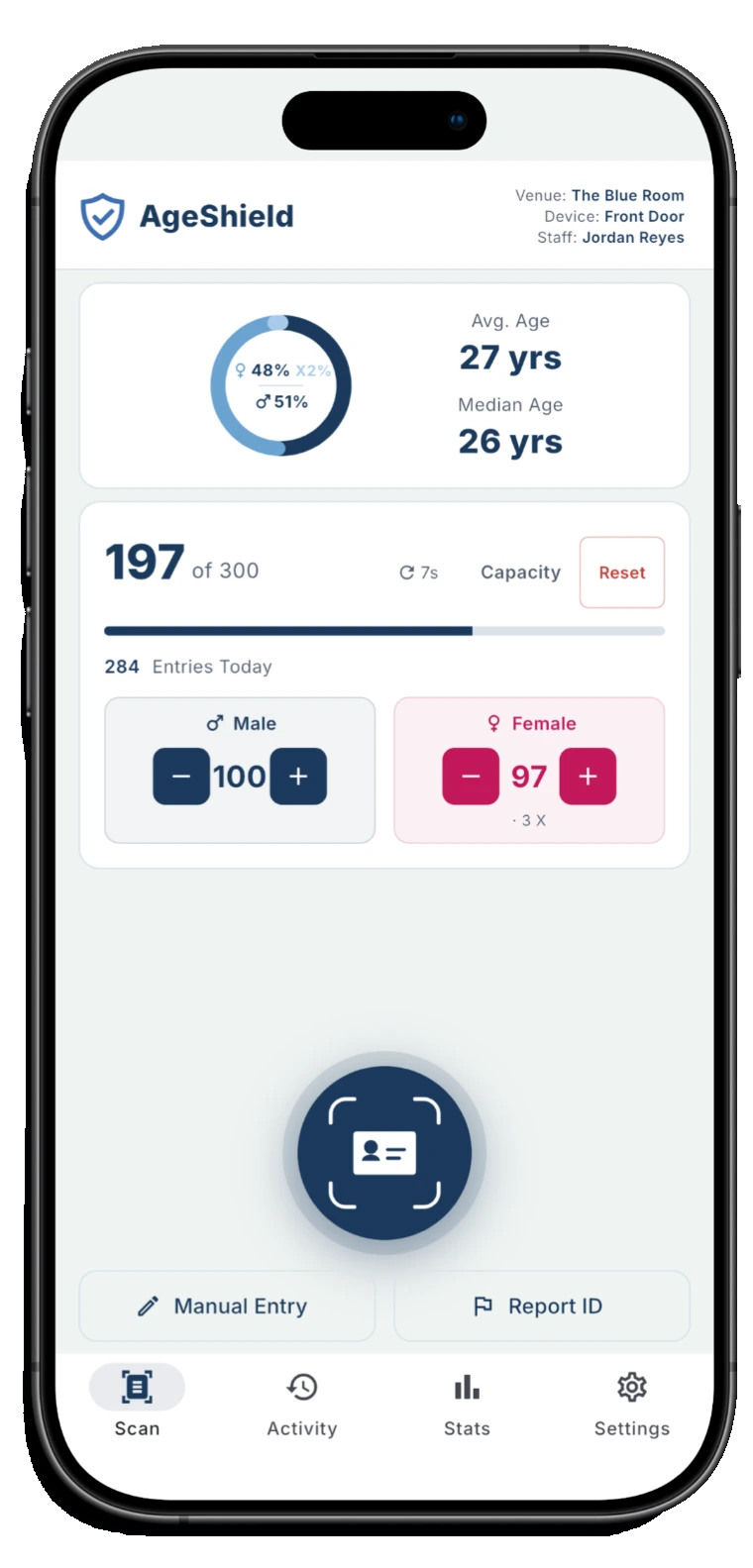
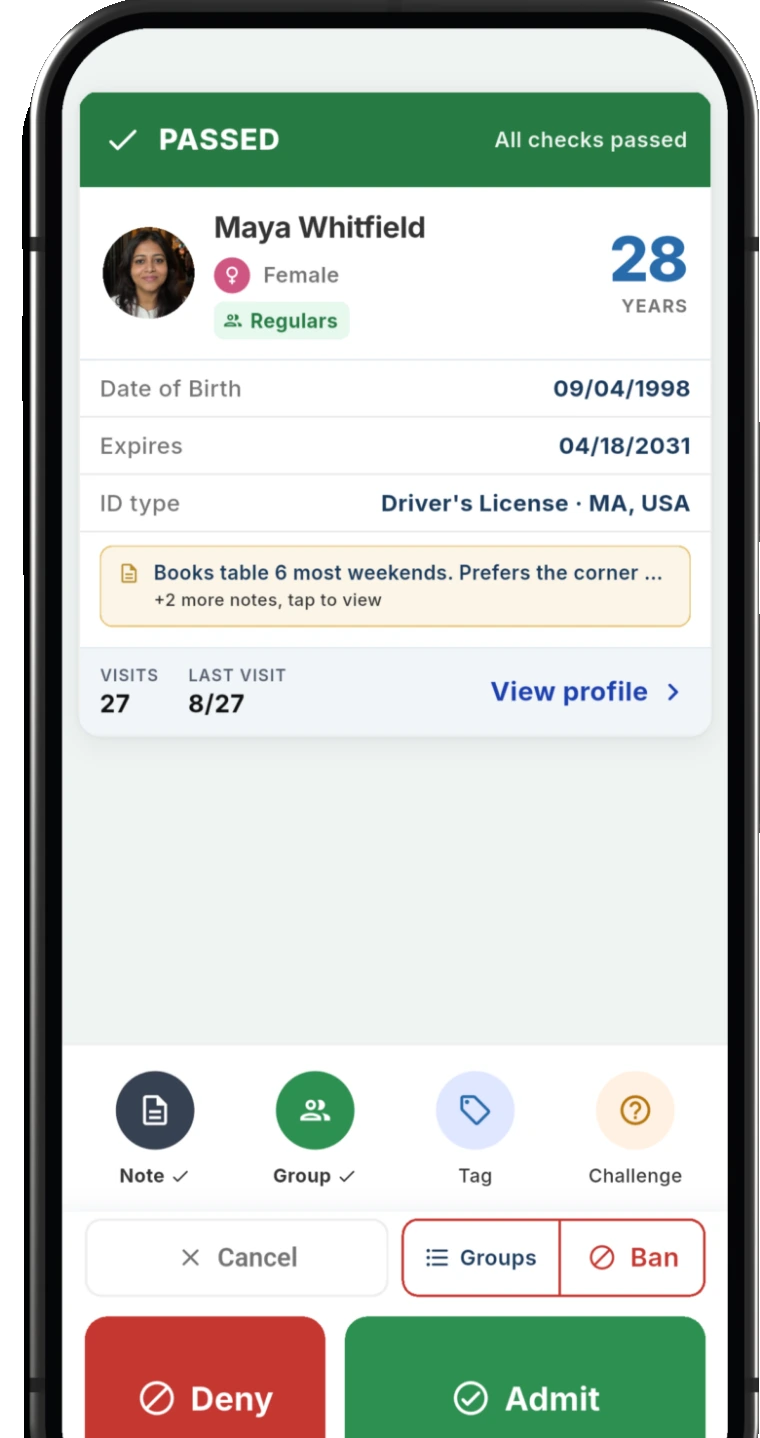
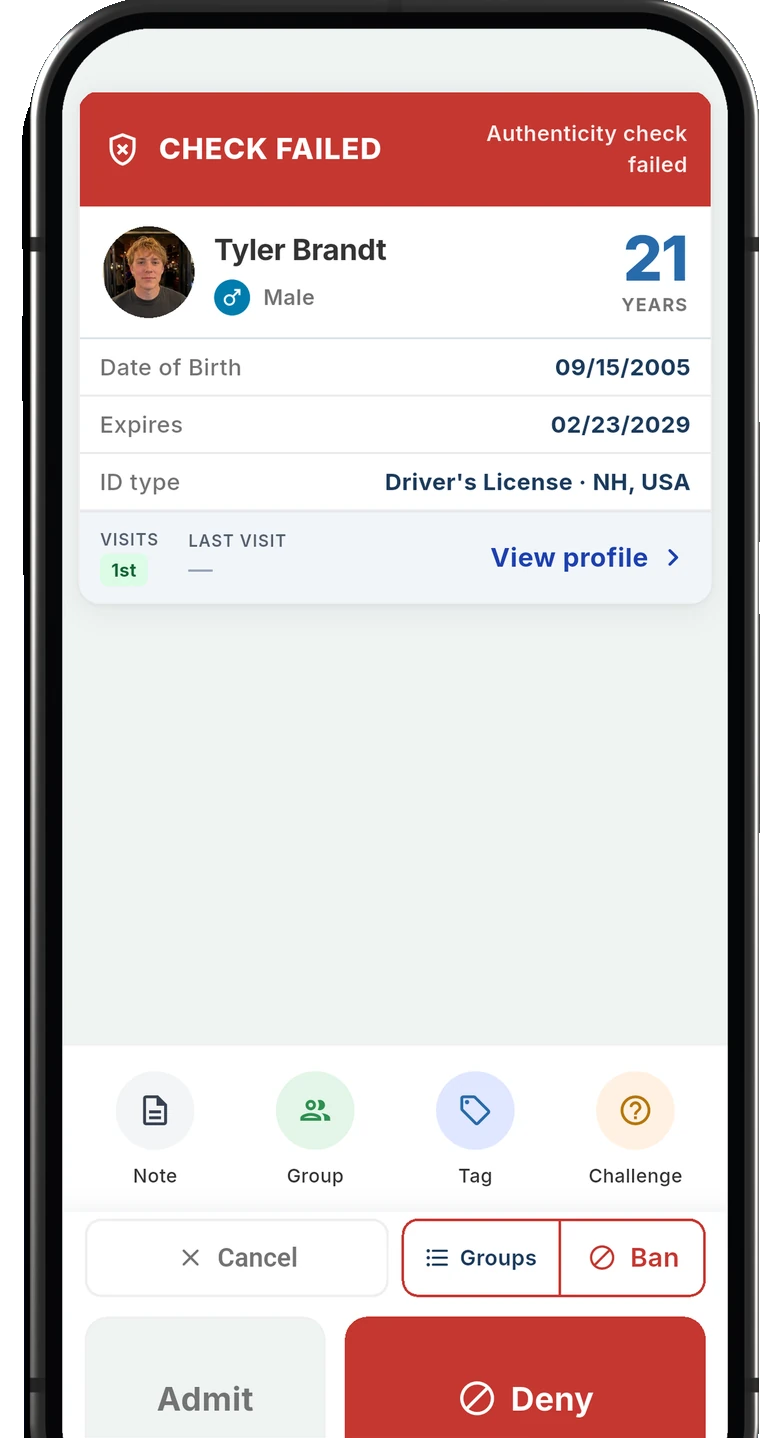
AgeShield ID Scanner
Tell guests before the scan
Turn on the consent screen and each guest sees what you collect, how long it is kept and who it is shared with, then taps I Agree or Decline. The choice is saved with the visit.
Florida: details by hand instead of a scan
Florida's law on reading driver's licenses and ID cards covers both the magnetic strip and the barcode. A business may read a card to verify age when providing an age-restricted good or service, but may not store, sell or share personal information collected from that read. A guest may consent to a read that collects and stores personal information after being told what is collected and why. The law also addresses guests who decline a scan.
If the individual does not want the private entity to swipe the individual's driver license or identification card, the private entity may manually collect personal information from the individual.
The next subsection says a business may not withhold goods or services solely because the guest asked for the details to be collected by hand, and a business that breaks the section may face a civil penalty of up to $5,000 per occurrence. A separate Florida alcohol statute says a licensed retail alcohol business may refuse service to anyone it finds objectionable or undesirable, but not on the basis of race, creed, color, religion, sex, national origin, marital status or physical handicap. The Florida guide covers both.
Georgia and Alaska: consent and the card's data
Georgia makes it a misdemeanor to scan another person's driver's license, permit or ID card without that person's prior knowledge and consent. Once the person consents, the same law lets the information be stored and used for any legitimate purpose. The Georgia guide covers how the rule applies.
Alaska's criminal code speaks to the card's data in different terms. Knowingly obtaining confidential information about another person without legal authority or their consent is a class B misdemeanor, and that information includes what is encoded on a driver's license or Alaska ID card. Neither law says what a venue does when a guest declines; the Alaska guide has the state's proof-of-age rules.
Where the law requires the scan
Some laws require a scan regardless of the venue's policy. Two states require one at the door of certain bars and other licensed venues, and Texas requires one for certain sales to take away:
- State
- Utah
- Who the rule covers
- Bars and taverns before anyone is admitted, restaurants before a customer who appears 35 or younger gets alcohol and some off-premises beer sales
- What the law says
- The law requires staff to ask for proof of age and verify it electronically. If it cannot be verified electronically, the customer is asked to follow a process set by the alcohol commission's rule. The statute does not mention a customer who declines.
- State
- South Carolina
- Who the rule covers
- Venues that sell alcohol for drinking on site at any time between midnight and 4 a.m.
- What the law says
- Since January 1, 2026, the law requires a forensic digital identification system that validates the ID of anyone who tries to enter as a patron. It names no alternative.
- State
- Texas
- Who the rule covers
- Retail sales of alcohol for off-premises consumption, such as at a package store. Mixed beverage permits, restaurants and some other sellers are excluded
- What the law says
- The law requires the seller to inspect the ID and read it electronically, and lets the seller type its details into an electronic reader if it cannot be scanned. The commission may not take disciplinary action for a missed scan on sales made before September 1, 2027.
Utah Code 32B-1-407S.C. Code 61-2-145Tex. Alco. Bev. Code 109.61
What Utah and Texas say about a card that cannot be read is in when an ID will not scan.
Where the law speaks to asking for a scan or an ID
New York's alcohol law lets a licensee perform a transaction scan as a precondition to the sale of any alcoholic beverage. Separately, its definition of a transaction scan describes a license or ID card presented as a precondition for admission to a venue licensed for on-premises drinking where admission is restricted to people 21 or older. If the scan does not match the card or shows it is false, the sale is denied. The section does not address a guest who declines; see the New York guide.
Connecticut lets a permittee perform a transaction scan as a condition for selling, giving away or otherwise distributing alcohol. Other states' laws speak to the ID rather than the scan: Wisconsin lets a licensee require an ID before serving alcohol or letting a person in, and Maine lets a licensee refuse to serve anyone who does not show one of its listed IDs when asked.
Washington, DC has a rule about the door itself. It does not mention scanning:
Except as otherwise permitted, a licensee shall not deny admittance to a person displaying a valid identification document displaying proof of legal drinking age.
N.Y. Alco. Bev. Cont. Law 65-bConn. Gen. Stat. 30-86Wis. Stat. 125.08528-A M.R.S. 706D.C. Code 25-782
Limits on what a scan may keep
Several of the same laws limit what a scan may keep. New York and Connecticut each limit a scan record to four details: the name, date of birth, ID number and expiration date. Utah's verification program must make sure scan information is used only to verify age and kept for seven days, and Texas's scanning law says a person may not retain information accessed under it. Florida's limits are in its section above, and Georgia allows storage once the person has consented.
Which details a scanner can read and other states' limits are in what a bar sees when it scans your ID. Every state guide answers "Can a customer refuse an ID scan?" for its own state.
N.Y. Alco. Bev. Cont. Law 65-bConn. Gen. Stat. 30-86Utah Code 32B-1-407Tex. Alco. Bev. Code 109.61
What happens at the door when a guest declines
Where a state's law says nothing about a declined scan, the venue's own entry policy sets what happens, within the state's other laws. A policy can name an alternative, such as checking the ID by eye and handing it back, or say that entry requires a scan. Declining a scan is different from refusing to show an ID: laws allowing a licensee to require an ID still apply.
A refusal can also fall under laws against discrimination. Kansas's public-accommodation law, for one, lists bars and taverns among public accommodations and defines discrimination there by reason of race, religion, color, sex, disability, national origin or ancestry as an unlawful discriminatory practice. A bar door policy can carry a house line for a guest who declines beside its other refusal lines, and how to refuse entry at a bar covers saying it without an argument.
Telling guests before the scan with AgeShield
With AgeShield's consent screen switched on, the guest sees what is collected, how long it is kept and who it is shared with, under the venue's name and privacy policy link, then taps I Agree or Decline. That choice is recorded with the visit.
The venue also decides what a scan keeps. Fields such as gender, issuing state and ZIP code can be excluded, shown at the door only or shown and stored, while the name and the expiration date are the two that cannot be excluded. With the retention window set to 0, no name, date of birth or ID digits are written to the visit record. Privacy controls lists every setting. If the camera cannot read a document, staff can tap Manual Entry and type the details in, and the record is marked "Manual entry", as how a scan works shows.
Four emails a year
What changed in ID law, before it takes effect
Many state rules on IDs and age checks take effect on January 1 or July 1. Each quarter we send one short summary of the changes we found, with the source for every line, starting with the states you pick.
Common questions
Do I have to let a bar scan my ID?
The laws that speak to it regulate the venue, not the guest. Florida lets a business collect the details by hand instead when a guest does not want a scan, Georgia requires the person's prior knowledge and consent before a scan, Alaska requires consent or legal authority to obtain the data on the card and Utah and South Carolina require a scan at the door of certain venues. Elsewhere, a guest who declines meets the venue's own entry policy.
Can a New York bar refuse entry if you won't let them scan your ID?
New York's alcohol law lets a licensee scan an ID as a precondition to an alcohol sale, and its definition of a transaction scan separately describes an ID presented as a precondition for admission to a licensed venue restricted to people 21 or older. The law does not address a guest who declines the scan.
Can a Florida bar refuse you for not wanting your ID scanned?
Florida's law says a business may collect the details by hand when a guest does not want a scan, and may not withhold goods or services solely because the guest asked for that. A separate Florida statute lets a licensed alcohol business refuse service to anyone it finds objectionable or undesirable, except on listed grounds such as race, religion or sex.
What does a bar keep when it scans your ID?
That depends on the scanner, its settings and the state. New York and Connecticut limit a scan record to the name, date of birth, ID number and expiration date. Utah's verification program has venues keep scan information for seven days. In AgeShield, the venue chooses what each field does and how long guest details stay.
Sources
- Fla. Stat. 322.143
- Fla. Stat. 562.51
- O.C.G.A. 40-5-120
- Ga. HB 396 (2010), section 20
- AS 11.76.115
- Utah Code 32B-1-407
- S.C. Code 61-2-145
- Tex. Alco. Bev. Code 109.61
- N.Y. Alco. Bev. Cont. Law 65-b
- Conn. Gen. Stat. 30-86
- Wis. Stat. 125.085
- 28-A M.R.S. 706
- D.C. Code 25-782
- K.S.A. 44-1002
This page is for informational purposes only and is not a substitute for professional legal advice. We research each rule and link its source, so you can check it against your own venue. Questions are welcome at support@ageshield.bar.
Still unsure what your state says about a declined scan?
Tell us what type of venue you run and we'll point you to the published rules we know of that may apply.