
Compliance checks and penalties
Selling alcohol to a minor in Illinois: what the license holder faces
Published November 25, 2026 · 20 sources linked
What happens to an Illinois liquor license after a sale to someone under 21?
In Illinois, one sale to someone under 21 can put both of a retailer's liquor licenses at risk and lead to a criminal charge. The local liquor control commissioner can suspend the local license for up to 30 days or revoke it and can fine up to $1,000 for a first violation within 12 months, alone or on top of a suspension, while the Illinois Liquor Control Commission (ILCC) can suspend or revoke the state license or fine up to $500 per violation instead. If staff demanded, were shown and reasonably relied on a government-issued ID, section 6-16 gives an affirmative defense in the prosecution and in a suspension or revocation proceeding, unless they knew the ID was false or fraudulent.
What one sale to a minor can bring in Illinois
- From the local commissioner
- Suspension of up to 30 days or revocation. A fine of up to $1,000 for a first violation in 12 months, alone or with a suspension
- From the ILCC
- Suspension or revocation of the state license, or a fine of up to $500 per violation instead
- For the person who sold
- A Class A misdemeanor charge: a fine of up to $2,500 and less than a year in jail
- The ID defense
- Staff demanded, were shown and reasonably relied on a government-issued ID
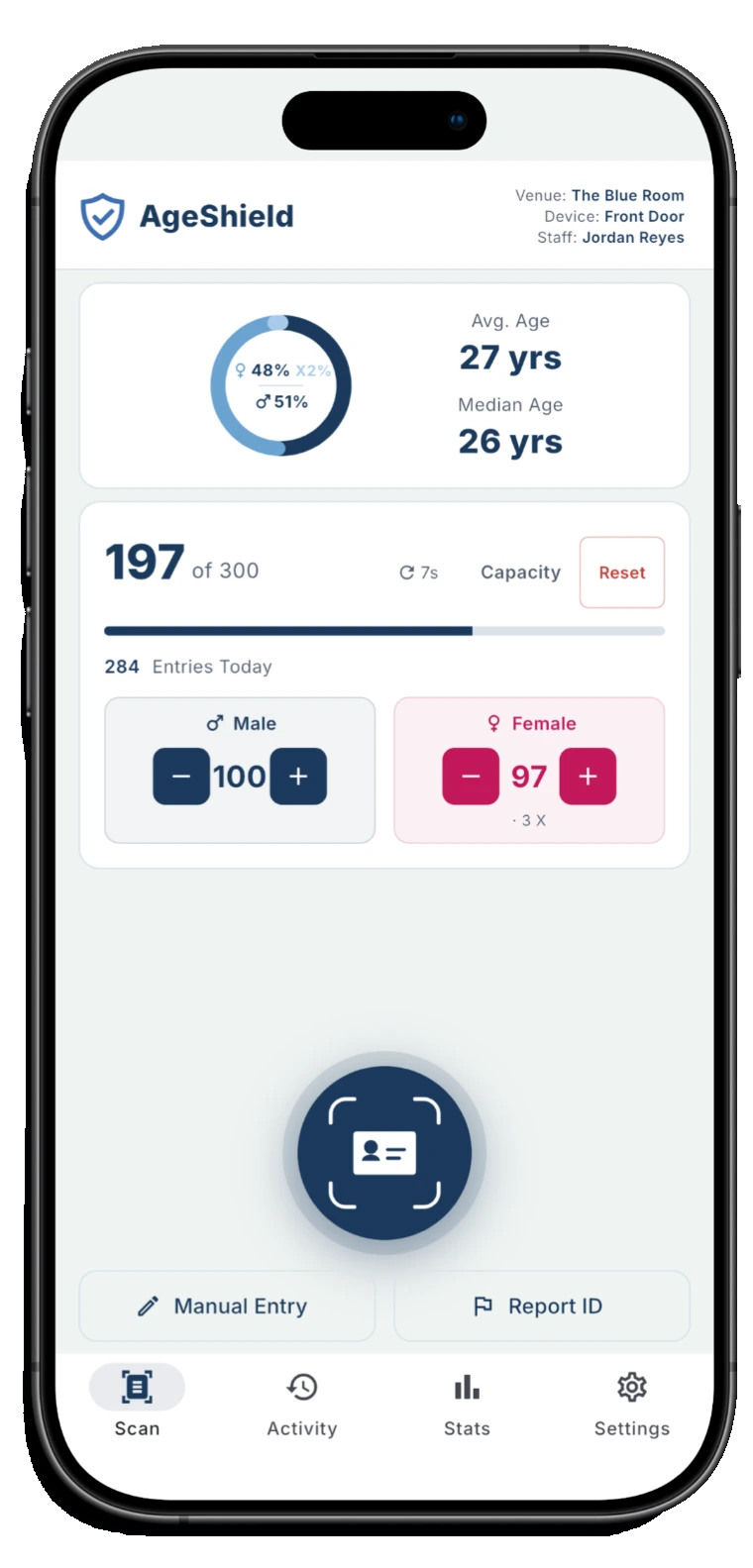
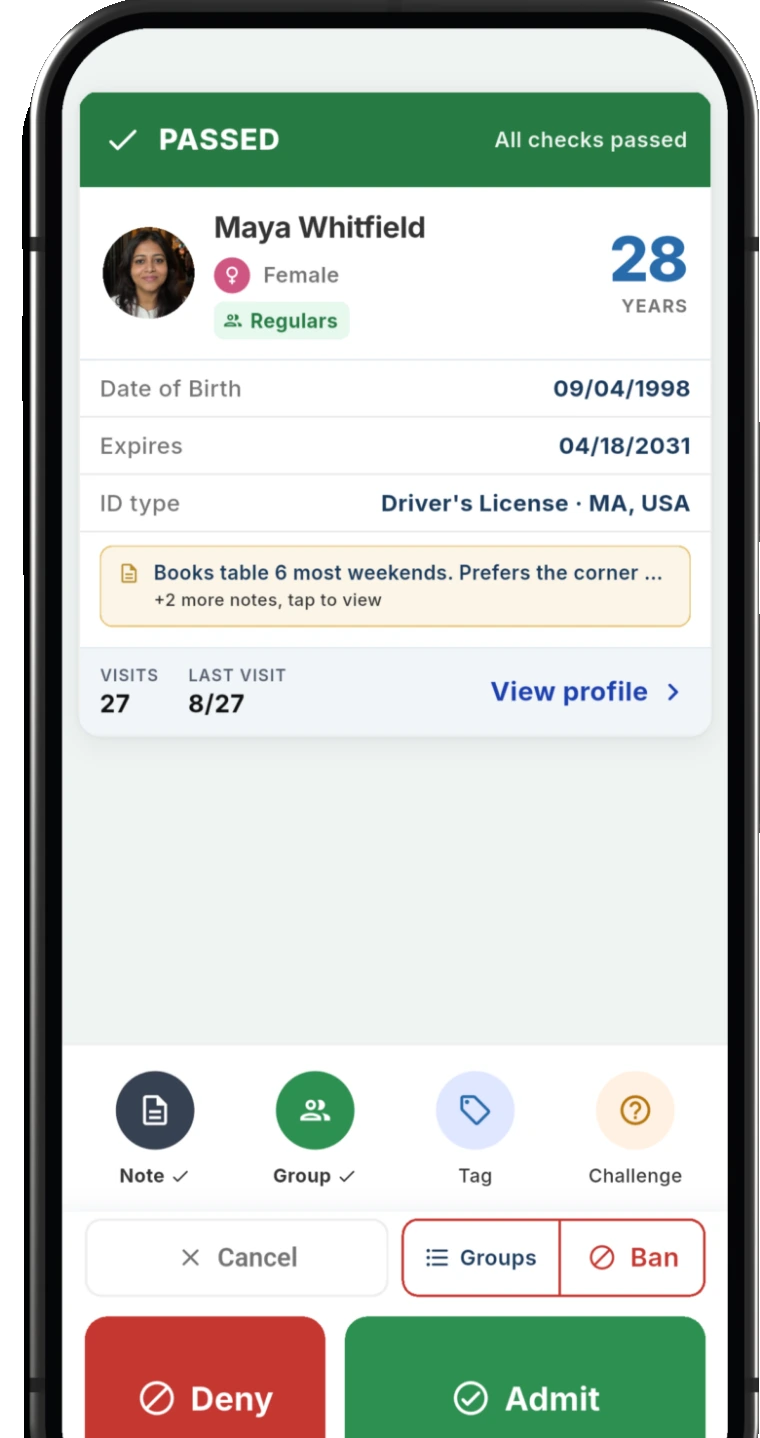
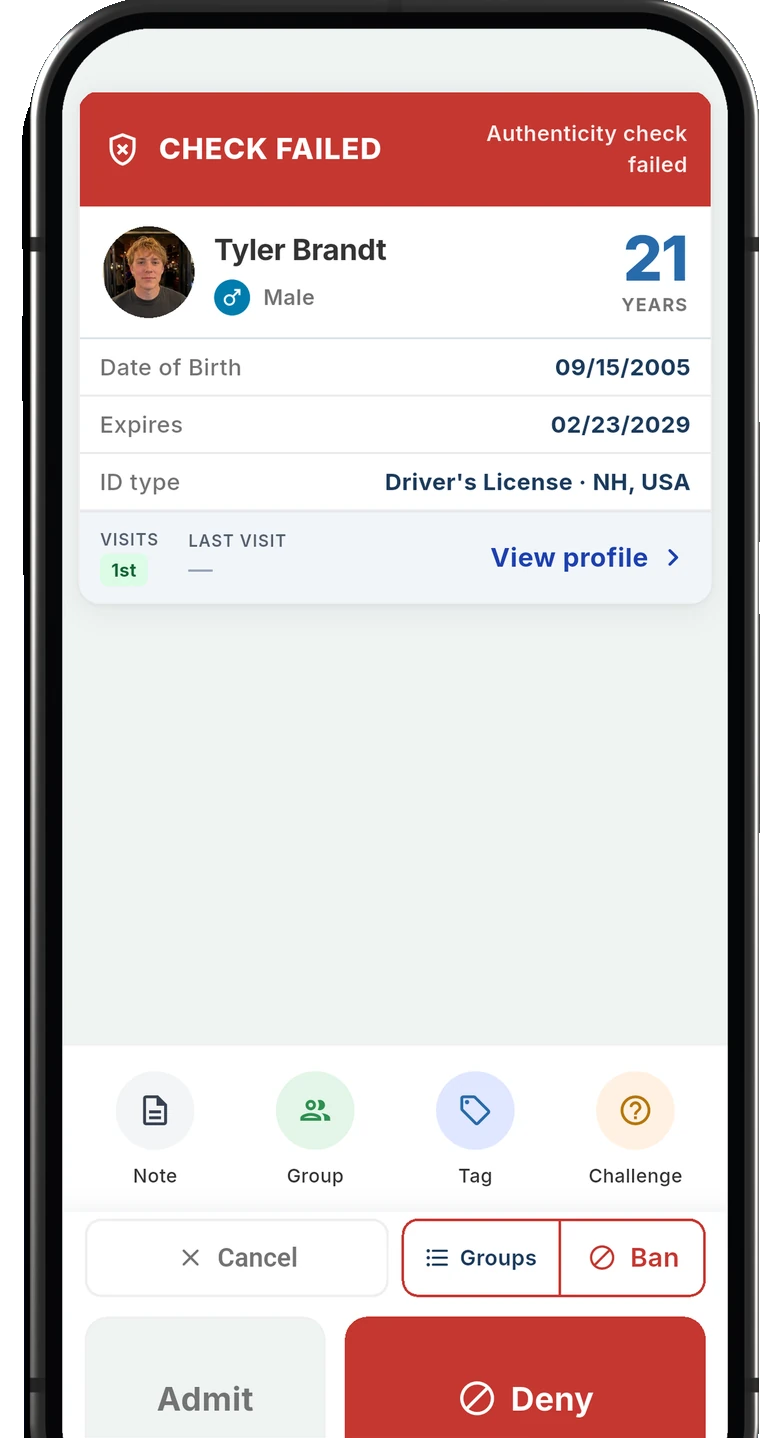
AgeShield ID Scanner
Check the age on every ID you scan
The app flags expired IDs and checks the date of birth against your venue's minimum age, which starts at 21. Each scan creates a visit record of who scanned, when and what staff decided.
Two licenses, and two authorities that can act
An Illinois retailer holds both local and state liquor licenses. The ILCC tells applicants that the first step toward a state retail license is a license from the local liquor commission, and section 7-6 of the Liquor Control Act says the revocation of a local license automatically revokes the state license.
The local liquor control commissioner is the mayor or village president, or for areas outside a town the president or chair of the county board, or someone they designate. City councils, village boards and county boards set license classes by ordinance and can set penalties for breaking local rules. The ILCC notes that local liquor commissions may have different ordinances.
The ILCC also conducts underage sales checks. In April 2026 its agents, working with law enforcement and volunteers from high schools and colleges, visited 225 licensed businesses and cited 45 for selling to someone under 21. How such operations run, and how a licensee can test its own staff, is set out in how alcohol compliance checks work.
Illinois Liquor Control Commission: How to obtain a State of Illinois retail liquor license (image)235 ILCS 5/7-6, Proceedings before the State Commission235 ILCS 5/4-2, Local liquor control commissioner235 ILCS 5/4-1, Local licensing powersIllinois Liquor Control Commission, Underage Compliance April Report, May 5, 2026 (PDF)
What the local liquor control commissioner can do
Section 4-4 lets the local commissioner suspend a local license for up to 30 days or revoke it for cause. Section 7-5 allows revocation or suspension for a violation of the Act, a local ordinance or a commission rule, and a fine, alone or on top of a suspension.
- Violation within a 12-month period
- First
- Highest fine
- $1,000
- Violation within a 12-month period
- Second
- Highest fine
- $1,500
- Violation within a 12-month period
- Third or later
- Highest fine
- $2,500
Each day a violation continues counts as a separate violation. Fines under section 7-5 may not total more than $15,000 against one licensee during the period of its license.
These penalties require a public hearing before the commissioner, with three days' written notice and an opportunity for the licensee to defend. The commissioner records the evidence and, within five days of the hearing, serves a written order giving the reasons and the fine, suspension length or revocation.
235 ILCS 5/4-4, Powers of local liquor control commissioners235 ILCS 5/7-5, Local revocation, suspension and fines
What the ILCC can do to the state license
Section 3-12 lets the ILCC suspend or revoke a state license after notice and a hearing, or impose a fine in place of either. The fine is capped at $500 per violation and $20,000 per licensee over the license period. The action can be limited to the license for the premises where the violation happened, and the ILCC has to start it within two years after it becomes aware of the violation.
When the ILCC counts repeat sales to people under 21, a later sale counts only if it was committed within five years of the earlier one. Any notice of a violation, or of a settlement or offer in compromise, has to include the field report, photographs and other supporting documents. Omitting them means the action is dismissed.
The ILCC's Legal Division reviews violations issued after inspections and, the division says, may issue offers in compromise, hold settlement talks through a pre-disciplinary conference or present the case at an administrative hearing before the commission. Under the commission's rules, the citation and notice of hearing reach the licensee at least 10 days before the hearing date.
235 ILCS 5/3-12, Powers and duties of State CommissionIllinois Liquor Control Commission: Legal Division11 Ill. Adm. Code 100.180, Procedure before Commission on citations235 ILCS 5/7-6, Proceedings before the State Commission
Appealing a local order
A licensee has 20 days after receiving a local order to appeal it. Outside cities of 500,000 or more the appeal goes to the ILCC, and inside one to the city's license appeal commission. In Chicago, the License Appeal Commission hears appeals of fines, suspensions and revocations from the city's Department of Business Affairs and Consumer Protection.
While the appeal of a local suspension or revocation is decided, the licensee resumes business, unless it is the second or later suspension or revocation placed on it within the past 12 months. In that case the order stays in effect until it is reversed. Where the local government has passed a resolution requiring review on the record, the ILCC looks only at the certified record of the local hearing and asks whether the commissioner followed the law, whether the findings support the order and whether substantial evidence supports the findings.
A party has 20 days to request a rehearing. No court will review the decision until that application has been filed and acted on.
235 ILCS 5/7-5, Local revocation, suspension and fines235 ILCS 5/7-9, Appeals from local orders235 ILCS 5/7-10, Rehearing235 ILCS 5/7-11, Judicial reviewCity of Chicago: License Appeal Commission
The criminal charge for the sale
Section 6-16(a) bars a licensee and its officers, agents and employees from selling, giving or delivering alcohol to anyone under 21, and section 6-16(b) makes a violation a Class A misdemeanor, in addition to the Act's other penalties. In Illinois a Class A misdemeanor can bring a jail term of less than one year and a fine of up to $2,500.
The person under 21 may also be prosecuted unless acting for law enforcement, the ILCC or a local liquor control commissioner. Using a false ID, or one that belongs to someone else, to buy alcohol is a Class A misdemeanor of its own, with a fine of at least $500 and at least 25 hours of community service.
Section 6-16 also limits what an employer can do to the seller: an agent or employee who demanded and was shown a government-issued ID before the sale cannot be disciplined or discharged for it, unless they accepted the ID knowing it was false or fraudulent.
235 ILCS 5/6-16, Prohibited sales and possession730 ILCS 5/5-4.5-55, Class A misdemeanors; sentence
BASSET training and a sale to a minor
Section 6-27.1 requires BASSET training from an ILCC-approved program for anyone who sells or serves open containers of alcohol at retail and anyone whose job includes checking ID for those purchases or for entry. New staff complete it within 120 days of starting work, and the certificate is valid for three years and belongs to the server, who can take it to a new employer.
Section 6-27.1 does not tie training to the penalty for a sale to a minor, and the penalty sections above do not mention it. Proof of training has to be available when State law enforcement officials reasonably ask for it, and staff without BASSET certification are first on the ILCC's list of the 10 most common violations its inspectors reported in a recent fiscal year.
235 ILCS 5/6-27.1, Responsible alcohol service server trainingIllinois Liquor Control Commission: BASSETIllinois Liquor Control Commission: Top 10 most common violations
The ID defense in section 6-16
Section 6-20(b) has a licensee or employee who believes, or has reason to believe, that a buyer is under 21 demand positive identification with proof of age, issued by a public officer, before the sale. Section 6-16 defines adequate written evidence of age and identity as a document issued by a federal, state, county or municipal government or agency, including a driver's license, a Selective Service registration certificate or an Armed Forces ID card.
The defense itself reads:
Proof that the defendant-licensee, or his employee or agent, or the representative, agent, or employee of the express company, common carrier, or contract carrier that carries or transports alcoholic liquor for delivery within this State demanded, was shown and reasonably relied upon such written evidence in any transaction forbidden by this Section is an affirmative defense in any criminal prosecution therefor or to any proceedings for the suspension or revocation of any license based thereon. It shall not, however, be an affirmative defense if the agent or employee accepted the written evidence knowing it to be false or fraudulent.
It turns on three facts: the ID was demanded, it was shown and staff reasonably relied on it. Accepting an ID known to be false or fraudulent takes the defense away. When a false Illinois license or ID card was used, the investigating officer reports it to the Secretary of State once the person who presented it is convicted.
235 ILCS 5/6-20, Transfer, possession and consumption of alcoholic liquor235 ILCS 5/6-16, Prohibited sales and possession
Where an ID scan fits
Neither section 6-16 nor the penalty sections mention scanning: the defense rests on asking for the ID, seeing it and relying on it reasonably. Illinois has separate rules on reading the barcode of an Illinois license and on using information taken from an ID, which the Illinois ID scanning guide sets out.
When staff scan an ID with AgeShield, the app checks the date of birth against the venue's minimum age, which starts at 21, flags an expired ID and checks the barcode on US and Canadian licenses and state IDs for signs of forgery. Each scan creates a visit record of who scanned, when, the document type, the result and what staff decided, as how a scan works shows. No scanner catches every fake, so staff still make the call.
Four emails a year
What changed in ID law, before it takes effect
Many state rules on IDs and age checks take effect on January 1 or July 1. Each quarter we send one short summary of the changes we found, with the source for every line, starting with the states you pick.
Common questions
What is the fine for selling alcohol to a minor in Illinois?
It depends on who is fined. The person charged with the sale faces a Class A misdemeanor, with a fine of up to $2,500. A local liquor control commissioner can fine the licensee up to $1,000 for a first violation within 12 months, $1,500 for a second and $2,500 for a third or later, and the ILCC can fine up to $500 per violation in place of suspending or revoking the state license.
Can an Illinois liquor license be revoked after one sale to a minor?
The Liquor Control Act allows it. Section 7-5 lets the local commissioner revoke a license for a violation of the Act, section 3-12 gives the ILCC the same power over the state license, and revoking the local license also revokes the state one. Neither section requires a number of earlier sales before revocation, and local ordinances can provide their own penalties.
Does BASSET training lower the penalty for a sale to a minor in Illinois?
Not under the sections that set the penalty. Section 6-27.1 makes BASSET training a requirement for servers and for staff whose job includes checking IDs for open-container purchases or entry, and neither it nor the sections that set fines, suspensions and revocations tie training to the penalty for a sale to a minor. Separately, an employee who demanded and was shown a government-issued ID before the sale cannot be disciplined or fired for it, unless they knew the ID was false or fraudulent.
What if the minor used a fake ID?
If staff demanded, were shown and reasonably relied on a government-issued ID, section 6-16 gives an affirmative defense in the criminal case and in a proceeding to suspend or revoke the license. The defense does not apply if staff accepted the ID knowing it was false or fraudulent. The minor faces a Class A misdemeanor with a fine of at least $500 and at least 25 hours of community service.
Can a licensee keep operating while it appeals a local suspension?
Yes, while the appeal is decided and the time for a rehearing runs, unless it is the second or later suspension or revocation placed on the licensee within the past 12 months. In that case the suspension or revocation stays in effect until it is reversed.
Sources
- Illinois Liquor Control Commission: How to obtain a State of Illinois retail liquor license (image)
- 235 ILCS 5/7-6, Proceedings before the State Commission
- 235 ILCS 5/4-2, Local liquor control commissioner
- 235 ILCS 5/4-1, Local licensing powers
- Illinois Liquor Control Commission, Underage Compliance April Report, May 5, 2026 (PDF)
- 235 ILCS 5/4-4, Powers of local liquor control commissioners
- 235 ILCS 5/7-5, Local revocation, suspension and fines
- 235 ILCS 5/3-12, Powers and duties of State Commission
- Illinois Liquor Control Commission: Legal Division
- 11 Ill. Adm. Code 100.180, Procedure before Commission on citations
- 235 ILCS 5/7-9, Appeals from local orders
- 235 ILCS 5/7-10, Rehearing
- 235 ILCS 5/7-11, Judicial review
- City of Chicago: License Appeal Commission
- 235 ILCS 5/6-16, Prohibited sales and possession
- 730 ILCS 5/5-4.5-55, Class A misdemeanors; sentence
- 235 ILCS 5/6-27.1, Responsible alcohol service server training
- Illinois Liquor Control Commission: BASSET
- Illinois Liquor Control Commission: Top 10 most common violations
- 235 ILCS 5/6-20, Transfer, possession and consumption of alcoholic liquor
This page is for informational purposes only and is not a substitute for professional legal advice. We research each rule and link its source, so you can check it against your own venue. Questions are welcome at support@ageshield.bar.
Questions about an Illinois sale to a minor?
Tell us what type of venue you run and we'll point you to the published rules we know of that may apply.