Compliance checks and penalties
Selling alcohol to a minor in Florida: what the license holder faces
Published November 25, 2026 · 13 sources linked
What happens to a Florida liquor license after a sale to someone under 21?
A sale to someone under 21 can bring a criminal charge against the person who served and a separate case against the license from the Division of Alcoholic Beverages and Tobacco (DABT). DABT's guidelines list $1,000 and a seven-day suspension for a first occurrence, $3,000 and a 30-day suspension for a second within 36 months and revocation for a third, although section 561.29 caps a civil penalty at $1,000 for a single transaction. Under the Responsible Vendor Act, a qualified vendor's license may not be suspended or revoked for an employee's sale if that employee had completed the required training beforehand, unless the vendor knew, should have known or took part.
What a sale to a minor can cost in Florida
- First occurrence, DABT's guideline
- A $1,000 fine and a seven-day license suspension
- Second within 36 months
- $3,000 and a 30-day suspension in the table; the statute caps a fine at $1,000 for a single transaction
- Third within 36 months
- Revocation of the license
- The person who served
- A second-degree misdemeanor: up to 60 days in jail and a fine of up to $500
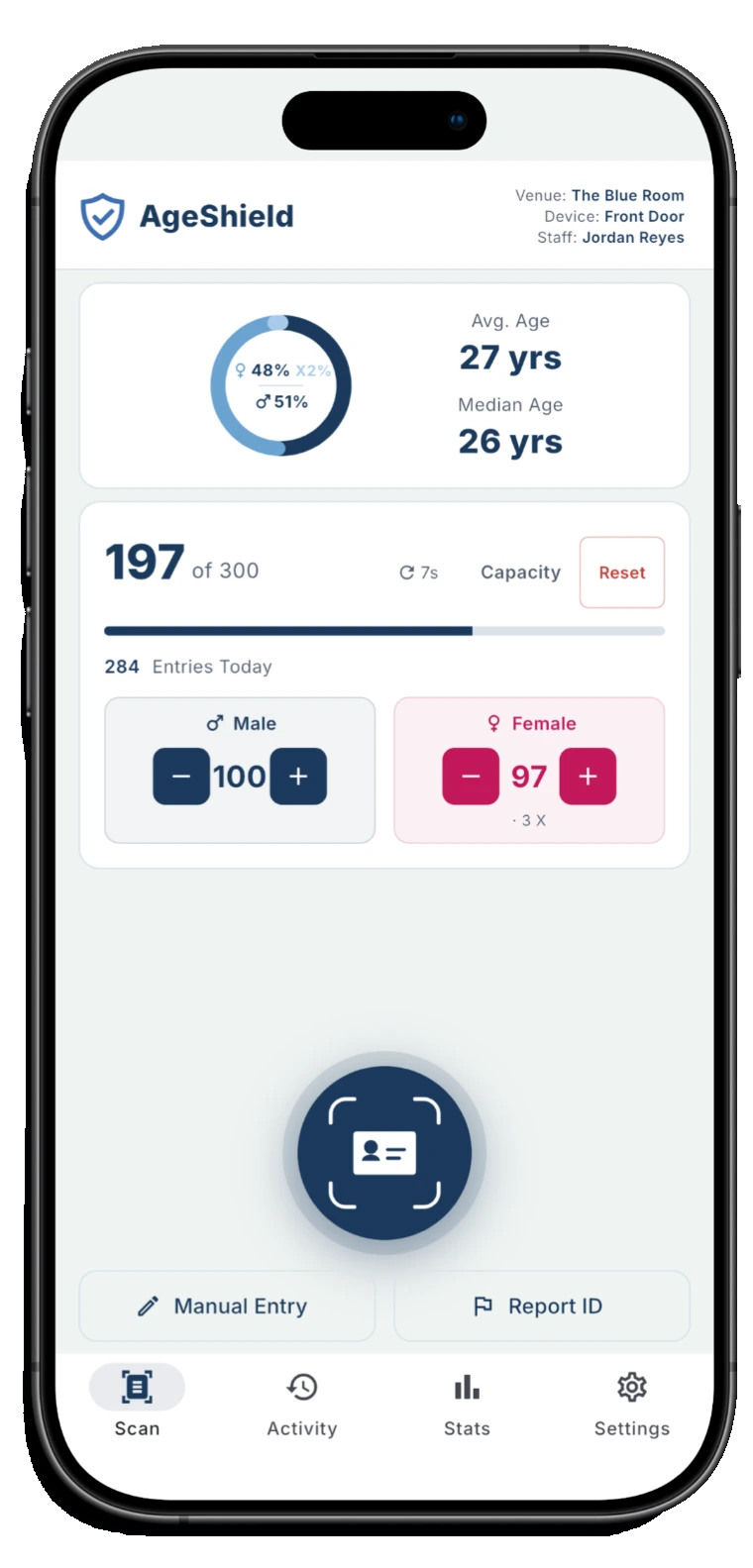
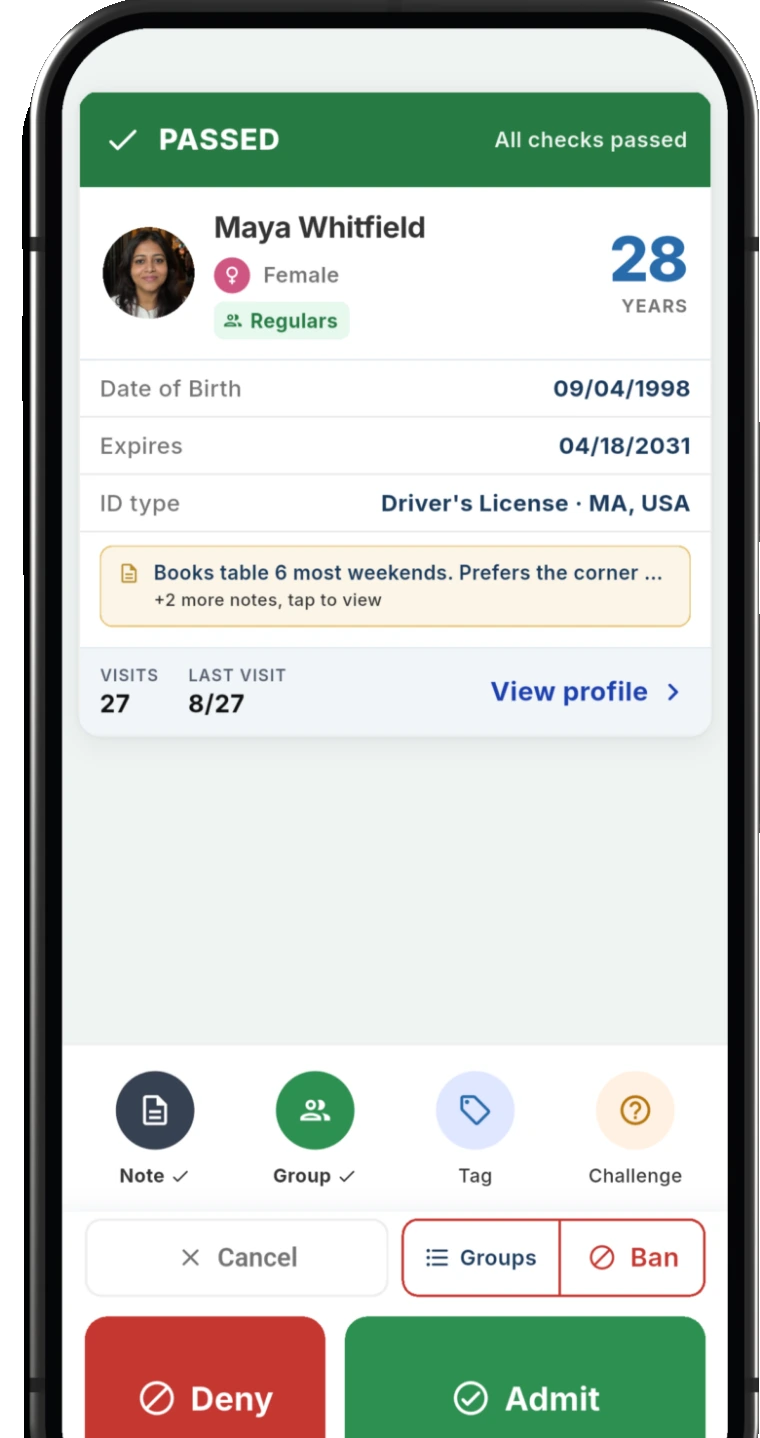
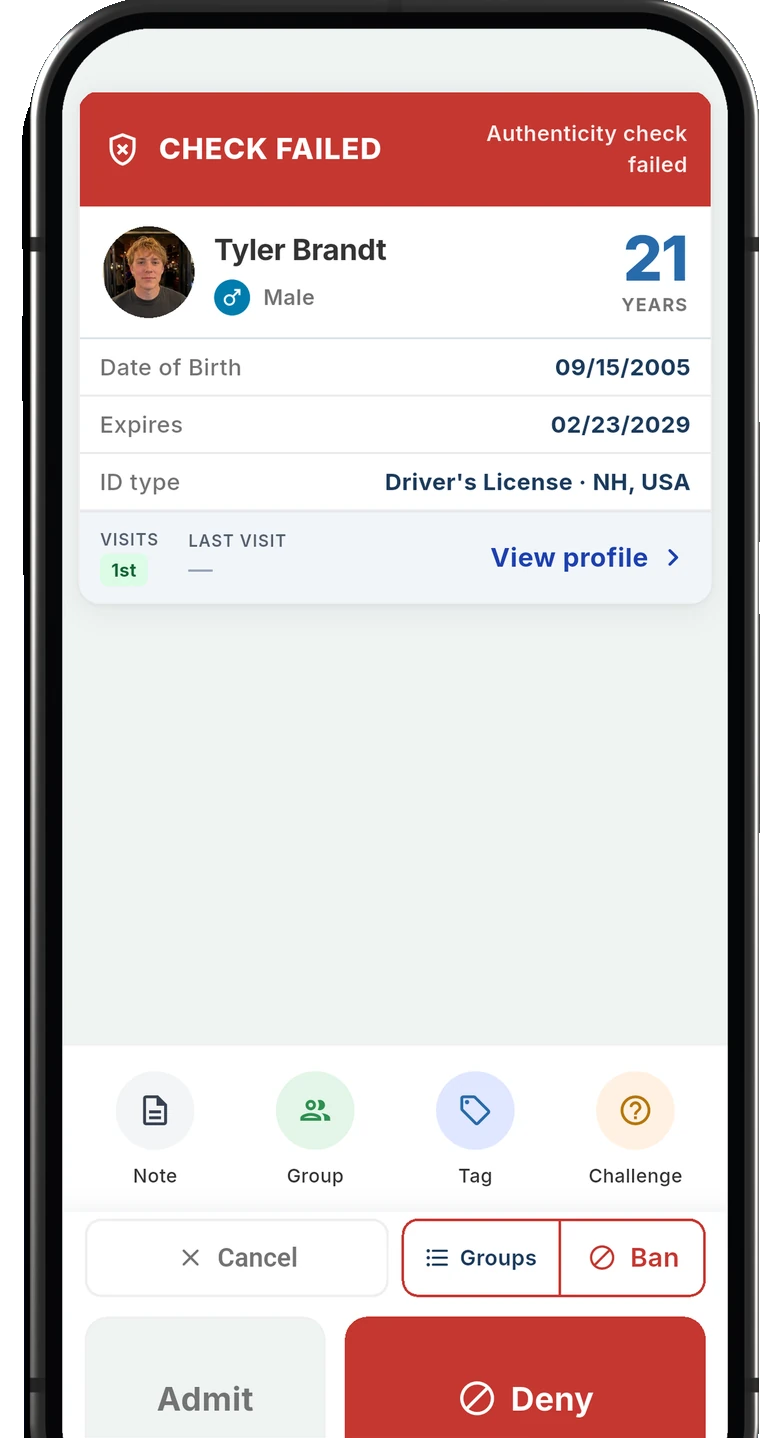
AgeShield ID Scanner
An underage result staff cannot override
The app works out the age from the date of birth and checks it against your venue's minimum, which starts at 21. There is no override for an underage result, and no scanner catches every fake, so staff still make the call.
A criminal case and a license case
Section 562.11(1)(a) of the Florida Statutes bars anyone from selling, giving or serving alcohol to a person under 21, or letting them drink on the licensed premises. It applies to the person who made the sale. Section 561.29 separately gives DABT full power to suspend or revoke a license when the licensee or its agents, officers, servants or employees break state law on the premises or in the scope of their work.
The cases are separate: a criminal conviction may be considered in DABT's license proceeding only as chapter 92 or the rules of evidence allow. In 2025, DABT agents carried out 5,983 alcohol compliance checks and found 423 sales to people under 21, according to the department.
How a compliance check works in general is covered in how alcohol compliance checks work, and the weeks after one in after a failed alcohol compliance check.
Fla. Stat. 562.11Fla. Stat. 561.29Florida DBPR: Highlights of 2025, January 7, 2026
DABT's penalty guidelines
Florida Administrative Code rule 61A-2.022 sets out the penalties DABT routinely imposes, as guidance for field offices and licensees. A repeat counts when the same violation happens within 36 months of the date of the first administrative notice.
- Occurrence
- First
- Guideline penalty
- $1,000 and a seven-day license suspension
- Occurrence
- Second within 36 months
- Guideline penalty
- $3,000 and a 30-day license suspension
- Occurrence
- Third within 36 months
- Guideline penalty
- Revocation
The same row covers allowing someone under 21 to drink. Section 561.29 and the rule itself both cap a civil penalty or settlement at $1,000 for violations arising out of a single transaction.
Fla. Admin. Code R. 61A-2.022, Penalty guidelinesFla. Stat. 561.29
The rule also describes which conduct its penalties cover:
The penalties provided below are based upon a single violation which the licensee committed or knew about; or a pattern of at least three violations on different dates within a 12-week period by employees, independent contractors, agents, or patrons on the licensed premises or in the scope of employment in which the licensee did not participate; or violations which were occurring in an open and notorious manner on the licensed premises.
Fla. Admin. Code R. 61A-2.022, Penalty guidelinesDABT, notice of rule development for 61A-2.022, Florida Administrative Register, July 7, 2025
Settling with DABT: money, days and a prevention plan
Under the rule, district supervisors, audit supervisors and bureau chiefs may accept a settlement that stays within the guidelines. A stipulation offering less needs the director's approval and a written statement of mitigation.
Each stipulation settling a sale-to-minor case also includes:
- A written statement that the violation has been corrected
- A written plan to prevent another violation of the same law
- As part of that plan, an affirmation of compliance with the Responsible Vendor Act
The rule lets a licensee offer days of suspension in place of a civil penalty, at one day per $50. Paying instead of a required suspension is allowed only with the director's approval. A licensee that breaks an accepted stipulation or a final order faces a new action under the same case number, and the penalty for the violation cited doubles.
The division can also seek reimbursement for investigation costs, such as overtime and evidence purchases, unless the total is under $25. Section 561.29 lets it suspend the imposition of any penalty on conditions it chooses, and a civil penalty left unpaid leads to a suspension for as long as the division specifies.
Fla. Admin. Code R. 61A-2.022, Penalty guidelinesFla. Stat. 561.29
The Responsible Vendor Act and an employee's sale
Florida's Responsible Vendor Act, sections 561.701 to 561.706, ties the license consequences of an employee's sale to staff training. Its central sentence reads:
The license of a vendor qualified as a responsible vendor under this act may not be suspended or revoked for an employee's illegal sale or service of an alcoholic beverage to a person who is not of lawful drinking age or for an employee's engaging in or permitting others to engage in the illegal sale, use of, or trafficking in controlled substances, if the employee had completed the applicable training prescribed by this act prior to committing such violation, unless the vendor had knowledge of the violation, should have known about such violation, or participated in or committed such violation.
A vendor cannot rely on having been away from the premises when the violations are flagrant, persistent, repeated or recurring. The division shall also consider responsible vendor status in mitigation of the penalty for an employee's sale to someone under 21.
To qualify, section 561.705 has the vendor:
- Train each employee who serves alcohol within 30 days of starting, including how to recognize and deal with underage customers, and supervise them until then
- Train each manager within 15 days of starting, including procedures for underage customers and keeping records of those incidents
- Hold a meeting for all employees once every four months
- Have each new employee fill in a written questionnaire, except at some beer and wine licensees, and acknowledge a written policy on illegal drugs
- Keep records of applications, acknowledgments and training
- Post signs stating its policy against serving people under 21 and that an underage purchase will result in ejection and prosecution
The act excludes grocery or drug stores over 5,000 square feet holding the beer or wine licenses it names. DABT staff use a checklist to judge how far a vendor meets section 561.705. The division also records each arrest under section 562.11 with whether the vendor trained its employees, and any interested person may examine those records.
Fla. Stat. 561.706Fla. Stat. 561.705Fla. Stat. 561.703DABT: Florida Responsible Vendor ActDABT: Become a responsible vendor (PDF)
The ID defense in a license case
Section 562.11(1)(c) gives a licensee a complete defense to a civil action over a sale to someone under 21, but it expressly excludes any administrative action by the division. In DABT's own case, the defense comes from its rule 61A-3.052.
Under that rule, a licensee cited for the sale has a defense when the buyer falsely evidenced being of legal age, looked it to an ordinarily prudent person and the licensee tried to verify their age by checking one of these:
- A driver's license with a photograph, issued by any government agency in the US or abroad
- A state-issued ID card with a photograph
- A passport
- A US military ID card showing the holder is serving in the Armed Services or is a family member of someone who is
No other type of identification will be recognized as mitigation if a licensee or a licensee's employee sells, gives, or serves alcoholic beverages, cigarettes, or tobacco products to an underage person.
The rule also makes it each licensee's responsibility to train staff to compare an ID with a sample of the genuine card. The security features of a real Florida card are in spotting a fake Florida driver's license.
Fla. Stat. 562.11Fla. Admin. Code R. 61A-3.052, Identification to verify age
The charge against the person who served
A first violation of section 562.11(1)(a) is a second-degree misdemeanor, punishable by up to 60 days in jail and a fine of up to $500. A second within a year of a prior conviction is a first-degree misdemeanor, with up to a year in jail and a fine of up to $1,000.
Section 562.11(1)(d) gives anyone charged a complete defense when the buyer falsely evidenced being 21 or older, looked it to a prudent person and the seller carefully checked a driver's license or ID card from Florida or another state, a passport or a US Uniformed Services ID and acted in good faith on the buyer's representation and appearance. The statute and DABT's rule list different IDs.
Where an ID scan fits
None of these texts mentions scanning. The defenses rest on checking a listed ID, the buyer's appearance and good faith, and the Responsible Vendor Act rests on training. Florida's driver's license law separately limits what a business may store from a scan used to verify age without the customer's consent, as the Florida ID scanning guide explains.
When staff scan an ID with AgeShield, the app works out the age from the date of birth and compares it with the venue's minimum age, which is 21 unless the owner changes it, and there is no override for an underage result. When a US or Canadian license or state ID barcode is scanned, AgeShield checks it for signs of forgery, as how a scan works shows. No scanner catches every fake, so a clean result still leaves the call to staff.
At its strictest privacy settings, the app keeps no date of birth, ID number or address and still records when the scan happened, which staff member scanned, what the ID check found and whether the guest met the minimum age.
Four emails a year
What changed in ID law, before it takes effect
Many state rules on IDs and age checks take effect on January 1 or July 1. Each quarter we send one short summary of the changes we found, with the source for every line, starting with the states you pick.
Common questions
What is the fine for selling alcohol to a minor in Florida?
For the license, DABT's guidelines list $1,000 with a seven-day suspension for a first occurrence and $3,000 with a 30-day suspension for a second within 36 months, while section 561.29 caps a civil penalty at $1,000 for violations arising out of a single transaction. For the person who served, a first offense carries a fine of up to $500 and up to 60 days in jail.
Can DABT revoke a license after one sale to a minor?
Section 561.29 gives the division full power to suspend or revoke a license when the licensee or an employee breaks state law on the premises. Its guidelines list revocation for a third occurrence within 36 months. A qualified responsible vendor's license may not be suspended or revoked for a trained employee's sale unless the vendor knew, should have known or took part.
Does responsible vendor training lower the penalty?
For a qualified vendor, section 561.706 bars suspension or revocation of the license for a sale by an employee who had completed the training first, unless the vendor knew, should have known or took part. For administrative penalties, the division shall consider the vendor's qualification in mitigation. DABT's rule also requires an affirmation of compliance with the act in every settlement of a sale-to-minor case.
What if the minor used a fake ID?
In the license case, DABT's rule gives a defense when the buyer falsely evidenced legal age, looked it to an ordinarily prudent person and the licensee checked one of the photo IDs the rule lists. In the criminal case, section 562.11(1)(d) gives a complete defense on similar conditions, where the seller carefully checked a listed ID and acted in good faith on the buyer's representation and appearance.
Sources
- Fla. Stat. 562.11
- Fla. Stat. 561.29
- Florida DBPR: Highlights of 2025, January 7, 2026
- Fla. Admin. Code R. 61A-2.022, Penalty guidelines
- DABT, notice of rule development for 61A-2.022, Florida Administrative Register, July 7, 2025
- Fla. Stat. 561.706
- Fla. Stat. 561.705
- Fla. Stat. 561.703
- DABT: Florida Responsible Vendor Act
- DABT: Become a responsible vendor (PDF)
- Fla. Admin. Code R. 61A-3.052, Identification to verify age
- Fla. Stat. 775.082
- Fla. Stat. 775.083
This page is for informational purposes only and is not a substitute for professional legal advice. We research each rule and link its source, so you can check it against your own venue. Questions are welcome at support@ageshield.bar.
Questions about a Florida sale to a minor?
Tell us what type of venue you run and we'll point you to the published rules we know of that may apply.